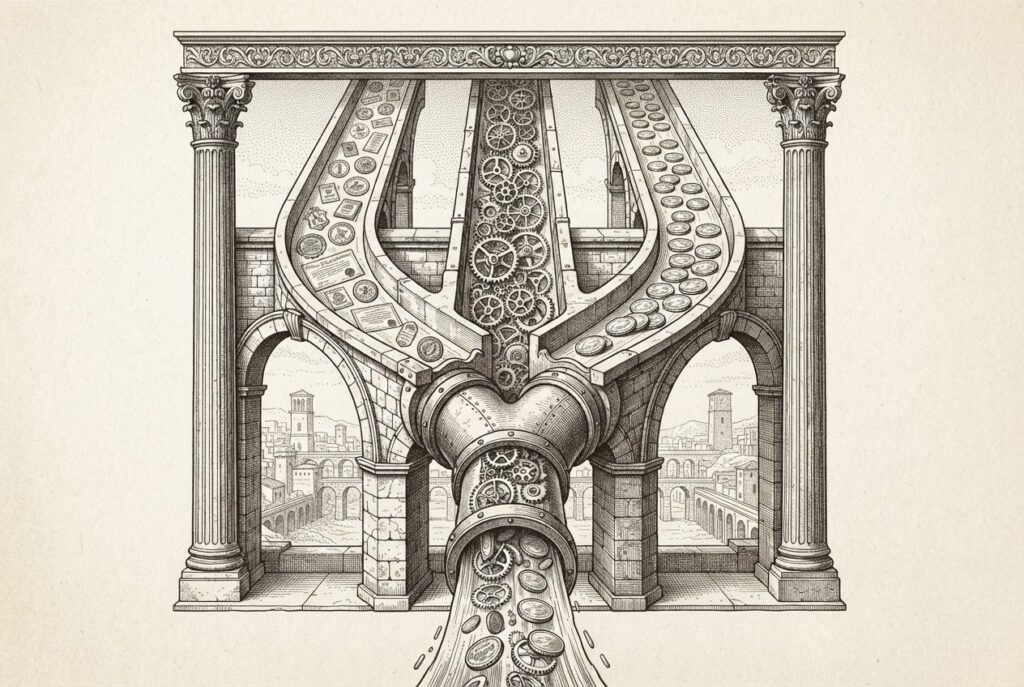
Capital markets are undergoing a structural realignment, moving from isolated experiments to a cohesive, investable thesis. This shift is defined by the convergence of three infrastructure layers: issuer, settlement, and liquidity. While issuance has become increasingly commoditized, the real work is happening in the plumbing—the rails that allow assets to move and settle with institutional efficiency.
The issuer layer reached a milestone on July 2, 2026, when Securitize Corp. listed on the NYSE following a SPAC merger. By tokenizing its own stock on Day 1 across Avalanche and Solana, the firm provided a high-profile proof of concept. As Securitize CEO Carlos Domingo noted, “We have long said that public equities are moving onchain, and there is no stronger validation of that belief than tokenizing our own public stock on Day 1.”
However, issuance is only the entry point. The settlement layer is where the friction of traditional finance—specifically the T+3 cycle—is being dismantled. The DTCC, as reported by The Block, is moving toward an October 2026 commercial launch for its tokenization service, targeting major asset classes like U.S. Treasuries and Russell 1000 constituents. Complementing this institutional scale, NYLIM has integrated RedStone Settle into its tokenized US High Yield Bond Fund, enabling T+0 exits via Dutch auction in approximately 300 milliseconds. As RedStone co-founder Marcin Kazmierczak observed, “Tokenization solved issuance. It did not solve settlement, and settlement is what defines whether an asset scales onchain with broader utility.”
These settlement rails are being bridged by a new liquidity layer. In June 2026, a consortium of major banks—including JPMorgan Chase, Bank of America, Citigroup, and Wells Fargo, as noted by The Block—announced plans for a shared tokenized deposit network via The Clearing House. Targeting a launch in the first half of 2027, this network aims to convert commercial bank deposits into blockchain tokens for 24/7 interbank clearing, a strategic response to the roughly $263 billion in circulating stablecoins. David Watson, CEO of The Clearing House, was blunt: “This is a big move for the banks.” Wells Fargo has also announced its own tokenized deposit service, designed to integrate with this broader network.
This convergence is being accelerated by the January 18, 2027, compliance deadline for the GENIUS Act. With the Treasury issuing its Notice of Proposed Rulemaking in August 2026, the industry is under pressure to align with federal and state licensing requirements for payment stablecoins. Treasury Secretary Scott Bessent recently stated, “Treasury is moving quickly to implement that framework.” This regulatory clarity acts as a forcing function, compelling these disparate layers to interoperate.
The dynamic between these layers is self-reinforcing: Securitize provides the assets, the DTCC and RedStone provide the settlement rails, and the bank network provides the liquidity. Each layer reduces friction for the others, creating a more robust ecosystem. Yet, liquidity remains the binding constraint. While issuance is now standard, secondary market depth is the primary differentiator for institutional adoption. The success of this convergence depends on whether these rails can generate the volume necessary to sustain deep, liquid markets. While forecasts for on-chain RWA value range from $4 trillion to $30 trillion by the early 2030s, the transition from pilot programs to systemic utility remains a work in progress. The infrastructure is being built, but the market is still waiting for the volume to follow.