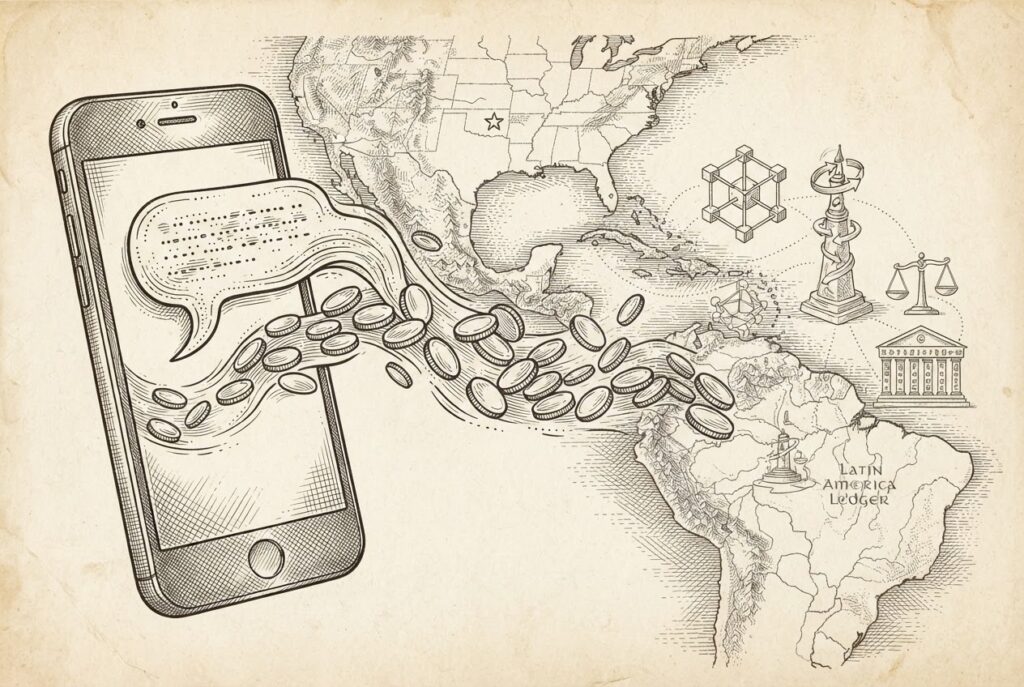
Sending money across borders is usually a chore. It involves legacy rails, high fees, and the distinct feeling that your cash is taking a scenic route through a series of dusty bank basements. Felix Pago, a Miami-based startup, has decided that the future of remittances shouldn’t look like a 1990s wire transfer form. Instead, it looks like a WhatsApp message.
On September 1, 2026, the company announced a $200 million Series B round. According to Bloomberg, this consists of $87 million in equity led by Andreessen Horowitz (a16z) and a $113 million credit facility from the General Catalyst Customer Value Fund. Additional equity participants include QED Investors, Castle Island Ventures, Switch Ventures, Contour Venture Partners, and Endeavor Catalyst. As noted by reporting from Coinpedia, this is the first major stablecoin-native raise specifically targeting a demographic corridor. By backing Felix Pago, a16z is effectively placing a massive bet that stablecoins are the new standard for LatAm immigrants.
The mechanism is deceptively simple. Felix Pago uses a WhatsApp-based AI chatbot to handle transfers, meaning users don’t need to download a separate, clunky app. Under the hood, the system uses USDC on the Stellar blockchain for settlement. To get the money into the hands of recipients, they partner with Bitso, Latin America’s largest crypto platform, acting as the essential on/off-ramp. It is a replicable architecture: distribution via a ubiquitous messaging app, settlement via a high-speed blockchain, and local liquidity via a regional partner.
The numbers suggest this isn’t just a clever tech demo. Felix Pago has processed over $8 billion in remittances to date, with revenue growing 12x between 2023 and 2024. They are currently clocking roughly 20% month-over-month growth, a pace that makes traditional incumbents like Western Union, MoneyGram, and Remitly look like they are moving through molasses. With an NPS above 90, the company has clearly found a product-market fit that goes beyond mere novelty.
But the real test is just beginning. The company is currently expanding into Brazil, Venezuela, El Salvador, and Nicaragua, while simultaneously pivoting toward a broader financial services suite. They are launching lending, savings, and an AI financial assistant. This expansion follows a well-worn path in the industry: solve a painful, high-frequency problem like remittances, then leverage that user trust to build a primary financial hub. (Though, as always, the transition from a utility to a bank is where most startups find their graveyard.)
There is also the looming shadow of the GENIUS Act. With enforcement just 137 days away—January 18, 2027—the regulatory environment is tightening. For a company built on stablecoin rails, compliance is no longer a back-office concern; it is the product itself. The urgency here is palpable. If Felix Pago can navigate the shifting regulatory landscape while scaling its new lending and savings products, it might just prove that the old guard of cross-border payments is not just being disrupted, but rendered obsolete.
The competitive landscape remains crowded, with Wise and Bitso itself vying for the same users. Yet, Felix Pago’s ability to integrate into the daily habits of its users—by living inside WhatsApp—gives it a distribution advantage that is hard to replicate with a standalone app. Whether this $200 million infusion is enough to cement their dominance or merely buys them a seat at the table for the next regulatory showdown remains to be seen. For now, they have the capital, the growth, and the backing of the most influential firm in the valley. The rest is just execution.