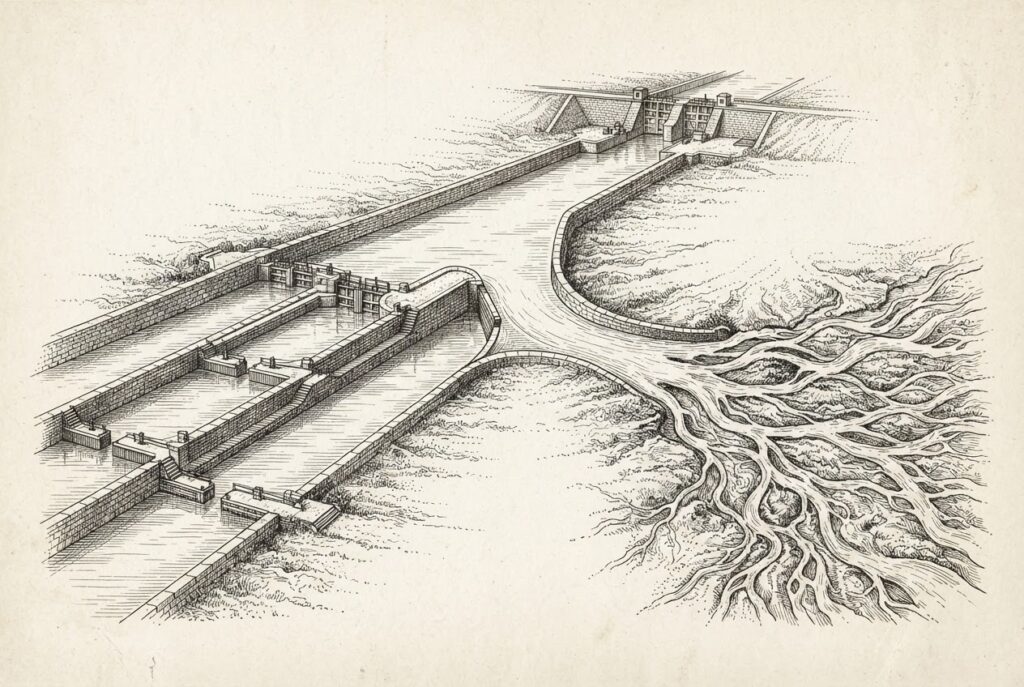
The World Artificial Intelligence Conference (WAIC) 2026 has crystallized a fundamental divergence in how agent infrastructure is being architected globally. While the Western ecosystem remains locked in a cycle of fragmented, vendor-specific protocol competition, China is rapidly consolidating a coordinated, full-stack infrastructure model. This shift moves beyond mere software updates; it represents a structural reordering of the agent economy, integrating operating systems, sovereign compute, and state-backed governance into a unified stack.
The debut of StepFun Agent OS serves as the primary signal of this transition. By replacing the traditional file-and-application paradigm with an intent-and-task model, StepFun is redefining the location of agent infrastructure. StepFun embeds the agent directly into the OS layer, marking a fundamental structural shift in system architecture. With a three-layer infrastructure spanning computing, data, and application services, and the decomposition of hardware and OS into atomic units — communication, applications, files, and system — agents gain the ability to invoke resources with unprecedented granularity. The built-in agent Amoo, which chains third-party services like Ctrip, Didi, Meituan, and Alipay end-to-end, demonstrates that this OS-level integration is already operational, effectively turning the operating system into the primary interface for agentic workflows.
This software-level consolidation is supported by a parallel shift in hardware. The Huawei Atlas 950 SuperPoD effectively breaks the reliance on Nvidia for agent-grade compute. With 8,192 Ascend 950DT NPUs per cluster, 8 ExaFLOPS of FP8 performance, and a massive 16.3 PB/s interconnect bandwidth, this system is designed specifically for the scale required by modern agents. By claiming three times the inference performance of the Nvidia H20 at one-quarter of the cost, Huawei is making sovereign compute a tangible reality. For infrastructure operators, this means the agent economy is no longer tethered to a single hardware vendor’s roadmap, provided they are willing to navigate the specificities of the Ascend ecosystem.
Governance is bifurcating alongside these technical stacks. The Cyberspace Administration of China (CAC) has introduced a 10-point framework for agent mutual trust, interconnection, and interoperability, marking the first systematic articulation of a national position on agent standards. This stands in stark contrast to the Western landscape, where competing protocols like Anthropic’s MCP (agent-to-tool), Google’s A2A (agent-to-agent), and Cisco’s Agntcy (enterprise) operate without government-backed equivalents. Builders are now facing a governance fork: they must choose between aligning with the CAC’s standardized, state-supported framework or navigating the fragmented, market-driven protocols currently being debated in forums like the IETF 126 Vienna agentproto BoF.
The infrastructure is also expanding beyond the digital realm into embodied systems. Companies like Pudu Robotics and ACE Robotics are pushing a three-layer physical agent architecture that integrates robot bodies, specialized OS layers, and foundation models. ACE Robotics’ World Model Cloud Ecosystem, which partners with major providers like Baidu, Alibaba, Huawei, and Tencent, highlights how cloud infrastructure is being re-engineered to support embodied-AI world models. This confirms that the agent economy is no longer confined to software; it is becoming a physical, spatial infrastructure.
Protocol-agnostic design has transitioned from an optional optimization to a survival requirement for builders. The ecosystem is bifurcating into distinct, incompatible stacks. Relying on a single vendor’s protocol or a specific hardware architecture now carries significant structural risk. As the industry moves toward the IETF 126 agentproto session on July 23, the focus must remain on the building blocks of interoperability — such as cross-domain discovery and invocation — rather than proprietary lock-in.
The structural state of agent infrastructure is currently defined by this tension between the coordinated, full-stack approach emerging from China and the decentralized, protocol-heavy landscape in the West. As we move through the remainder of 2026, the ability to build across these divides will distinguish the next generation of agent platforms. The infrastructure is maturing, but it is doing so in two different directions simultaneously.