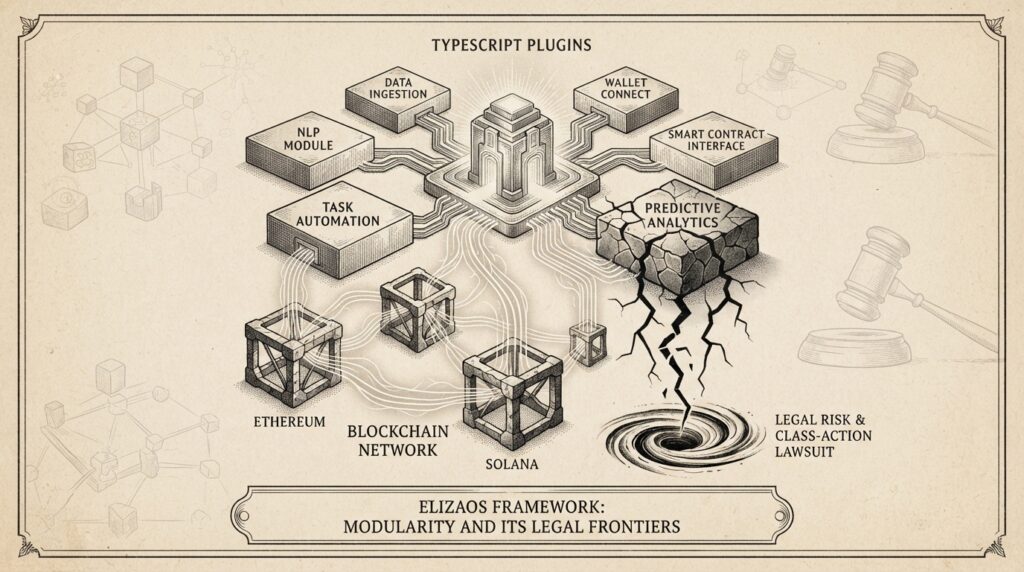
ElizaOS utilizes a modular, TypeScript-based, MIT-licensed architecture designed for runtime-centric agent development. Unlike enterprise-focused frameworks that prioritize vendor-locked convenience and rigid governance, this project is model-agnostic, supporting integrations ranging from OpenAI and Anthropic to local Llama instances. These capabilities are unified by a plugin system currently featuring over 90 official npm packages. At its core, the framework employs an AgentRuntime for lifecycle management and a Unified Message Bus for component communication, signaling a clear preference for developer-level control over managed, black-box solutions.
The widening gap between the project’s claimed scale and its independently verified production maturity remains a significant concern. While the BNB Chain official blog reported over 150,000 agents deployed on its network as of April 2026, this figure is vendor-adjacent reporting. It reflects deployment counts rather than an independent audit of production status, active usage, or long-term reliability. When looking beyond the project’s own documentation, the technical reality becomes more nuanced. A 2026 independent technical assessment characterizes the developer experience as mixed; while the framework is powerful and highly customizable, it suffers from notable framework friction, dropped features, and weak migration paths between versions. For conventional enterprise workflows that demand mature observability, rigorous security, and vendor-neutral validation, ElizaOS currently lacks the necessary benchmarks to compete with more established infrastructure.
This tension between modularity and reliability is further complicated by the project’s legal and governance challenges. A class-action lawsuit, Doe v. Walters, No. 1:26-cv-03238, filed in the Southern District of New York in April 2026, has cast a long shadow over the ecosystem. The complaint, brought by Burwick Law, names founder Shaw Walters, Eliza Labs Inc., Sebastian Quinn-Watson, the ai16z DAO, DAOs.fun, Jeff Wolcott, and pseudonymous individuals ‘Skely’ and ‘Baoskee’ as defendants. The plaintiffs allege that the $AI16Z and $ELIZAOS tokens were marketed as governance instruments for an autonomous AI-managed venture fund—modeled after Andreessen Horowitz—but were instead controlled by human insiders. Furthermore, the lawsuit alleges that the Andreessen Horowitz brand was used without authorization and that a token migration between September and November 2025, which expanded the supply from 1.1 billion to 11 billion tokens, was used to dilute holders for the benefit of the defendants. On-chain data cited in the filing suggests losses across at least 3,945 customer wallets. It is critical to note that these are unproven allegations in a filed complaint, not adjudicated findings, and the case remains unresolved.
Within this volatile environment, the project continues to push forward with its own technical roadmap. The framework’s multi-agent orchestration layer, which the project refers to as ‘Composable Swarms,’ is a functional subsystem utilizing a Worlds/Rooms architecture to coordinate multiple agents. While the term is a product of the project’s own marketing, the underlying architecture is a tangible attempt to solve the problem of agent-to-agent communication. This is complemented by native Solana integration for token management and cross-chain capabilities via Chainlink CCIP. The ai16z DAO itself remains a technically novel, if controversial, governance experiment, utilizing an AI agent named ‘Marc AIndreessen’ to evaluate proposals. The long-term accountability implications of such a system remain entirely unclear.
ElizaOS provides a blockchain-native, plugin-extensible environment that appeals to developers who prioritize runtime control, yet it serves as a cautionary case study for the agent economy. The ecosystem is undeniably active, with ongoing development on GitHub through July 2026 and a suite of connectors for platforms like Discord, Telegram, and X. Nevertheless, the discrepancy between the project’s ambitious claims and its demonstrated production maturity is significant. Building on ElizaOS involves a clear trade-off: developers gain a high degree of modularity and decentralization, but they inherit the risks associated with a framework that has yet to prove its reliability in high-stakes, enterprise-grade environments.