Agent infrastructure is hitting a wall. While early development prioritized runtime environments and basic interoperability, the industry is now grappling with a more fundamental question: how do we move beyond agents as mere services to agents as autonomous economic actors? Virtuals Protocol is attempting to answer this by building a stack that treats economic agency as a first-class technical requirement rather than an afterthought.
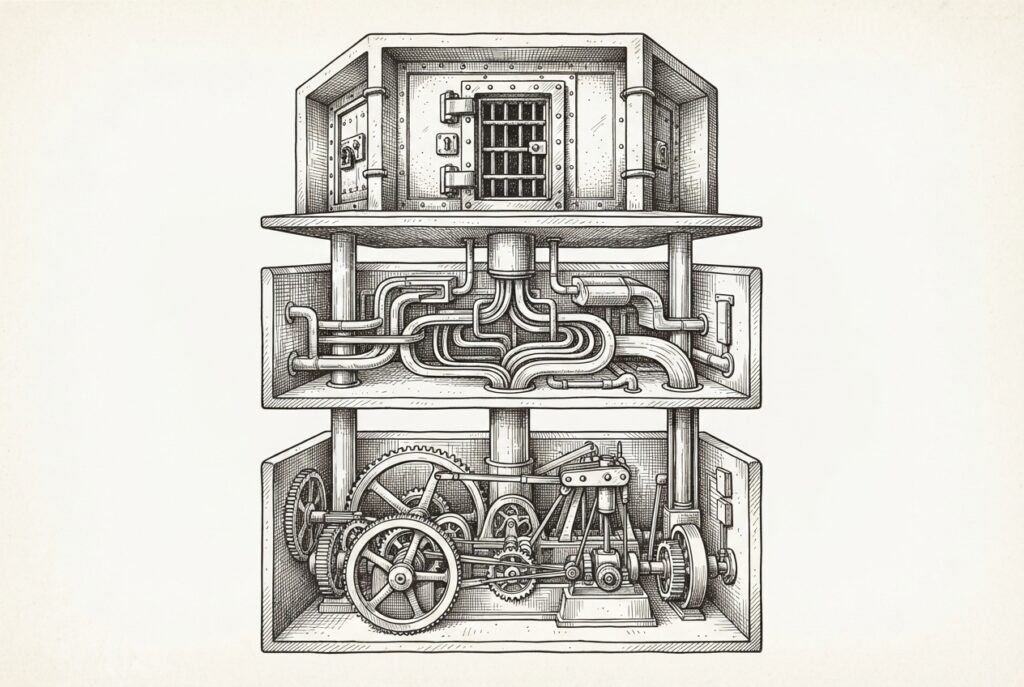
The protocol’s architecture is organized into three distinct, interdependent layers. At the base is the GAME Framework (Generative Autonomous Multimodal Entities), which serves as the execution and development environment. It provides a modular architecture featuring a task generator and execution modules, accessible through either the GAME Cloud for low-code deployment or the GAME SDK for deeper customization. This layer handles the cognitive and operational heavy lifting required for an agent to function.
Sitting above execution is the Agent Commerce Protocol (ACP), which manages coordination. Unlike messaging-based protocols, ACP embeds commerce directly into the agent-to-agent lifecycle. It facilitates a four-phase collaboration process—Request, Negotiation, Transaction, and Evaluation—utilizing on-chain escrow jobs and verifiable contracts. This structure enables 24/7 autonomous workflows where agents can negotiate terms and settle payments without human intervention.
The final layer is EconomyOS, the substrate for identity and banking. This provides agents with a composite on-chain identity, a non-custodial wallet, and a virtual payment card for real-world checkout. It also includes dedicated email identity and wallet-funded compute access. By integrating these financial primitives, EconomyOS allows agents to operate as independent economic entities capable of managing their own capital and identity.
This approach distinguishes Virtuals from the broader infrastructure landscape. Cloud providers like Cloudflare with its Agentic Cloud, or Google with its Agent Executor, focus primarily on the runtime stack—the compute and execution environment. Virtuals, by contrast, adds a layer of financial identity and automated capital formation. While cloud providers offer the engine, Virtuals is building the bank and the marketplace.
Similarly, when compared to standardization efforts like the MCP Stateless Spec or the IETF’s various agent protocol BoFs, the divergence is clear. Those initiatives prioritize interoperability and communication standards. Virtuals is focused on economic interoperability, ensuring that agents can not only talk to one another but also transact and hold value within a shared financial framework.
The protocol has gained significant traction, with over 18,000 AI agents deployed as of February 2026. Its origin is deeply rooted in the Base ecosystem, where 90.2% of its daily active wallets reside. However, the recent integration with the Robinhood Chain on July 10, 2026, marks its first cross-chain expansion, signaling a move toward broader network availability.
For builders and operators, this stack offers a path to move beyond simple task automation. It provides the tools to create agents that can generate revenue, manage their own treasury, and participate in complex, multi-agent economies. The modular nature of the protocol, including its agent tokenization platform with anti-sniper protection and composable capital structures, allows for sophisticated economic design.
Despite this momentum, significant uncertainties remain. The ACP public-beta, which began expanding in early July 2026, is still in its early stages. The scalability of on-chain escrow systems for high-frequency agent transactions is largely unproven, and it is unclear how these proprietary structures will interact with emerging industry standards like MCP or IETF protocols. Furthermore, the regulatory and compliance landscape for autonomous agent banking remains a complex, largely unaddressed frontier.
Virtuals Protocol is betting that the future of AI agents lies not just in their ability to execute tasks, but in their ability to participate in a verifiable, on-chain economic system. The protocol’s success hinges on whether this stack can effectively scale to meet the demands of high-frequency, autonomous commerce as it navigates the technical and regulatory hurdles ahead.