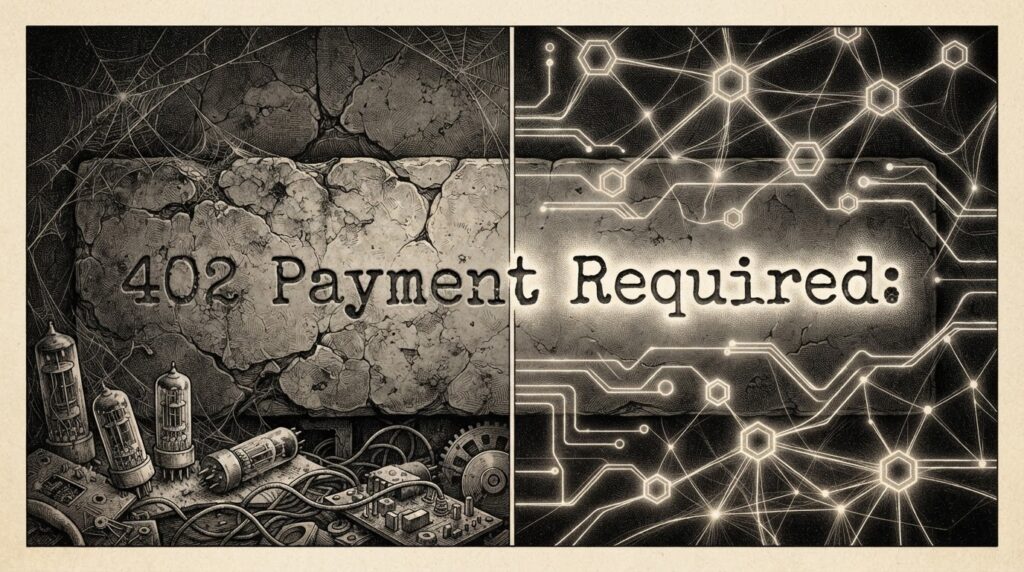
The HTTP 402 status code, long allocated to “Payment Required” in the internet’s technical specifications without widespread deployment, has been repurposed as the foundational layer for machine-to-machine commerce. The code’s activation came through the launch of the x402 Foundation in July 2026. By embedding payment directly into the HTTP request/response cycle, the protocol provides a structural answer to a fundamental question: how do machines settle transactions without human intervention?
This infrastructure is the engine beneath the thesis articulated by Animoca Brands Chairman Yat Siu. In a recent Forkast interview, Siu argued that “agents paying each other for skills via native tokens is the angle — it’s not about replacing, it’s about expanding.” For an autonomous agent to possess true operational power, it requires sovereign money. The x402 protocol facilitates this by allowing a client to request a paid resource, receive a 402 response with payment details, and execute a stablecoin transaction that settles on-chain in approximately two seconds.
The x402 model operates with zero protocol fees, relying only on blockchain gas costs — roughly $0.00025 per transaction on Solana, a fraction of a cent on Base. The GENIUS Act, signed in July 2025, established the U.S. regulatory framework for stablecoins, meaning the protocol rides a legal rail that did not exist two years ago. The cost of settlement is pushed toward zero — not because someone subsidizes it, but because sending money finally costs what sending data costs.
The industry response suggests consensus, not a single-vendor playbook. The x402 Foundation launched under the Linux Foundation on July 14, 2026, with 40 organizations, including 17 premier members such as Visa, Mastercard, Stripe, Google, AWS, Cloudflare, Coinbase, American Express, and the Solana Foundation. When every major card network, cloud provider, and blockchain consortium joins the same table around the same open protocol, the signal is infrastructure convergence — and the signal is quieter than marketing theater.
The gap between headline volume and present-day commercial reality is still wide. The network has recorded over 200 million transactions as of June 2026, according to Major Matters’ x402 Adoption Tracker. But Artemis Analytics found that more than 95% of that activity is protocol signaling — machines testing the plumbing — not buyer-seller exchange. Self-dealing and wash trading, where the same wallet transacts with itself or the seller funds the buyer to loop transactions back, account for a substantial portion. CoinDesk reported in March 2026 that real daily commercial volume was approximately $28,000. Transactions over $1 have grown to 95% of the mix, but those figures largely reflect API costs, not consumer shopping carts.
Mastercard is simultaneously hedging both sides of this transition. The network completed its $1.8 billion acquisition of BVNK in August 2026 — a stablecoin infrastructure firm processing roughly $30 billion in annualized payment volume across 200 countries. Mastercard is buying the bridge while simultaneously sitting on the board of the protocol that eliminates bridges. If x402 takes off and machine-native settlement becomes the default, Mastercard is connected. If trust gaps keep intermediaries essential, Mastercard owns the intermediary.
The transition from protocol signaling to genuine commercial exchange is now the primary bottleneck for the agent economy. The infrastructure consensus is wider than almost anything in crypto before it — 40 members, zero fees, two-second settlement. The real question is how fast the volume beneath the signaling layer converts into actual value transfer, and which architecture captures the spread when it does.