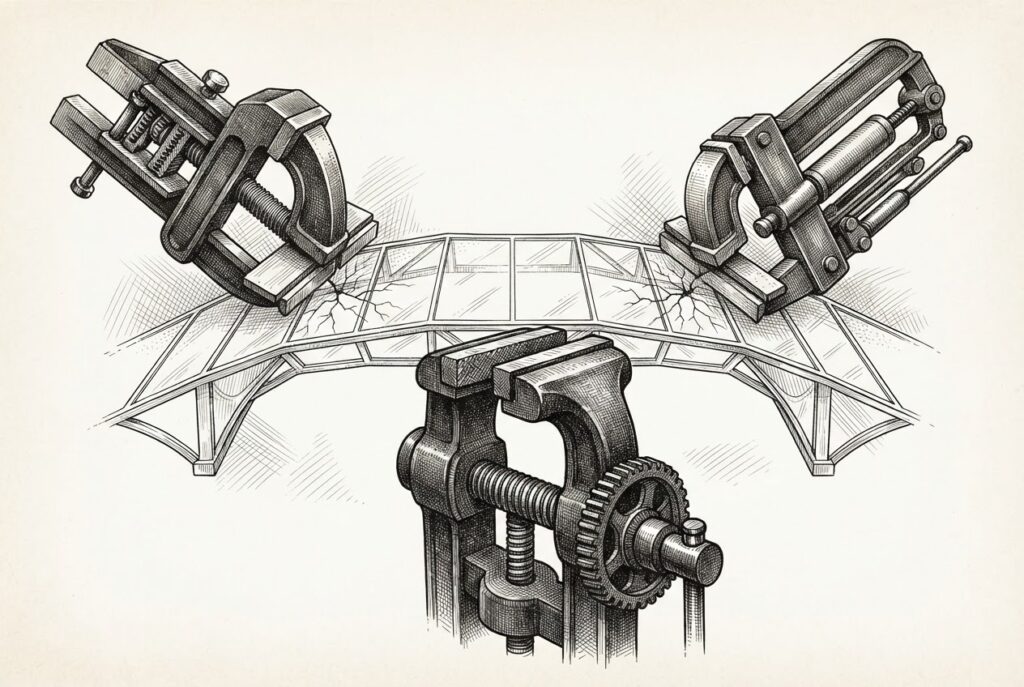
One week in September 2026 did more damage to the AI safety coordination thesis than five years of debate. An antitrust lawsuit, a presidential dismissal, and a legislative blockade converged to dismantle the institutional framework that Anthropic, OpenAI, SpaceXAI, and Google had been building since Dario Amodei published We Must Pace the Frontier on September 12. The question is no longer whether frontier labs can coordinate on safety. The question is whether they can do so without breaking the law, losing political cover, and exposing themselves to existential litigation.
The Antitrust Trap
On September 18, four paid subscribers filed Buist et al. v. Anthropic PBC et al. in the Northern District of California (No. 3:26-cv-10693), alleging that coordinated public endorsements of AI slowdowns constitute an output-restricting cartel under Section 1 of the Sherman Act. The plaintiffs — Charles Buist, Nick Spetsas, Cheyenne Hunt, and Christine Bullock — argue that when competitors agree to limit the speed or capability of their products, they are restricting output, regardless of their stated safety rationale.
The filing arrived six days after Amodei’s pacing essay triggered same-day endorsements from Sam Altman, Elon Musk, and Demis Hassabis. By September 15, OpenAI’s Chris Lehane confirmed to TechCrunch that the major labs had been coordinating on safety protocols for weeks. The lawsuit argues that this coordination — voluntary or not — fits the legal definition of a cartel. As we covered in our analysis of the antitrust filing, the labs now face a binary: abandon safety coordination or defend it against Sherman Act scrutiny.
The Executive Dismissal
On September 19, President Trump announced the creation of an AI Force and appointed a new AI Czar. In a post on Truth Social, the President dismissed AI safety as a “hoax,” vowed that his administration would not “hinder or stifle the Growth of this incredible Industry,” and suggested renaming AI to “Superior Intelligence” or “Extreme Intelligence.” No appointee was named and no implementation details were provided.
This follows the resignation of David Sacks, who stepped down as AI czar in March 2026 after reaching the 130-day special government employee limit. The new appointment signals a fundamental shift: the executive branch is no longer a potential ally for safety coordination. It is actively hostile to it. As we analyzed in Trump’s AI Force, this redefines the role of the federal government from oversight to mandate-for-growth.
The Legislative Blockade
Even before the antitrust suit landed, the legislative path had closed. On September 15, Senator Josh Hawley, supported by Senator Ted Cruz, blocked a national-security antitrust exemption in the NDAA manager’s package. Hawley stated: “No antitrust exemptions for AI. Not a chance.” This action eliminated the legal window Amodei had identified as necessary for industry-wide safety cooperation — the narrow federal waiver that would allow competitors to coordinate on safety standards without triggering antitrust exposure.
The bipartisan Cruz-Klobuchar-Thune duty-of-care bill (Post 130441) remains on the table, but it faces a hostile political environment. With the executive branch dismissing safety as a hoax and the Senate blocking the exemption mechanism that would enable coordination, the legislative framework for AI safety governance is gridlocked.
What Survives
The institutional momentum remains. The FINRA-style safety body that Anthropic, Google, and reportedly OpenAI are building continues to operate. The capital pressure is real — Anthropic’s reported IPO deliberations and the company’s need to balance safety positioning against growth expectations will not disappear. The OpenAI no-IPO stance (Post 130424) shows that at least one major lab is willing to absorb the capital cost of maintaining safety-first positioning.
But the framework that made coordination possible — voluntary safety pacts backed by political goodwill and legislative cover — no longer exists. The antitrust lawsuit tests whether safety coordination can survive Section 1 scrutiny. The Trump AI Force removes executive support. The Hawley-Cruz blockade eliminates the legislative waiver. Each of these forces hits the same target from a different direction, and together they create an environment where the costs of coordination may exceed the costs of unilateral action.
The Structural Question
The safety coordination thesis was built on an assumption: that frontier labs could coordinate on capability restraint without violating antitrust law, that the federal government would enable or at least tolerate such coordination, and that Congress would provide the legal framework to formalize it. All three assumptions collapsed in one week.
What remains is the liability vacuum. The Amodei pacing framework (Post 130208) proposed voluntary deceleration as a governance model. The antitrust suit argues that voluntary deceleration among competitors is illegal. The executive branch says deceleration is unnecessary. And Congress has blocked the mechanism that would have made it legal. The result is a governance gap where no actor — not the labs, not the executive, not Congress — has the authority or the will to set the terms.
The labs that built institutional infrastructure around safety coordination — the FINRA body, the pacing framework, the coordination pacts — now face a choice: continue operating in a legal gray zone, or abandon the coordination that their safety positioning depends on. The safety-thesis contradiction we identified in the Anthropic IPO analysis — safety positioning vs. capital pressure — has now expanded into a safety-thesis collapse: safety positioning vs. legal exposure, political hostility, and legislative gridlock, all arriving in the same seven days.