The Great Decoupling: Huawei’s Rise and the Collapse of Nvidia’s China Dominance
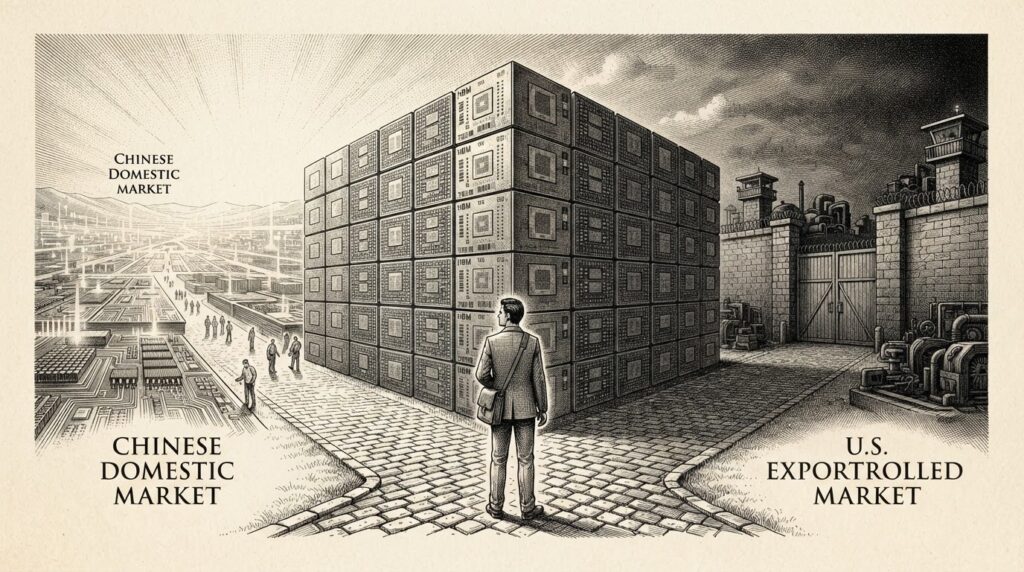
Nvidia’s footprint in the Chinese AI chip market is undergoing a historic contraction, plummeting from a 39% share in 2024 to a projected 8% by 2026. This collapse is not merely a statistical shift; it is a strategic evacuation. In May 2026, Nvidia CEO Jensen Huang publicly acknowledged that the company has “largely conceded” the market to Huawei, advising investors to expect nothing regarding future approvals for advanced chips. As Nvidia retreats, Huawei is positioned to capture approximately 50% of the Chinese AI chip market, marking a definitive pivot toward domestic self-reliance.
Bernstein Research projects that China’s domestic AI chip production is accelerating, with localization rates climbing from 17% in 2023 to a projected 55% by 2027. By 2028, domestic production capacity is expected to exceed total demand, signaling that the current market reconfiguration is not a temporary disruption but a permanent realignment of the global semiconductor supply chain.
Since January 2026, the U.S. Bureau of Industry and Security (BIS) has enforced a rigorous case-by-case license review policy for chips with specific performance thresholds, including total processing performance (TPP) below 21,000 and DRAM bandwidth under 6,500 GB/s. These controls, combined with six compliance conditions-ranging from independent lab reviews to strict shipment caps-have effectively rendered the Chinese market commercially untenable for Nvidia’s most advanced hardware.
However, the narrative of Huawei’s total dominance is tempered by significant operational bottlenecks. While Huawei’s Ascend production has a theoretical ceiling of 1.6 million dies, this figure is derived from approximately 13 million HBM stacks procured. In reality, achievable production is materially lower due to persistent HBM supply shortages. Without access to additional foreign HBM, Huawei may struggle to fabricate even 1 million Ascend chips in 2026, creating a supply-demand gap that limits the speed of its market takeover.
Adding to this complexity is the friction of Chinese regulatory approvals. Even when U.S. authorities granted approval in May 2026 for Nvidia H200 sales to ten major Chinese firms-including Alibaba, JD.com, ByteDance, and Lenovo-the deals remained stalled by pending domestic regulatory clearance. This dual-layer of oversight creates a bifurcated environment where neither foreign nor domestic suppliers can operate with full agility, forcing Chinese tech executives and investors to navigate a landscape defined by scarcity and political risk.
Capital allocation strategies must now account for a permanent bifurcation in compute standards, as the fracturing of the global market forces a shift toward localized, Huawei-anchored ecosystems. While Nvidia retains a residual 8% share, its role is increasingly peripheral. The structural decoupling is now baked into the hardware layer, ensuring that the future of AI compute in China will be defined by the limits of domestic fabrication and the ongoing volatility of international trade policy.