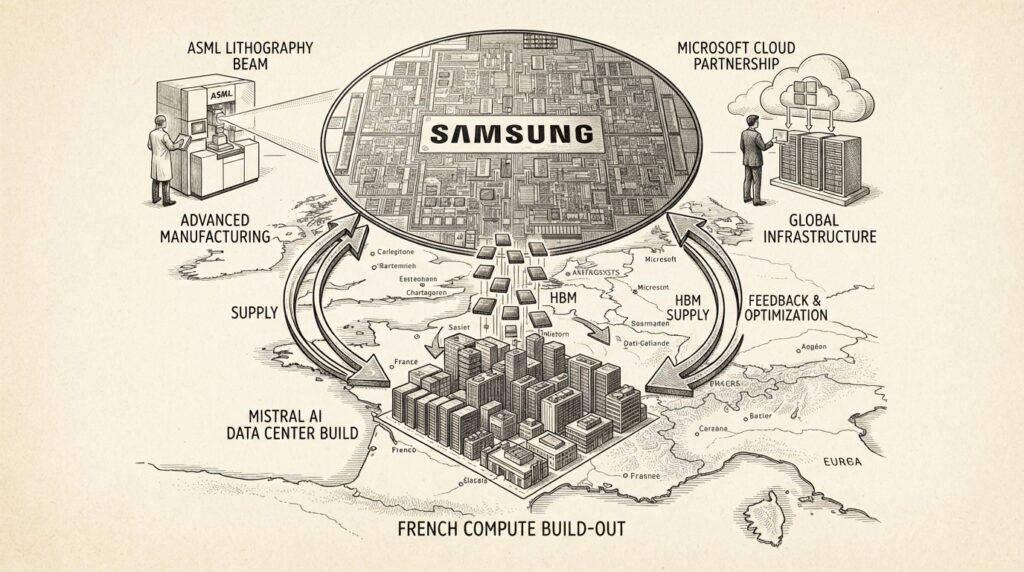
Samsung is securing a foothold in the European AI ecosystem, with reports indicating the Korean giant is in talks to invest approximately €1 billion into Mistral AI. This is not a passive financial play. By positioning itself as a cornerstone investor, Samsung is leveraging its status as a critical compute supply chain player – holding 38% of the global DRAM market and preparing to become the first HBM4 supplier to Nvidia – to integrate itself into the heart of Europe’s frontier AI development.
The proposed investment is part of a broader €3 billion fundraising round that would value the Paris-based lab at roughly €20 billion. While these discussions are ongoing and not yet finalized, the move marks the first major entry of a Korean chaebol into a European frontier AI lab. It follows a clear precedent set by ASML, which invested €1.3 billion in Mistral’s Series C round in September 2025, securing an 11% stake and a seat on the company’s Strategic Committee.
The timing of the Samsung talks is telling, coming just one day after Microsoft announced a multibillion-dollar infrastructure deal with Mistral. However, the two deals represent fundamentally different strategies. Microsoft’s agreement focuses on infrastructure, allowing Azure customers to utilize Mistral’s European data centers and integrating models into Foundry and Copilot Studio without taking new equity. Samsung, conversely, is seeking a direct ownership stake, signaling a desire for deeper, structural alignment with Mistral’s roadmap.
What that actually means is that Samsung is betting on Mistral’s aggressive infrastructure expansion. Mistral is currently investing €4 billion into European data centers, with a 1 gigawatt target by 2030 and plans to deploy Nvidia’s Vera Rubin GPUs. For Samsung, this is a dual-purpose play: they are the supplier of the high-bandwidth memory (HBM) and DRAM required to power these clusters, and they are a customer looking to leverage Mistral’s models for their own internal AI applications.
The urgency behind this move is underscored by the broader compute supply chain squeeze. TSMC’s Q2 2026 results show revenue reaching T$1.27 trillion, a 77.4% year-over-year increase in net income, and a raised capital expenditure guidance of $60–64 billion. Yet even with this massive investment, the supply outlook remains precarious. SK Hynix’s CEO has warned that 2027 could be the worst year in memory history, with HBM supply expected to remain constrained well beyond 2030.
Samsung’s position in this landscape is complex. While the company is projected to triple its HBM shipments in 2026, its HBM market share has fluctuated, dropping from 35% in Q3 2025 to 21% in Q1 2026. Securing a deep partnership with a major European AI player like Mistral provides a guaranteed, high-value outlet for next-generation memory products, effectively hedging against the volatility of the broader market.
The near-doubling of Mistral’s valuation – from roughly €11.7–12 billion in its Series C to the current €20 billion target – signals a significant shift in how the market prices European AI sovereignty. Investors are no longer just betting on model performance; they are betting on the ability to build and control the underlying compute infrastructure.
The question is whether these talks will translate into a finalized deal. If they do, Samsung will have bridged the gap between Asian hardware manufacturing and European AI software development – a position no pure financial investor can replicate. For now, the industry is watching to see whether this capital infusion will secure the compute capacity required to keep Europe’s AI ambitions independent of the dominant US-based cloud providers.