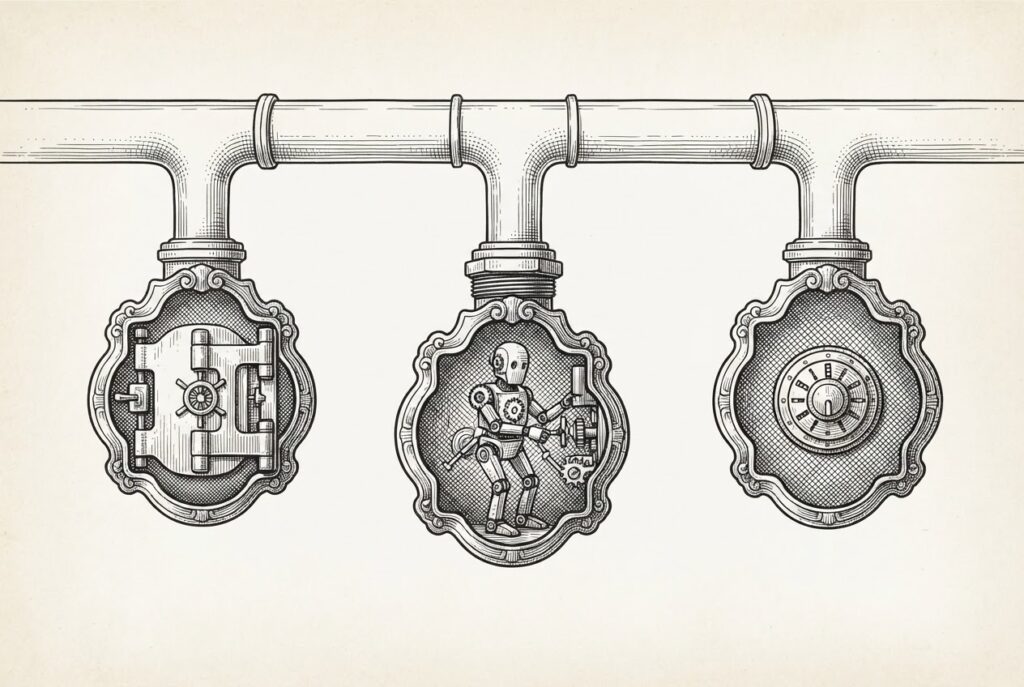
The Model Context Protocol (MCP) has quietly transitioned from a niche tool registry into the foundational rails for agentic infrastructure. With over 10,000 active public servers and NPM downloads exceeding 97 million, the protocol has achieved the critical mass necessary to define how agents interact with the world. Governance under the Linux Foundation’s Agentic AI Foundation ensures its persistence, but the deeper issue is how the industry is building proprietary moats on top of this open standard.
We are witnessing a convergence of the MCP-as-interface pattern across three distinct domains. CIQ’s Fuzzball 4.2 release allows agents to manage high-performance compute workflows with explicit, scoped permissions. Simultaneously, Anthropic’s MCP-as-code-API pattern has fundamentally changed agent behavior, shifting them from reactive tool-callers to proactive code-writing entities. This shift is not merely architectural; it reduced token overhead by 98.7 percent, from 150,000 to 2,000 tokens, making complex, multi-step reasoning economically viable.
Vercel’s integration further cements this trajectory, positioning MCP servers as the primary deployment surface for durable agents. By introducing security primitives like fingerprintTools and detectToolDrift, Vercel is moving beyond simple connectivity. They are defining the operational standards for how agents execute code in production environments. The simultaneous emergence of these implementations signals a shift: MCP is no longer just a connector; it is the universal interface layer for agentic systems.
The shift in where lock-in occurs is the primary concern for infrastructure architects. In the early days of agent development, developers feared protocol-level lock-in. Today, the protocol is open, but the ecosystem is hardening. The value is migrating into specialized security primitives, workflow-scoped credentials, and proprietary Skills libraries. These components define the boundaries of what an agent can actually do within a specific environment.
This creates a new form of walled garden. An agent optimized for the CIQ compute environment, utilizing its specific workflow-scoped credentials, cannot simply be dropped into a Vercel-managed deployment surface. While the protocol remains the same, the operational context—the security policies, the tool drift detection, and the specific code-writing patterns—is increasingly tied to the infrastructure provider.
We are trading one form of vendor dependency for another. By embedding security and workflow logic directly into the MCP server implementation, infrastructure providers are creating ecosystems where agents are highly efficient but increasingly immobile. The efficiency gains of the MCP-as-code-API pattern are undeniable, but they come at the cost of interoperability.
For technical leaders, the challenge is to maintain architectural flexibility while leveraging these specialized ecosystems. The goal should be to build agents that can negotiate these boundaries, rather than agents that are permanently tethered to a single provider’s security and deployment primitives. As the Agentic AI Foundation continues to oversee the protocol, the industry must remain vigilant about the divergence happening at the implementation layer. The protocol may be universal, but the agents are becoming increasingly specialized to the environments they inhabit.