The Agent as the New Front Door: DigitalOcean’s Infrastructure Play
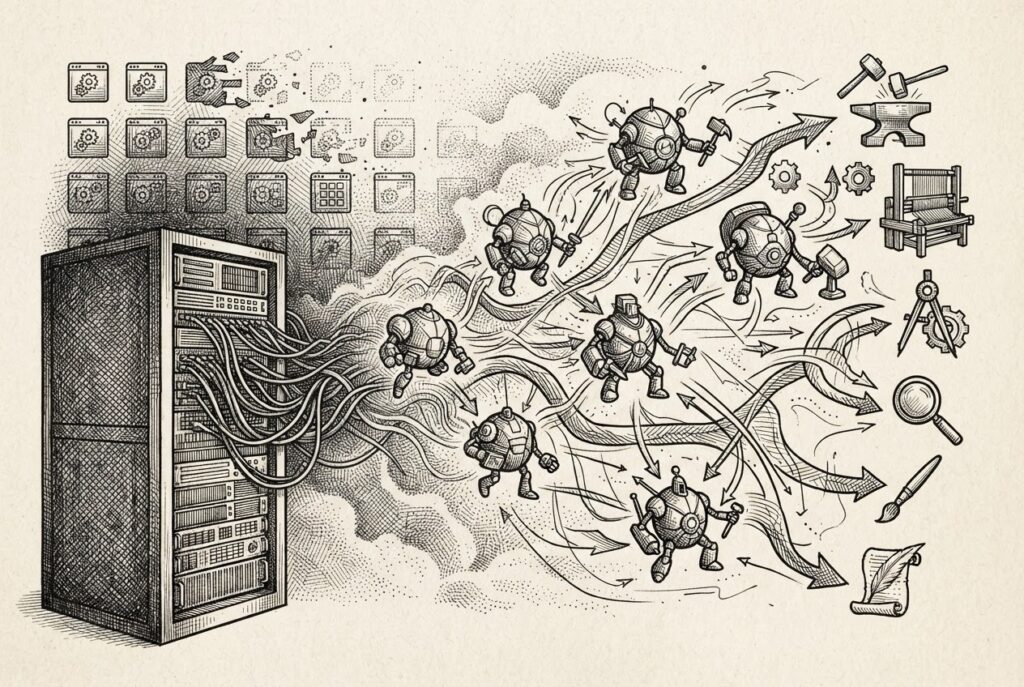
Treating the autonomous agent as the primary interface for cloud resources represents a fundamental architectural pivot, moving away from the virtual machine as the central unit of compute. On September 22, 2026, DigitalOcean announced the public preview of agent infrastructure services that codify this shift, positioning the agent as the new front door for cloud-native development.
Vinay Kumar, framing the industry transition, noted: “EC2 was the front door to the first generation cloud. Customers rented a virtual machine and assembled everything else around it. The next generation cloud is AI-native, and the agent is the front door.” This perspective places DigitalOcean directly into a competitive landscape alongside AWS AgentCore, Azure AI Foundry, Google Cloud Run agents, and Cloudflare Agentic Cloud, all of which are racing to define the standard for how agents interact with compute, storage, and external tools.
The architecture of DigitalOcean’s offering is split into two distinct, yet tightly integrated components: the Harness Runtime and the Action Gateway. The Harness Runtime is built on Firecracker microVMs, providing isolated execution environments for each session. By leveraging OCI containers, it allows for a “Bring Your Own Template” (BYOT) approach, giving developers flexibility in their environment configuration. Crucially, it supports session persistence, allowing developers to pause and resume agents without losing context, or even checkpoint and fork sessions for debugging or parallel experimentation. This is harness-agnostic, supporting frameworks like Claude Code, Codex CLI, OpenCode, Hermes, LangGraph, and CrewAI.
The Action Gateway serves as the connective tissue between these isolated runtimes and the outside world. It provides access to over 16,000 tools and includes an MCP endpoint for standardized communication. From a security and operational standpoint, the gateway handles credential brokering—ensuring tokens resolve at execution time and never reach the model itself—and provides centralized permissions per tool and action. It also includes a mechanism for required human approval for sensitive operations, addressing a primary concern for enterprise adoption.
For builders, the most immediate impact of this architecture is the shift in cost dynamics. DigitalOcean has introduced an active CPU billing model, where charges apply only when agents are actively processing. There are no CPU charges while the agent is waiting on model responses or tool results. Pricing is set at $0.044 per vCPU hour for active compute, $0.0095 per GB-hour for memory, and $0.005 per GiB-month for snapshots. This model aligns infrastructure costs directly with agent utility, rather than idle uptime.
The implications for system design are significant. By offloading the complexities of runtime authority, session management, and secure tool integration to the cloud provider, developers can focus on agent logic rather than infrastructure plumbing. Early customers like OpenHands, Qencode, and Amplitude are already testing these capabilities. Spenser Skates of Amplitude noted: “Amplitude helps organizations deliver more impact when building with AI. This will let us focus more of our engineering effort on helping customers build better products and get more out of their AI spend.”
This infrastructure layer is becoming a standard component of the cloud-native stack. As Murad Mordukhay observed, “It’s been a huge force-multiplier for our team. It gets the right ticket to the right person without anyone having to watch every thread themselves.” By automating the routing and execution of tasks, these managed environments reduce the operational overhead of maintaining agent fleets.
The technical precision of the Action Gateway, which according to the DigitalOcean announcement boasts tool discovery with 99.3% accuracy, suggests that the industry is moving toward a more reliable, predictable model for agentic workflows. By centralizing permissions and providing a secure, isolated runtime, DigitalOcean is attempting to solve the “black box” problem that often plagues complex agent deployments.
DigitalOcean’s entry into this space confirms that the major cloud providers view agentic workflows as a first-class citizen of the cloud. For builders, this means the tools to deploy, secure, and scale agents are moving from custom-built, fragile implementations to robust, managed services.
The success of this approach will depend on how well these managed environments integrate with existing developer workflows. By supporting a wide range of frameworks and focusing on the specific needs of agentic compute—such as session persistence and secure credential handling—DigitalOcean is positioning itself to be a foundational layer for the next generation of AI-native applications.
Ultimately, the convergence of isolated runtime environments and standardized tool gateways suggests that the future of cloud computing will be defined by the granularity of agent-level control. As these managed services evolve, the ability to checkpoint, fork, and audit agent sessions will likely become the baseline requirement for any production-grade AI system.