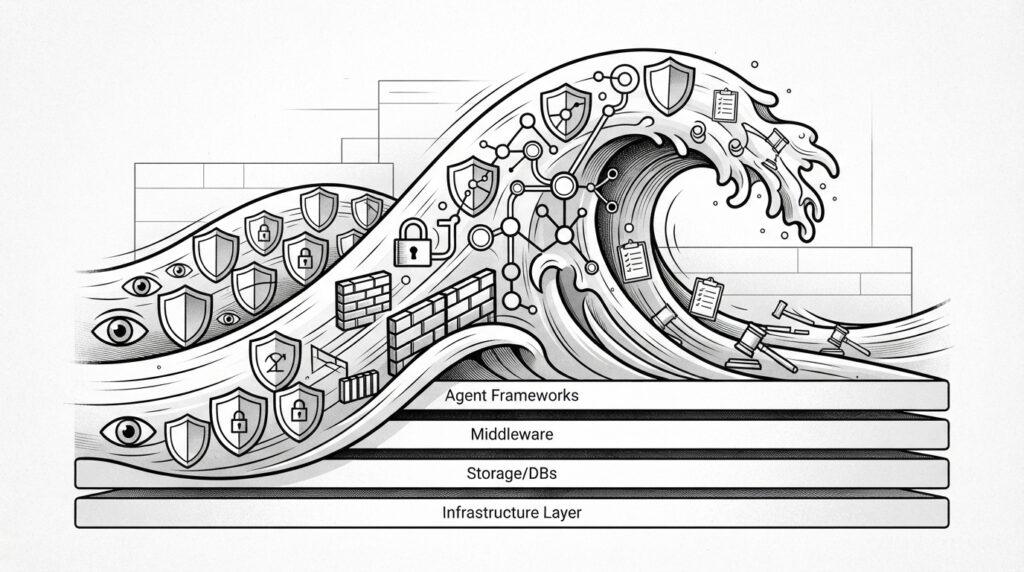
Black Hat USA 2026 has effectively codified a new market segment. Over the span of just forty-eight hours, more than 15 vendors launched specialized products dedicated to agent infrastructure security, building on the signal we identified in our preview two days ago. This rapid influx of tools signals that the industry has moved past abstract debates regarding AI risk, shifting instead toward the practical requirements of securing autonomous systems within production environments.
This surge of activity follows the Day 1 briefings, which detailed framework-level vulnerabilities and compute-layer attacks. The research community demonstrated how easily agentic workflows could be subverted, and the vendor ecosystem responded with a coordinated wave of product announcements. These offerings now coalesce into four distinct functional categories, providing a clear framework for how organizations can begin to secure their agentic fabric.
Visibility and Discovery
Security teams are prioritizing visibility as their first line of defense. Agents and Model Context Protocol (MCP) servers often operate without oversight, hidden within enterprise networks. Cyera has launched Agent Guardian to discover shadow agents and MCP activity across endpoints, SaaS, and cloud environments. Rubrik introduced Agent Identity to provide inventory, least-privilege access, and Agent Rewind to undo harmful actions. Meanwhile, SailPoint utilizes its Agentic Fabric to expose hidden agents through browser and endpoint sensors.
Runtime Controls and Active Defense
Once visibility is established, the focus shifts to active intervention. Check Point is addressing this with its AI Network Firewall, which discovers MCP communications and provides prompt visibility. Sweet Security launched Agentic AI Blocking to terminate unauthorized tool calls and sessions at runtime. Zero Networks offers Least Agency Enforcement to limit what agents can access and mandate human approval for sensitive operations.
Securing the Model Context Protocol
The Model Context Protocol has emerged as a primary target for attackers. To secure these connections, Tanium released the Atlas MCP Server to expose data securely to platforms like Claude and Microsoft Security Copilot. Promptfoo provides an MCP Proxy for secure communications, featuring live red-team demos at the OpenAI booth. Legit Security introduced VibeGuard 2.0 to discover and secure AI coding agents with specific MCP security controls.
Governance and Deception
The market is also addressing the need for ongoing oversight and proactive deception. Acalvio is deploying ShadowPlex Deception Guardrails, using honeytokens and decoy tools to lure and expose malicious activity. Governance is being handled by a broad group of vendors: KnowBe4 is extending its risk management to include Claude, while Drata is focusing on the discovery, monitoring, and traceability of AI agents. 1Password is bringing just-in-time privilege controls to employees and AI agents, Mimecast is surfacing agentic risk, and Abnormal AI is extending behavioral identity protection to the agent layer.
The speed of this vendor wave is unprecedented, yet it remains a direct reflection of the urgency created by the vulnerabilities identified during the conference. As the Business Hall prepares to close on August 6, the immediate question for builders and investors is not just which of these products will gain traction, but which will survive the transition from a conference launch to a sustainable enterprise solution. The category has been formed, but the process of market maturation is only just beginning.