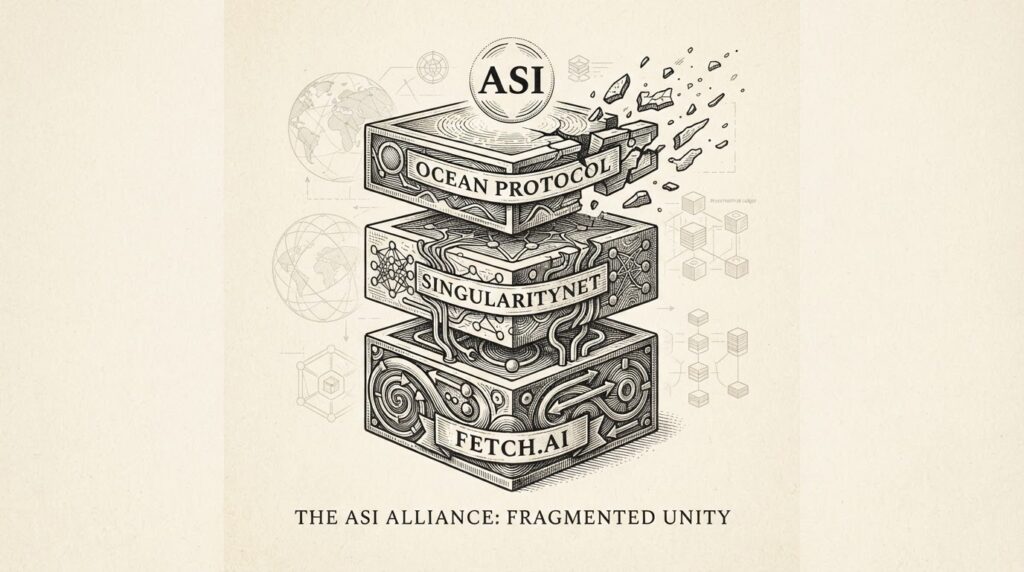
The Artificial Superintelligence (ASI) Alliance is attempting to bind disparate, complex technical stacks into a unified infrastructure for the agentic web through a token-merger model. Formed in June 2024, the alliance brought together Fetch.ai, SingularityNET, and Ocean Protocol under a unified ASI token governance structure. However, the reality of integrating these systems has proven far more friction-heavy than the initial whitepapers suggested, raising fundamental questions about whether token-based coordination can survive the realities of product development.
The alliance’s architecture is ambitious, attempting to stack multiple layers of agentic infrastructure. It includes the uAgents Python framework for event-driven agents, the Agentverse registry, the ASI:Cloud/CUDOS permissionless GPU infrastructure, and SingularityNET’s MeTTaClaw, a compact agentic system built in the MeTTa language. As SingularityNET CEO Ben Goertzel noted on his Substack, there is a strategic intent behind this: “the non-coincidence that the MeTTa programming language is both our AGI language of thought… and the smart-contract language of the ASI:Chain blockchain we’re in the process of rolling out.” Yet, this integration remains a work in progress; the ASI:Chain itself is still in the DevNet stage, introducing substantial execution risk for any production-grade AI workloads attempting to rely on it.
Reconciling fundamentally different technical philosophies—ranging from Python-based agent frameworks to the specialized MeTTa language—has proven difficult. This friction culminated in October 2025 when Ocean Protocol withdrew from the alliance. According to Ocean’s public account, the exit was prompted by pressure from Fetch.ai to convert all $OCEAN treasury tokens into $FET, a move Ocean refused on the grounds that the oceanDAO treasury was an independent third party. Ocean further characterized the alliance’s governance as “administratively heavy, slow, and prioritizing show over practical product development.” While Fetch.ai and SingularityNET have disputed these characterizations, the withdrawal serves as a critical case study in the difficulty of aligning sovereign entities under a single token banner.
Beyond governance, the gap between marketing and technical reality is widening. Fetch.ai has touted figures of 2.7 to 3 million agents, but an independent arXiv audit (2606.20570) conducted in early 2026 paints a more sober picture. By auditing 204 API endpoints on the Agentverse platform, researchers Robin Dey and Panyanon Viradecha identified a “Gap Taxonomy” of 8 categories and 62 missing capabilities, including critical areas like agent memory, observability, and security. The audit found only 36,000+ protocol-active agents in the Almanac, a significant discrepancy from the marketing figures which appear to include simple marketplace registrations. Despite this, adoption metrics show genuine activity: the network processed over 34 million transactions in 2025, with 557.47 million FET staked across 91 active validators and approximately 25,000 delegators.
Institutional interest remains a persistent signal, even as the technical stack matures. The 19th Annual AGI Conference (AGI-26), which concluded in San Francisco on July 30, 2026, featured a heavyweight lineup including Yoshua Bengio, Richard Sutton, and Peter Norvig. While the outcomes and paper awards from the conference are not yet published, the sheer density of academic and industry leadership present suggests that the underlying vision of agentic coordination remains a focal point for the broader AI community. As Fetch.ai founder Humayun Sheikh has stated, “We’re creating the same foundation for agents that Google created for websites. Instead of just finding information, your personal AI coordinates with verified brand agents to get things done.”
The ASI Alliance is testing whether a token-merger governance model can hold a decentralized infrastructure stack together when faced with the realities of divergent development cycles and operational friction. With the ASI:Chain still in DevNet and the departure of a key partner like Ocean Protocol, the alliance faces a difficult path. The project has secured significant backing, such as the $500 million corporate treasury facility announced by Interactive Strength in June 2025, but capital alone cannot solve the integration complexity inherent in merging Python-based frameworks with specialized AGI languages. Success now depends on whether the alliance can move beyond its current state of siloed development to demonstrate a functional, unified protocol that justifies its governance overhead.