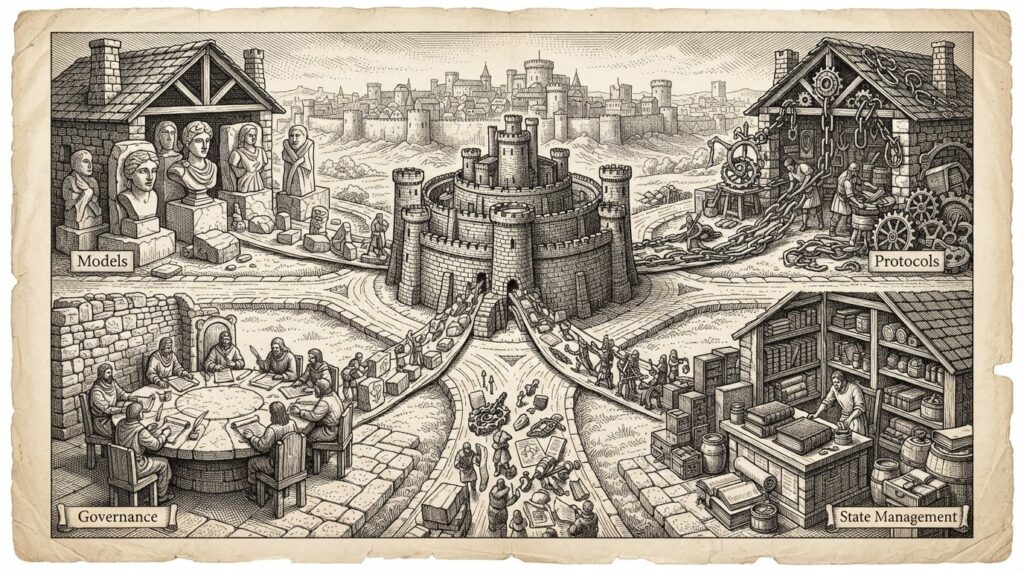
Four open-source layers converged in the same week, and the pattern is hard to miss. The enterprise agent stack is being built on foundations that nobody owns — open models, open protocols, open governance, open state management. And the companies betting billions on the agentic future are treating this as the winning strategy, not a concession.
The Open-Source Offensive, Layer by Layer
Start with the models. Nous Research raised $90 million in a Series B at a $1.5 billion valuation on October 7, led by Robot Ventures with NVIDIA, Microsoft M12, Samsung, Union Square Ventures, Menlo Ventures, and 1789 Capital participating. The company’s open-source Hermes agent has been cloned more than 24 million times, and it now projects $100 million in revenue by year-end, up from $36 million in annualized revenue by mid-September. The capital funds a new enterprise offering, Hermes for Businesses, built on an MIT-licensed ecosystem that supports more than 200 models.
That same day, Atlassian launched the Agentic Multiplayer Protocol at its Team ’26 Europe conference in Amsterdam. AMP treats agents as first-class citizens in the enterprise: each one gets a Non-Human Identity with scoped authority, shared context, and a full audit trail. Atlassian’s MCP Server, meanwhile, has hit nearly 2 million monthly active users and 15 million daily tool calls — a 15x jump in six months. CEO Mike Cannon-Brookes described AMP as “more a diplomatic protocol than a technical protocol, because you have this problem that the way of interacting is a protocol.” It is a framing that sounds abstract until you see what it actually means: agents appear alongside humans in real-time presence bars, with distinct identities that admins can manage and audit, and four explicit interaction modes — human activity, agent activity, agent-on-behalf-of-human, and human-assisted-by-agent.
The governance layer is catching up too. OpenClaw Enterprise launched September 29 as a free, MIT-licensed, vendor-neutral control plane for managing persistent agents in sensitive environments. Originated at OpenAI and donated to the OpenClaw Foundation, with backing from OpenAI, Red Hat, and NVIDIA, it provides multi-tenancy, security boundaries, fine-grained permissions, sandboxing, and lifecycle auditing — the stuff enterprises previously had to build from scratch. OpenAI’s internal “Androidclaw” agent, which investigates broken builds and traces problems to pull requests, is already running on it.
And the protocol layer that connects it all — the Model Context Protocol — has become the de facto standard. Roughly 97 million monthly SDK downloads across Python and TypeScript, near 500 million combined. Ten thousand active public servers. Twenty-eight percent of the Fortune 500 have deployed MCP servers in production. The protocol was donated to the Linux Foundation’s Agentic AI Foundation in December 2025, with Anthropic, OpenAI, and Block as co-founding members and Google, Microsoft, AWS, Cloudflare, and Bloomberg as platinum members. Gartner projects 40 percent of enterprise applications will include AI agents by end of year, up from less than 5 percent.
Orchestration Is the New Moat
Consider what NVIDIA is doing. The company has a $10 billion investment in closed-source Anthropic. It also participated in the Nous Research Series B. It selected Nous as the reference runtime for the Nemotron 3 Ultra 550B at Computex 2026. The compute landlord thesis is playing out in real time: NVIDIA wins regardless of which model ecosystem dominates, provided the compute demand continues to scale. The hardware giant is not picking winners. It is ensuring it remains the foundation either way.
The agent state management layer is fracturing across fourteen-plus vendors with zero shared protocols, as we covered this week. Cloudflare’s Artifacts is building Git-compatible versioned storage specifically for agents. A2A reached v1.0 GA in March with 150-plus supporting organizations and production deployments in Azure AI Foundry, Amazon Bedrock AgentCore, and Salesforce Agentforce. The open-source offensive is not just about models — it is about every layer of the stack.
When the underlying infrastructure is open, the competitive edge moves up the stack. The proprietary advantage is no longer in owning the protocol. It is in how enterprises connect, secure, and run their agents. The runtime safety layer is still fragmented, with five major vendors shipping incompatible mechanisms in two weeks. The testing infrastructure lags deployment — Fortune 500 companies are building critical business logic on MCP without standardized certification. And the Nous Research benchmarks remain vendor-reported, which matters when enterprise buyers need more than marketing numbers.
What This Means for Enterprise Decision-Makers
The data points to a clear direction: open-source foundations are becoming the default infrastructure for enterprise agents. But “open” does not mean “free from lock-in.” When fourteen vendors build incompatible state management systems, when testing infrastructure lags deployment, and when runtime safety remains fragmented, the moat simply shifts from protocol ownership to orchestration quality. The enterprise that figures out how to compose these open layers into reliable, auditable agent workflows will hold the advantage — not because it owns the standard, but because it runs the stack better than competitors.
The Linux playbook says: commoditize the plumbing, compete on the orchestration. The question is not whether open-source will dominate the agent stack. The numbers say it already does. The question is whether the orchestration layer will consolidate around a few players — or whether the current fragmentation becomes the next lock-in problem that enterprises have to solve.