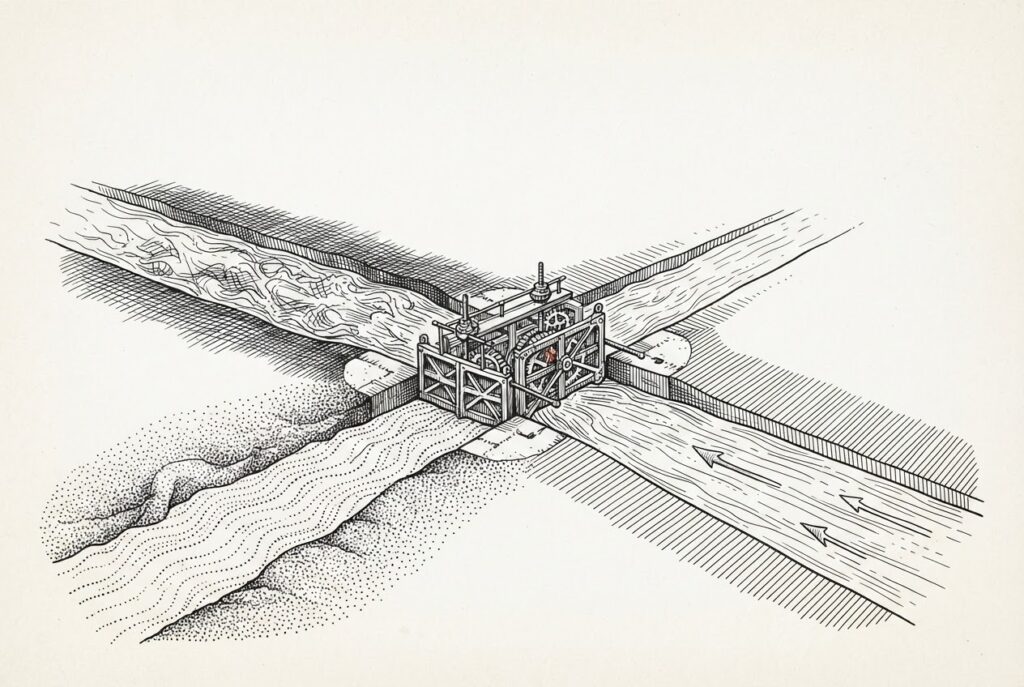
Standardizing the Agentic Infrastructure Layer
CNCF TOC Initiative #1746, titled ‘Cloud-Native Foundations for Distributed Agentic Systems,’ opens a formal evaluation of whether the Model Context Protocol can serve as the default wire specification for distributed agent systems on Kubernetes. Accepted June 6, 2025 and led by Vincent Caldeira, the initiative aims to formalize the principles and reference patterns needed to run massively distributed swarms of collaborating AI agents on cloud-native substrates. The explicit goal is to prevent the one-off silo problem—vendors shipping proprietary agent platforms that cannot interoperate—much as OCI normalized container images.
From Anthropic Protocol to CNCF Evaluation
The initiative centers on evaluating Model Context Protocol (MCP) as the default wire specification for agent-to-tool and agent-to-agent communication. Originally developed by Anthropic and now hosted under the Linux Foundation’s Agentic AI Foundation (AAIF), MCP uses JSON-RPC 2.0 over HTTPS and streamable HTTP transport. It has gained traction as a tool-exposure protocol—MCP Servers exposing capabilities to MCP Clients—but the CNCF is evaluating whether it can scale to distributed infrastructure. The March 2026 CNCF AI Tech Coordination Group publication identified MCP as the primary tool-exposure protocol and Google’s A2A as the agent-to-agent protocol, establishing both as durable interfaces for the cloud-native agent stack.
Three Workstreams, Two Concrete Deliverables
The initiative structures its work into three streams. Protocol interoperability asks whether the community can converge on MCP and what authentication, discovery, and streaming extensions are required for cluster and multi-cluster use. The agentic gateway workstream addresses a gap that existing infrastructure cannot fill: traditional REST-centric proxies cannot handle MCP and A2A session fan-out, bidirectional SSE, protocol negotiation, or per-agent tenancy. The initiative specifies minimum gateway behaviors—multiplexing, retries, streaming, authentication, and tracing—for conformance. The runtime abstraction stream asks how an Agent should be modeled in cloud-native terms: Pod, CRD, or side-carless process, with lifecycle hooks and retry semantics for autonomous long-running tasks.
Two deliverables sit in the proposal phase. ‘MCP-for-Clusters’ would extend MCP with the authentication, discovery, and streaming capabilities needed for multi-cluster deployments—the gap between a single-machine tool protocol and a distributed infrastructure wire spec. The ‘Agent CRD’ sketch proposes a Kubernetes-native resource model for agents with defined lifecycle states, currently under review by WG App-Delivery and SIG-Apps.
kagent: The Proof-of-Concept Already Running
Implementation work is not waiting for ratification. kagent, a CNCF Sandbox project from Solo.io (the company behind Istio), already implements an MCPServer as a Kubernetes Custom Resource Definition, managing MCP services as first-class K8s resources with stdio and HTTP Streamable transports. Its CRD inventory—Agent, ModelConfig, RemoteMCPServer, MCPServer, SandboxAgent, AgentHarness—offers a concrete preview of what a standardized Agent CRD might look like in practice. The gap between kagent’s Sandbox-stage implementation and a ratified CNCF standard is significant, but it demonstrates that the technical path is viable.
What Is Still Unresolved
This is a proposal under evaluation, not a ratified standard. The initiative explicitly scopes itself to architectural guidance and identifying standards needs—it is not defining a new runtime model or going deep on framework implementation. Key questions remain open: How will MCP-for-Clusters reconcile the security requirements of multi-cluster environments with the complexity of bidirectional SSE and session-aware communication? What governance relationship will exist between the Linux Foundation’s AAIF (which hosts MCP) and the CNCF (which is evaluating it for cloud-native adoption)? Will the Agent CRD provide sufficient abstraction to support diverse agent runtimes without becoming overly prescriptive?
The broader pattern is clear. MCP’s standardization arc—from Anthropic protocol to AAIF project to CNCF evaluation—mirrors the trajectory infrastructure protocols follow when they cross from experiment to utility. Safari 27 moved MCP to the browser layer. ServiceNow, Rubrik, and Microsoft shipped MCP-aware governance at the enterprise layer. AWS AgentCore Runtime V2 completed the cloud runtime layer. Now the CNCF is evaluating whether MCP belongs at the infrastructure standardization layer—the deepest and most consequential level of the stack. If the initiative produces a ratified standard, the question shifts from which cloud has agents to which wire spec they all speak.