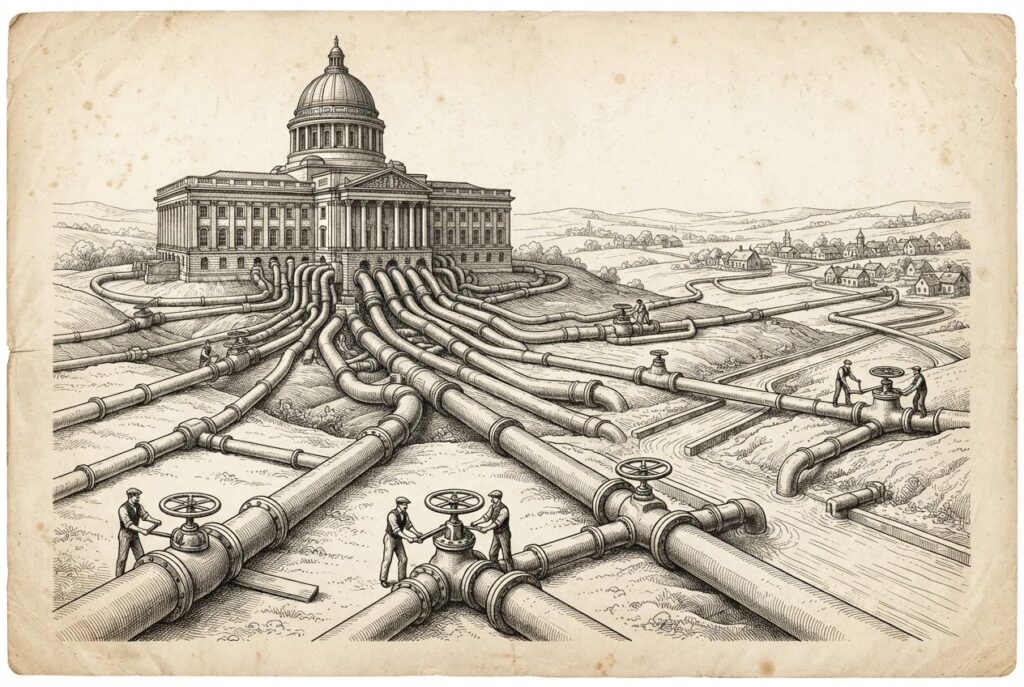
While Washington debates the legislative mechanics of the GENIUS Act, the actual plumbing of global finance is being ripped out and replaced in real-time. The failure of the CLARITY Act in a 50-49 vote on September 15, 2026, is less a story of congressional gridlock than a footnote to a larger shift: stablecoin settlement rails are expanding aggressively into the markets that need them most, bypassing the traditional correspondent banking system entirely.
The current global payment system is a legacy architecture built for a different era. To send money from one African nation to another, funds often take a scenic route through correspondent banks in Europe or the US, incurring roughly $5 billion in annual fees. It is a slow, expensive, and inefficient way to move capital. In contrast, the industry has adopted a streamlined approach: fiat in, USDC across, fiat out. To the sender and receiver, the blockchain is invisible. To the balance sheet, it is a revolution.
The momentum is undeniable. B2B stablecoin payments have exploded from less than $100 million per month in early 2023 to over $6 billion per month by mid-2025. That is a 60-fold increase in just 30 months. This growth is not happening in the speculative corners of crypto-Twitter; it is happening in the trenches of emerging markets, where roughly 66% of the global stablecoin supply is now held. Argentina alone processed approximately $34 billion in stablecoin transactions in 2024, with 67% of that volume dedicated to cross-border movement.
Circle’s strategy is a masterclass in infrastructure acquisition. By partnering with Onafriq, they have gained access to 1 billion mobile money wallets and 500 million bank accounts across 40 African markets, slashing rollout times from six months to a mere four to six weeks. As Rajat Mishra, Onafriq’s Network Product CPO, noted, regulated stablecoins provide a practical, fast, and flexible way to handle cross-border settlement. This is complemented by their recent $400 million acquisition of Tazapay, which brings local payout rails in over 100 markets into the fold, and their collaboration with Thunes, which has effectively eliminated the 3-5 day pre-funding and nostro float requirements for corridors like Ghana and the Philippines.
This shift is occurring against a backdrop of tightening monetary policy. The FOMC’s September 16 decision to hike rates by 25 basis points to a 3.75%-4.00% range—the first hike since July 2023—has made stablecoin reserve yields increasingly attractive. However, it also raises the opportunity cost of holding non-yielding assets, forcing firms to be more surgical with their liquidity. This environment creates a natural tailwind for USDC, which saw its annual transaction volume hit $18.3 trillion in 2025, officially overtaking USDT.
The private sector is moving faster than the regulators, even as the Office of the Comptroller of the Currency works toward a final rule on the GENIUS Act by November 2026. While the market watches for the impact of the Circle Arc validator set or the potential competitive pressure from Ripple’s RLUSD, the underlying reality is that the geopolitical framing provided by Carolyn Wilkins (external member, Bank of England Financial Policy Committee)—who has argued that stablecoins could challenge the dominance of traditional FX reserves—is becoming a technical reality. Industry estimates suggest that with the US Treasury projecting a $3 trillion stablecoin market by 2030, the current infrastructure build-out is merely the foundation.
Of course, this rapid expansion is not without its friction. Regulatory uncertainty remains a persistent shadow, and the failure of the CLARITY Act serves as a reminder that the political path is rarely linear. Yet, the demand for efficient cross-border rails in emerging markets is a force of nature that policy debates struggle to contain. When a business in Mexico sees a 450% year-over-year growth in USDC volume, as reported by BBVA, they are not waiting for a legislative green light. They are simply choosing the rail that works.
The direct-settlement model is proving that removing the middleman does more than save money; it fundamentally unlocks capital velocity. As Circle integrates its new acquisitions and expands its global network, the industry focus has shifted from theoretical debates about stablecoin utility to the practical reality of transaction speed. The plumbing is being replaced, and for the first time in decades, the most efficient path for global capital is no longer through traditional correspondent banks, but through the digital rails finally reaching the countries that need them most.