The Sovereign Alternative
When the Globe and Mail reported September 11 that Cohere is in advanced talks to raise between $2 billion and $3 billion at a $20 billion valuation, the headline numbers were striking enough: a nearly threefold jump from the company’s $7 billion valuation just twelve months prior, and the largest funding round on record for a private Canadian startup if it closes. But the number itself is not the story. The story is who is writing the check, and what that says about where AI capital is flowing when it leaves the United States.
The Canadian government is participating directly. Ottawa committed up to CA$240 million through its Sovereign AI Compute Strategy in December 2024 – the first investment through the $2 billion program designed to build domestic compute capacity. Cohere confirmed strong inbound interest as part of its Series E process but declined to comment on specifics. The deal is not finalized; terms could shift.
Three Labs, Three Exit Strategies
Cohere’s raise must be read against the broader capital landscape. OpenAI closed $122 billion at an $852 billion valuation in March 2026, building itself into a compute infrastructure utility. Anthropic is targeting a $100 billion IPO at a $2 trillion valuation, with Nvidia in talks for a $10 billion anchor investment. We tracked this divergence in three labs, three exit strategies – the AI IPO wave is not one story.
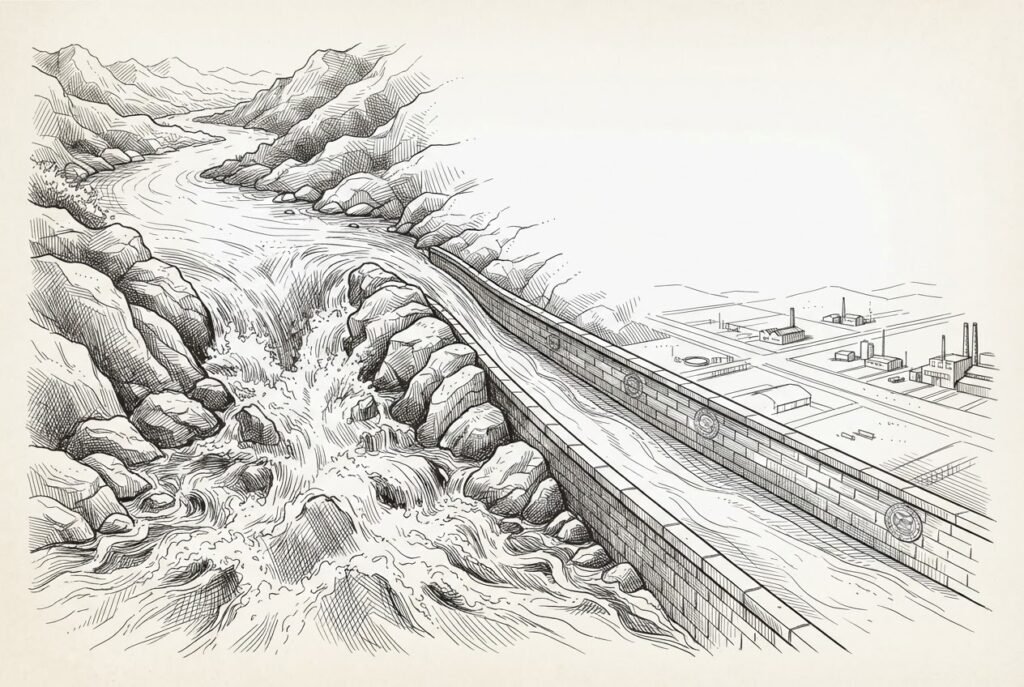
Cohere is the third path. Not the capital-intensive, consumer-facing infrastructure play of OpenAI. Not the clean-balance-sheet, public-market exit of Anthropic. Instead, a sovereign industrial policy model: state-backed capital, enterprise-private deployments, and a Canada-Germany axis as geopolitical moat.
The Canada-Germany Axis
The April 2026 merger with Aleph Alpha – structured as roughly 90% Cohere, 10% Aleph Alpha – was not a typical tech acquisition. It was a diplomatic arrangement. The Canada-Germany Sovereign Technology Alliance, signed earlier in 2026, provided the framework. German Digital Minister Karsten Wildberger attended the Berlin announcement alongside Canada’s Minister of AI Evan Solomon. The Schwarz Group committed $600 million as Series E lead, providing access to its STACKIT sovereign cloud and an €11 billion data center investment near Berlin.
Cohere reportedly rejected offers to reincorporate in the United States. The decision to remain Canadian-incorporated, with dual headquarters in Toronto and Berlin, trades the potential for a Silicon Valley-scale exit for the stability of state-backed support and a clear mandate to serve regulated sectors.
The Financial Profile
The numbers tell a different story than the US frontier labs. Cohere reported $240 million in annual recurring revenue as of February 2026, surpassing its 2025 target of $200 million by 20%. Gross margins sit around 70%. But the structurally significant figure is that 85% of revenue comes from private deployments – not public cloud API access, but on-premise and private-cloud installations for enterprise and government clients including Oracle, Fujitsu, RBC, LG, Notion, SAP, Dell, and McKinsey.
This is a fundamentally different business than selling tokens through a public API. Private deployments require bespoke integration, ongoing support contracts, and localized infrastructure. The labor intensity is higher. The margins are tighter than standardized SaaS. But the switching costs are also higher, and the client relationships are stickier.
What the Clean Story Obscures
The sovereign AI thesis is compelling, but it rests on a premise that deserves scrutiny: that governments and enterprises will pay a sustained premium for data sovereignty when cheaper, more capable alternatives exist on public infrastructure. The part that gets hidden is who absorbs the risk if sovereign demand proves shallower than McKinsey’s projected $600 billion market.
Cohere’s $240 million ARR, while growing, implies a revenue multiple of roughly 83x at the reported $20 billion valuation. OpenAI’s $25 billion run rate at $852 billion is a 34x multiple. The market is pricing Cohere’s sovereign premium at more than twice OpenAI’s – a bet that state-backed enterprise demand can sustain a growth trajectory independent of the consumer and developer markets that drive US frontier lab economics.
Whether that bet pays off depends on execution under constraints that US competitors do not face: bilateral regulatory alignment between Canada and Germany, sustained government procurement commitments, and the operational complexity of maintaining private deployments across two continents. If the demand for sovereign control is deep enough, Cohere has a structural moat. If it is not, the company is building expensive infrastructure for a market that may not materialize at the scale the valuation requires.
What to Watch
The composition of the final investor syndicate will reveal how much of this round is driven by market conviction versus strategic state interest. Further Canadian or German government participation beyond the initial CA$240 million commitment would signal deeper industrial policy integration. The timing – the deal could close as soon as next week per the Globe and Mail – and the split between cash and compute commitments will determine whether this is a capital raise or a sovereignty pact dressed as one.