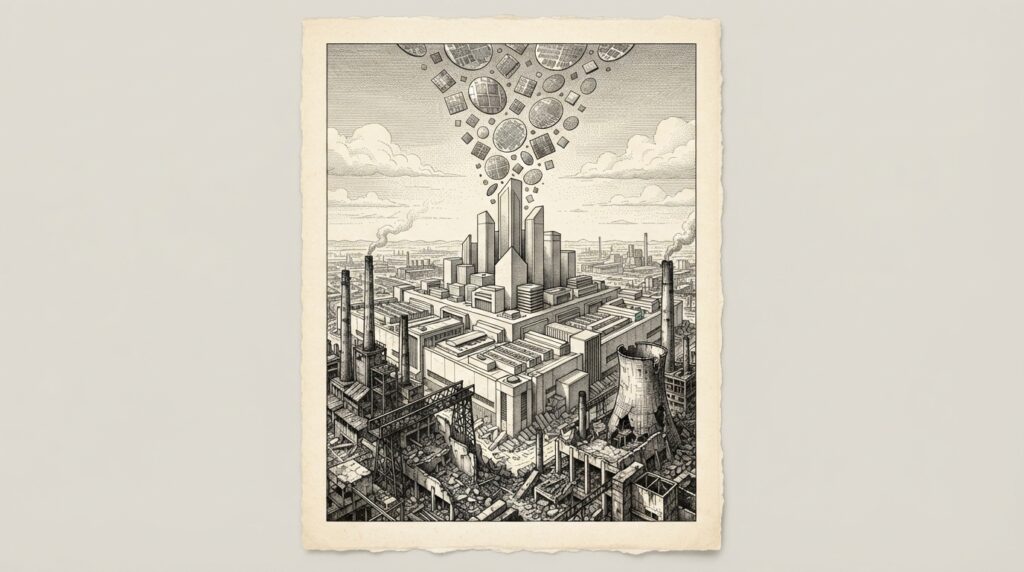
On August 5-6, 2026, the joint venture between SpaceX, Tesla, and Intel was formalized in Grimes County, Texas, following the signing of a JETI tax abatement agreement and a $10 million non-refundable payment. The project, centered at the former Gibbons Creek coal-fired power plant site, marks a definitive step toward the construction of what Elon Musk has described as “the largest and most valuable building on Earth,” according to Reuters.
The scale of the ambition is reflected in the numbers: a 100-million-square-foot facility designed for vertically integrated semiconductor fabrication, encompassing logic, memory, packaging, and testing under one roof. While Governor Abbott and Musk have announced an initial $16.8 billion investment, the total potential across multiple phases reaches $119 billion. However, the part that gets hidden is the distinction between ambition and obligation. SpaceX’s May 2026 IPO filing explicitly characterized Terafab as a “general framework” with no binding commitments. The $16.8 billion figure is an announced target, not a contractually locked expenditure.
This move represents a fundamental shift in the compute landlord thesis. We have previously traced these capital flows through the Volta Infra initiative, the SpaceX 10 GW project, the Nvidia $600 billion exposure, and the $71 billion Anthropic SPV. Terafab now emerges as the fifth pillar: manufacturing vertical integration. SpaceX is moving beyond the role of a tenant renting Nvidia GPUs. By building its own fab for custom AI chips, the company is attempting to secure the hardware supply chain for Tesla Optimus robots, Cybercabs, and the Starmind orbital compute network.
The connection to the recent 10 GW Nvidia hardware commitment is too clean to ignore. While the 10 GW story focused on immediate, massive-scale hardware acquisition, Terafab is a longer-term bet on domestic AI chip sovereignty. This aligns with the broader CHIPS Act context, aiming to insulate domestic AI infrastructure from global supply chain volatility. Yet, the role of Intel remains qualified; the manufacturing partner has not disclosed the specific nature or scale of its contribution to the project.
What this actually means for the local landscape is a significant industrial footprint. The project promises over 3,000 construction jobs and 1,800 permanent positions. The decision to utilize the Gibbons Creek Reservoir for water supply addresses a primary constraint for semiconductor manufacturing, though the vote to approve the tax abatement passed 4-1 despite local opposition regarding resource strain and community disruption. The state has further incentivized the project with a $30 million Texas Enterprise Fund grant.
The question is whether a vertically integrated SpaceX/Tesla/Intel fab can realistically compete with the foundry lock held by TSMC on the most advanced nodes. Tesla is currently dual-sourcing its AI5 chip from Samsung’s Taylor, Texas facility and TSMC, with Samsung volume production slated for the second half of 2027. Terafab is not a solution for today’s supply constraints; it is a multi-year attempt to bypass the existing foundry hierarchy entirely.
The $119 billion potential investment signals that Musk is prepared to absorb the risk of building a proprietary silicon pipeline. The question remains: can a company accustomed to the rapid iteration cycles of aerospace and automotive manufacturing successfully navigate the rigid, high-stakes precision of advanced semiconductor fabrication at this scale? The facility is designed to output over 1 terawatt of AI compute capacity per year, or 100 to 200 billion custom chips, according to the Reuters report and SpaceX IPO filings. Whether this capacity becomes a reality or remains a “general framework” will depend on the execution of a manufacturing process that has historically been the most difficult barrier to entry in the global economy.