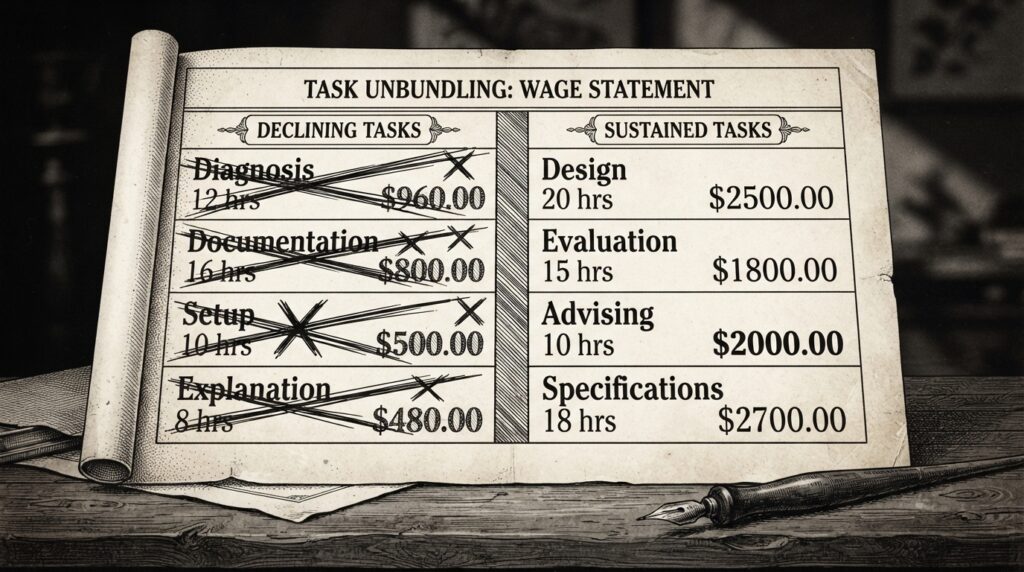
The economic value of work is being unbundled in real-time, driven by the specific tasks AI can perform rather than the job titles we assign to them. A new study from the ADP Research Institute and Stanford Digital Economy Lab provides the first empirical look at this shift, moving beyond surveys to analyze payroll data from 26 million workers.
By applying hedonic wage regression to a balanced sample of 25,000 firms and 4.6 million matched workers, the researchers mapped O*NET task definitions directly onto actual payroll outcomes to measure how AI is systematically devaluing specific components of daily work. This is not a projection or a survey. It is payroll data — the most grounded signal we have of what employers actually value.
The data reveals a clear divide. A cluster of tasks — including system diagnosis, model development, documentation, system setup, and technical explanation — is seeing a decline in economic value. These are the execution-layer tasks that AI handles with increasing efficiency. Employers are paying less for the work that machines can now do adequately.
Conversely, a higher-value cluster is emerging. Tasks centered on design and evaluation, advising on technology use, directing technical activities, and developing specifications are retaining or gaining value. These are the judgment-heavy, strategic functions that AI cannot yet replicate reliably. For enterprise leaders, the implication is direct: investment should flow toward roles that emphasize these higher-order capabilities rather than the execution-heavy tasks that automation is commoditizing.
The most immediate impact of this shift is falling on early-career workers. The Canaries Dashboard, an ongoing collaboration between the two institutions updated through July 22, 2026, shows that early-career workers aged 22 to 25 in highly exposed occupations are seeing employment decline by approximately 3.8% per year. Software developers and customer service representatives are particularly affected, as the entry-level, execution-heavy rungs of these career ladders are being hollowed out. The training ground is disappearing.
This task-level unbundling provides critical context for enterprise AI deployment patterns. While Gartner research reports that 80% of AI projects are embedded but only 31% are fully shipped, the pace of organizational restructuring remains high. Companies are not waiting for perfect AI outcomes to reorganize their teams. They are restructuring around the changing value of tasks today — which explains why deployment accelerates even when outcomes disappoint.
It also explains why execution failures dominate. ChatSee.ai research analyzing 10,000+ enterprise AI failure events found that hallucinations now account for less than 10% of failures, while execution and action-related failures rose 62%. The tasks employers are devaluing — diagnosis, setup, documentation, resolution — are precisely the tasks where agents are failing. Enterprises are hollowing out the human layer that manages execution, then discovering that AI cannot yet fill the gap autonomously.
There is a significant caveat. The ADPRI research identifies correlations within the labor market, not definitive causation. The Canaries Dashboard data shows that automation-heavy occupations see employment declines or muted growth, while augmentation-heavy occupations show no clear employment relationship. But the direction of causation — whether task devaluation drives employment decline, or whether AI capability drives both — remains an open question. The researchers are careful to note that their balanced sample of ADP firms is not nationally representative.
As BCG research suggests that 50-55% of US jobs will be reshaped by AI within the next few years, the ADPRI and Stanford findings offer a necessary framework. The question is no longer whether AI will change a job. It is which specific tasks within that job will remain worth paying for — and whether enterprises are prepared to invest in the strategic layer that survives.
Related: Enterprise AI Failure Modes Have Shifted (Post 128488) | The Deployment Gap (Post 128408) | The Attribution Gap (Post 128176)