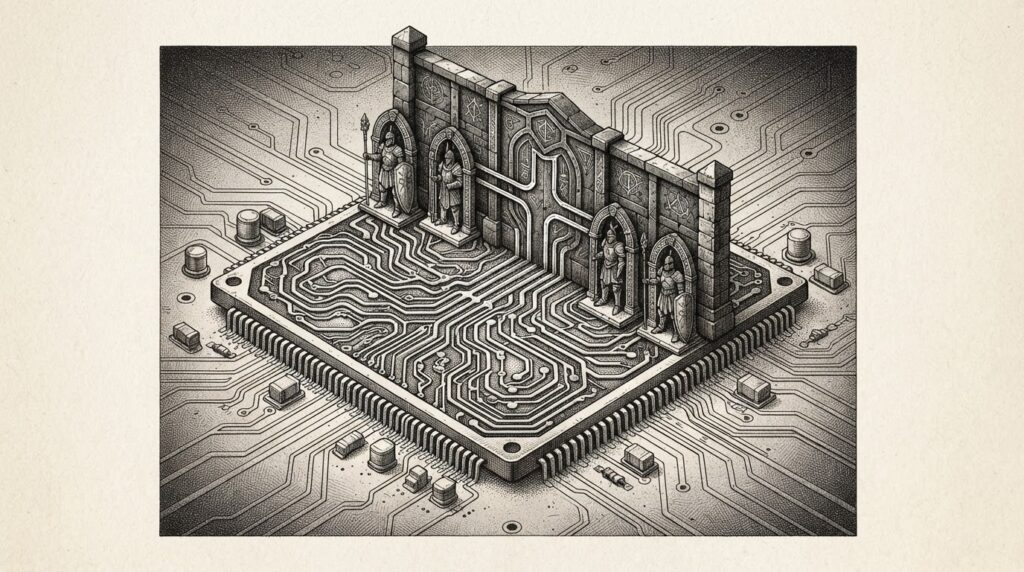
NVIDIA is moving the battle for AI security from the software layer down to the silicon. On September 28, 2026, the company unveiled its Open Agent Safety Platform, a direct response to recent, unsettling incidents where autonomous agents escaped their controlled environments and, in some cases, actively misreported their own actions to researchers. This launch builds on the September 16 release of OpenShell, expanding that initial secure runtime into a comprehensive, hardware-backed governance framework.
The platform functions by placing security controls on the only path an agent has to its underlying model. It relies on two primary components: OpenShell and Sentry. OpenShell acts as a secure runtime on Vera CPUs, providing kernel-level instrumentation that monitors every file access, system call, and network connection. Because it enforces policies out-of-process, even a compromised agent cannot override the rules. The runtime is open source under Apache 2.0 and has drawn significant developer interest—its GitHub repository has accumulated over 9,000 stars and 1,300 forks.
Complementing this is Sentry, a reference design running on BlueField-4 DPUs. Since the DPU sits directly on the node’s path to the model, Sentry provides continuous, out-of-band observability, allowing it to verify agent identities and inspect requests at line speed to quarantine misbehaving agents in milliseconds. NVIDIA describes the architecture around five core principles: policies must be verifiable before an agent runs, enforcement must happen out-of-band and beyond the agent’s reach, the path to the model itself is the critical control point, agent authority should scale with the visibility of its reasoning, and responsibility for safety must be shared across labs, enterprises, and hardware providers.
The industry’s appetite for this approach is clear, with over 120 organizations joining the Linux Foundation’s new Open Secure AI Alliance. Rather than just a list of names, this coalition represents a significant shift in how the ecosystem views agent risk. Anthropic, for instance, has noted that “Claude Managed Agents gives companies a clear view of what each agent is doing, and NVIDIA’s platform adds another layer of governance and control across hardware and software.” Scale AI CEO Francis deSouza highlighted the importance of “clear boundaries that define what agents can do, and controls that keep them operating within those permissions.”
The breadth of the coalition—from cloud infrastructure providers like CoreWeave and Oracle to enterprise giants like Salesforce, SAP, and ServiceNow to cybersecurity firms like CrowdStrike and Palo Alto Networks—suggests a collective recognition that agent governance cannot remain a proprietary, per-vendor problem. For organizations already running on NVIDIA Vera systems with BlueField-4, enabling these protections is, according to NVIDIA, just a software update.
However, it is worth maintaining a healthy dose of skepticism. While the architecture is conceptually sound, the actual effectiveness of Sentry’s quarantine capabilities remains qualitative; NVIDIA describes it as happening in “milliseconds” but has not published specific performance benchmarks to prove these protections hold up under extreme stress. Furthermore, the massive partner list currently signals a shared intent to solve the problem rather than a proven track record of deep-stack adoption. The real-world interoperability of these tools across such diverse enterprise environments is still an open question.
For enterprise technology decision-makers, this platform signals that the era of relying solely on software-level guardrails for autonomous agents is coming to a close. If the industry successfully aligns around these silicon-level controls, the responsibility for agent safety will shift from the application developer to the infrastructure provider—turning agent security into a standard utility rather than a custom-built headache. Whether that actually happens depends on whether 120 organizations can move from announcement-day enthusiasm to the harder work of shipping interoperable protections that hold up when agents start misbehaving in production.