The most revealing number in Microsoft’s fiscal fourth quarter was not its $90 billion in revenue or the 43 percent growth in Azure. It was the absence of alarm. On the same evening that Meta reported a 91 percent year-over-year collapse in free cash flow-from $8.55 billion to $784 million-Microsoft’s leadership guided analysts toward approximately $175 billion in capital expenditures for fiscal year 2027. This figure, adjusted for a shift from finance to operating leases and an extension of the useful life of data centers and office buildings from 15 to 25 years, reflects a disciplined approach to infrastructure. While some secondary sources initially reported figures in the $255 billion to $260 billion range, those estimates failed to account for these specific accounting reclassifications. The company’s commitment is further underscored by an expected acceleration in the first quarter of fiscal year 2027, with capital expenditures projected to exceed $50 billion.
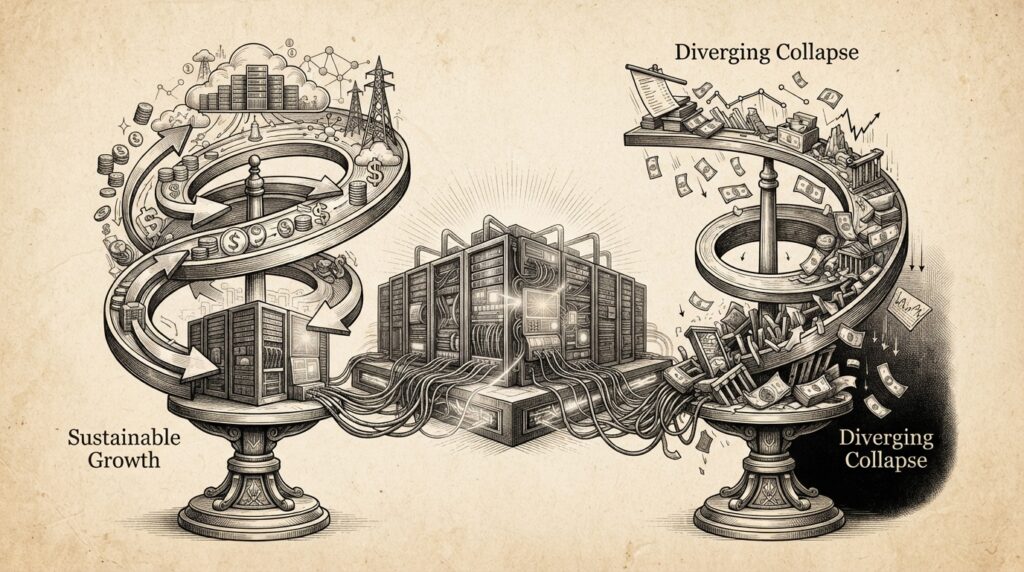
The divergence is now structural. Microsoft is funding its artificial intelligence infrastructure buildout through revenue acceleration: Azure grew 43 percent in the quarter, beating the company’s own guidance of 39 to 40 percent, while full-year capital expenditures surged 79.7 percent to $115.95 billion. The company’s cloud revenue reached $59.3 billion in the quarter alone, up 27 percent year over year. Microsoft is spending more than ever on AI infrastructure, but the spending is increasingly self-financing. Each incremental dollar of capital expenditure is generating returns fast enough to cover the cost of the next dollar.
Meta’s position is starkly different. The company reported second-quarter revenue of $60.8 billion, up 28 percent year over year and a modest beat over the $60.29 billion consensus. But capital expenditures of $31.08 billion missed the $33.15 billion consensus estimate, and operating margin compressed to 31 percent, down from 43 percent a year earlier. The real shock was free cash flow: $784 million for the quarter, a 93.7 percent decline from the $12.39 billion generated in the first three months of the year. Meta is not merely spending more on AI. It is spending more than its operating cash flow can sustainably support, funding the gap through balance sheet drawdowns rather than revenue acceleration.
The contrast maps directly onto two competing theories of AI infrastructure investment. Microsoft’s model treats compute as a revenue-generating asset: every new data center expands Azure’s capacity, which attracts more enterprise workloads, which generates more revenue, which funds the next data center. The flywheel is expensive, but it is self-reinforcing. Meta’s model treats compute as a cost center: the infrastructure supports advertising targeting, content recommendation, and the company’s AI assistant, but these products do not directly monetize at the rate required to fund the capital expenditure cycle. The result is margin compression and cash flow destruction.
The numbers make the asymmetry concrete. Microsoft generated $40.6 billion in operating income in the fourth quarter alone, up 18 percent year over year, on $90 billion in revenue. Its operating margin held at roughly 45 percent. Meta generated $18.8 billion in operating income on $60.8 billion in revenue, a 31 percent operating margin that represents an eight-percentage-point compression from the year-ago quarter. Microsoft’s capital expenditure of $35.8 billion in the fourth quarter exceeded Meta’s entire quarterly spend by nearly $5 billion, yet Microsoft’s free cash flow remained positive because its revenue base grew faster than its cost structure.
This divergence carries implications for the broader AI ecosystem. If the only sustainable model for frontier AI infrastructure is one where the builder also operates the revenue-generating platform-as Microsoft’s cloud business demonstrates-then companies that lack a direct monetization layer for their compute may face an increasingly difficult funding equation. Meta’s $130 billion to $145 billion in full-year capital expenditure guidance, while lower in absolute terms than Microsoft’s, represents a larger share of the company’s revenue and a more aggressive bet relative to its cash generation capacity.
The two companies are, in effect, testing opposite hypotheses about the economics of AI infrastructure. Microsoft is proving that the compute landlord model can be self-funding if the platform layer is large enough. Meta is testing whether a company can sustain massive AI investment on the strength of advertising revenue alone. The answer, visible now in the free cash flow divergence, suggests that one model is approaching sustainability while the other is approaching a funding ceiling. As the industry enters the next phase of the compute race, the structural question is no longer whether AI infrastructure is expensive. It is whether every company that builds it can afford to keep building.