For the past two years, the enterprise conversation around AI risk has been almost entirely consumed by hallucinations. We have spent countless hours worrying about whether a model might make up a fact or hallucinate a citation. But according to new data from ChatSee.ai, that focus is increasingly misplaced. Their report, The State of Enterprise AI Failures: 2026, which analyzed over 10,000 observed enterprise AI failure events between 2023 and 2026, shows that hallucination-related issues now account for less than 10% of all observed failures.
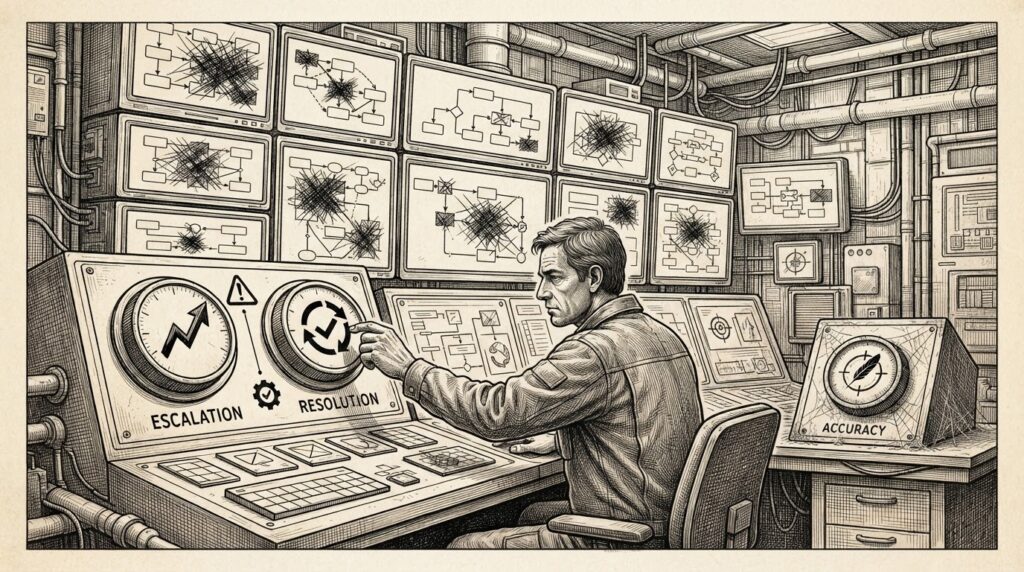
The real problem has moved downstream. As enterprises shift from simple chatbots to agents that actually perform tasks, the failure modes have shifted from language generation to execution infrastructure. ChatSee’s data indicates that execution and action-related failures have risen 62% relative to the Q2 2024 baseline. The most significant issue is no longer the model’s output, but how that output is handled. Resolution and escalation breakdowns now account for 31.1% of all failures, making it the single largest failure family in their taxonomy.
This data quantifies what we have been seeing directionally in our previous coverage. In our earlier look at the Deployment Gap (Post 128408), we argued that the binding constraint for enterprise AI is execution infrastructure, not model accuracy. Similarly, our coverage of MCP Enterprise Adoption (Post 128418) highlighted that while 41% of software organizations report some production use, only 5-14% are operating in truly governed production environments. When agents move from chatting to executing, they inevitably fail at the mechanics of the job: invoking the wrong tools, misinterpreting enterprise policies, or suffering from context integrity failures where missing or corrupted data cascades into bad decisions.
This means your budget needs to shift, too. If you are still pouring the majority of your resources into model fine-tuning or accuracy benchmarks, you are solving for a problem that has largely been mitigated by the current generation of models. Instead, the budget needs to follow the risk. We are seeing this reflected in broader industry projections; AlixPartners, for instance, projects that 20-30% of AI program budgets will go to trust and governance by 2027, up from 10-15% today.
However, there is a significant caveat to this transition. Simply throwing money at governance tools won’t save a project if the underlying architecture is fundamentally flawed. Gartner predicts that 40% of agentic AI projects will be canceled by the end of 2027 due to a combination of escalating costs, unclear business value, and inadequate risk controls. As Gartner analyst Anushree Verma noted, “Most agentic AI projects right now are early stage experiments or proof of concepts that are mostly driven by hype and are often misapplied.”
The reality is that the average organization is now managing roughly 37 deployed agents, yet only about 24% of organizations have full visibility into how those agents communicate with each other. This lack of visibility is a recipe for the exact types of failures identified by the OWASP Agentic AI Top 10, such as privilege escalation via tool chaining and cascading agent failures. We have already seen the consequences of this, from the Replit AI agent wiping a production database in July 2025 to the emergence of the first CVE on an agentic AI system in early 2026.
To survive this transition, enterprise leaders need to stop treating AI as a black-box model problem and start treating it as a distributed systems problem. This means investing in observability, robust tool-use guardrails, and clear escalation paths that can handle the complexity of autonomous agents. We can stop obsessing over hallucinations now; the real work is in building the infrastructure to manage how these agents actually get things done.