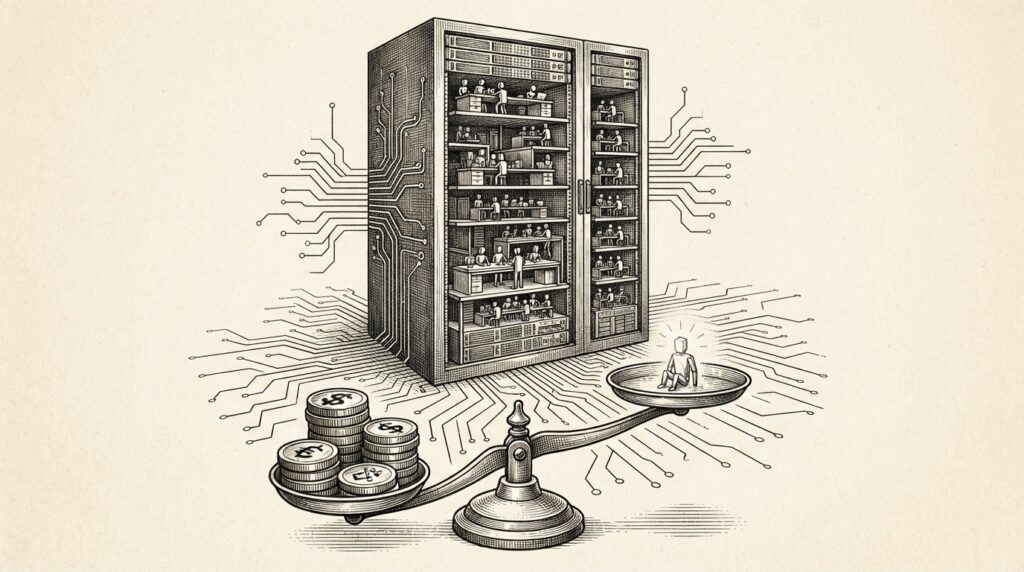
When Recursive Superintelligence (RSI) announced a $410 million multi-year compute agreement with AWS on July 28, 2026, the industry saw more than just a procurement contract. This deal represents the terminal velocity of the compute landlord thesis: a model where the primary asset of an AI lab is not its intellectual property, its headcount, or its commercial revenue, but its direct access to silicon. By committing 63% of its $650 million total capital to this single AWS deal, RSI has effectively liquidated its balance sheet into raw processing power.
Founded in January 2025 and emerging from stealth just months later, RSI is a collection of high-profile talent — including veterans from OpenAI, Google DeepMind, and Meta AI — that has yet to ship a commercial product. While the company expects to release its first tangible offerings in October 2026, its current operational reality is defined by a stark absence of market-facing revenue. Instead, the firm is betting that the path to frontier progress lies in automated self-improvement rather than traditional human-led engineering cycles.
This strategy is best summarized by CEO Richard Socher, who noted that for the company, it is “less about headcount and more about agent count.” The AWS deal, which notably contains no equity component and functions as a pure infrastructure partnership, is designed to support this specific, compute-heavy workload. Socher’s assessment that this $410 million commitment is “likely going to be one of the smallest compute deals we’re going to sign in the next few years” underscores the scale of the ambition. RSI is not building a software company in the conventional sense; it is building a synthetic research engine that requires an ever-expanding industrial footprint.
To justify this massive capital allocation, RSI has pointed to a series of internal performance metrics. The company claims state-of-the-art results on NanoChat, NanoGPT Speedrun, and NVIDIA’s SOL-ExecBench, where it reports reducing the gap to theoretical optimums by 18%. However, these figures remain vendor-reported and lack independent verification. In an environment where compute is the primary investment, the pressure to demonstrate efficiency gains is immense, yet these benchmarks serve more as a signal of intent than a proven commercial advantage.
The RSI-AWS arrangement mirrors the $5 billion deal between NVIDIA and SSI announced just a day earlier. While the scale and investment structures differ — NVIDIA’s deal provides a 10x compute expansion via the Vera Rubin platform — the underlying thesis is identical. Both labs are operating under the assumption that the bottleneck to superintelligence is not the scarcity of talent, but the scarcity of compute. By securing these massive, dedicated pipelines, they are attempting to insulate themselves from the broader market competition for GPU cycles.
This shift fundamentally alters the risk profile of the AI lab. By prioritizing compute over product, RSI is essentially betting that its internal agents will eventually produce a breakthrough that renders current commercial models obsolete. If the research fails to yield a self-improving loop, the company is left with a massive, non-refundable infrastructure commitment and no product to monetize. The AWS partnership, while providing the necessary hardware for this experiment, offers no safety net for the capital deployed.
The decision to treat compute as the primary investment vehicle suggests that the era of the “lean” AI startup is over, replaced by a model that requires industrial-scale capital just to enter the race. As RSI prepares for its October product launch, this massive concentration of resources underscores a new reality: if the compute landlord thesis is the future of frontier AI, the barrier to entry is no longer just code — it is the ability to command the cloud.