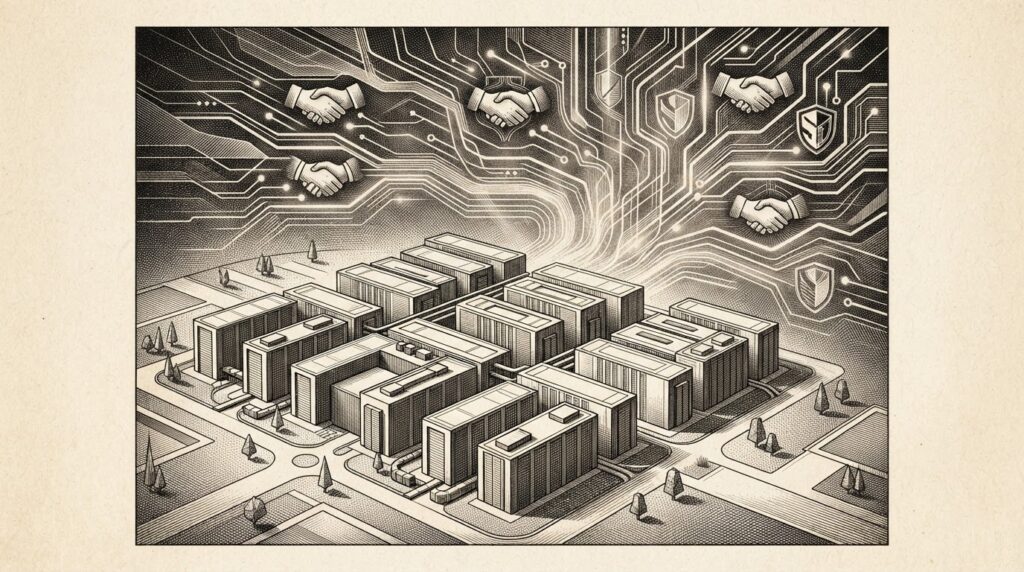
The AIP consortium’s acquisition of Aligned Data Centers signals the end of data center expansion as a standard corporate capital expenditure on tech balance sheets. Compute infrastructure is now being institutionalized as a standalone, sovereign-backed asset class, engineered to absorb the multi-decade capital requirements of the AI transition.
On July 21, 2026, the AIP consortium finalized its 100% equity acquisition of Aligned Data Centers from Macquarie, representing a $40B enterprise value. The deal, originally announced on October 15, 2025, includes an additional $5B in committed growth capital. Under the new ownership, CEO Andrew Schaap will continue to lead the company, maintaining operational independence across its 51 campuses and 6.4 GW of operational and planned capacity spanning the U.S., Mexico, and South America.
The architecture of the AIP consortium – formerly known as GAIIP and rebranded in March 2025 – is the most significant indicator of this shift. Chaired by BlackRock CEO Larry Fink, the group integrates a diverse coalition of hyperscalers, chip manufacturers, and sovereign wealth funds. The membership includes Microsoft, NVIDIA, xAI, the Kuwait Investment Authority, Temasek, and MGX (Abu Dhabi), supported by energy partners GE Vernova and NextEra Energy, and tech partner Cisco.
By pooling sovereign capital with the strategic interests of NVIDIA and Microsoft, the consortium creates a vehicle capable of deploying a $30B equity target and up to $100B in total investment. This structure bridges the gap between the long-term, massive capital needs of infrastructure and the short-term volatility of corporate earnings. It is not merely a real estate play; it is a strategic integration of the entire compute stack, from energy generation to silicon deployment.
The necessity for this model is underscored by the ongoing compute squeeze. With TSMC reporting revenue guidance increases above 40% year-over-year and frontier labs like OpenAI raising their 2030 capex projections to $750B, the demand for physical capacity has outpaced traditional financing methods. Previous moves, such as the AMD-Anthropic $5B equity deal, signaled that chip manufacturers were becoming active participants in the lab ecosystem. The AIP-Aligned deal takes this logic to the physical layer, ensuring that the hardware and the power required to run it are secured well in advance.
With this investment in Aligned Data Centers, we further our goal of delivering the infrastructure necessary to power the future of AI, while offering our clients attractive opportunities to participate in its growth. – Larry Fink, AIP Chair
Moving infrastructure off the balance sheets of individual corporations and into a consortium-owned vehicle effectively socializes the risk of massive infrastructure build-outs while centralizing control over the supply chain. This creates a clear divide: those with access to the consortium’s capital and energy partnerships will be able to scale, while smaller players may find themselves increasingly squeezed out of the market for prime, power-ready sites.
However, the consortium faces significant headwinds. The July 14, 2026, New York statewide moratorium on hyperscale data centers – a one-year permitting pause for facilities over 50MW – highlights the growing friction between AI infrastructure and local regulatory environments. As AIP looks to deploy the remainder of its $100B target, it will need to navigate an increasingly complex landscape of energy constraints and public policy pushback.
The critical test for AIP is whether it can navigate the intensifying conflict between its global scale and the localized, often restrictive, regulatory environments of the regions where it operates. Observers should watch for the emergence of competing consortia attempting to replicate this model, as the industry grapples with the reality that sovereign-backed compute infrastructure is fundamentally changing the power dynamics of the digital economy.