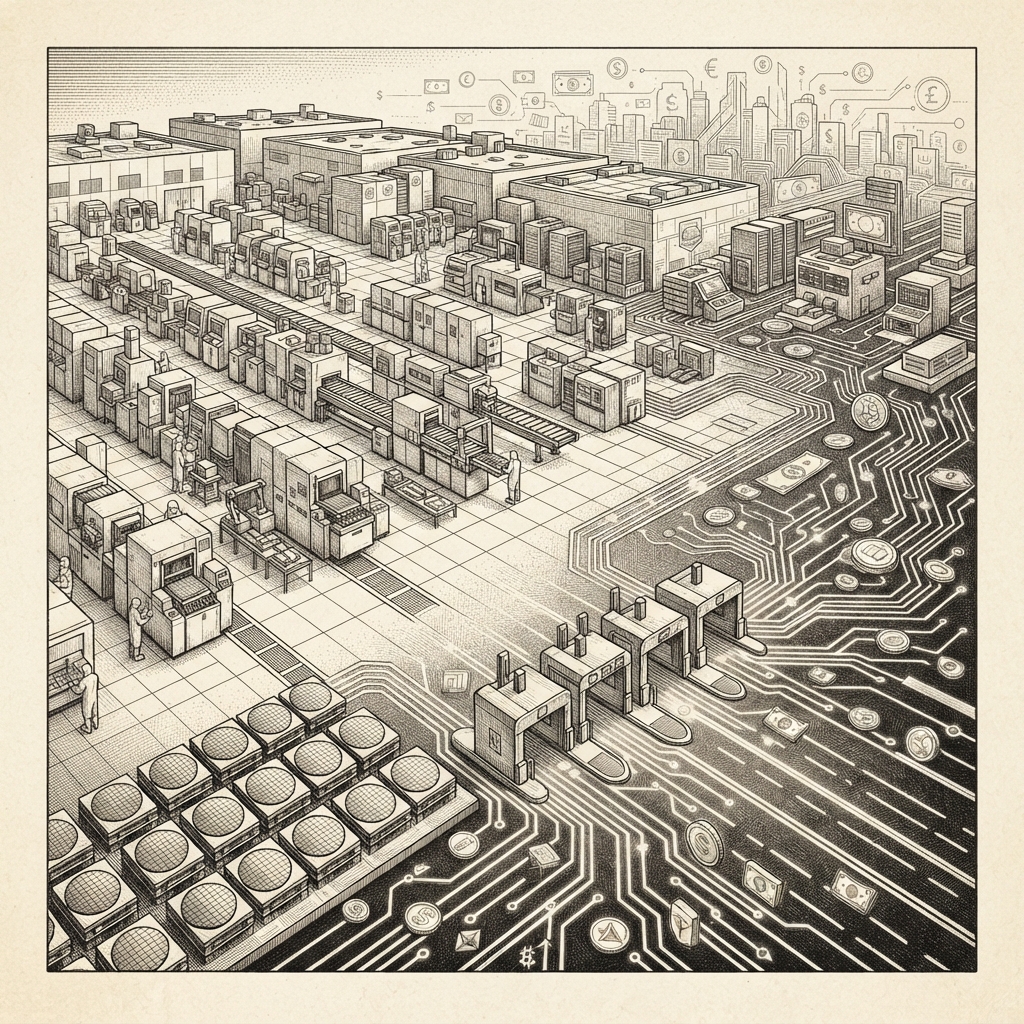
TSMC’s second-quarter earnings didn’t just beat expectations — they confirmed that AI infrastructure capex at semiconductor scale is, functionally, payment-infrastructure capex with a lag. The foundry raised full-year capital expenditure guidance to $60–64 billion, up from $52–56 billion, as it ramps CoWafer-on-Substrate capacity from 120,000 to 140,000 wafers per month by end of 2026. That capacity builds the compute substrate that stablecoin settlement, payment processing, and financial AI agents run on. Every stablecoin issuer scaling institutional settlement needs this silicon to exist.
The numbers were unambiguous. Revenue hit $40.2 billion, up 36% year-over-year, beating the high end of guidance. Net income reached $22 billion — a 77% jump that exceeded the LSEG SmartEstimate by 12%. Gross margin expanded to 67.7%, clearing the 65.5–67.5% guided range. Earnings per ADR came in at $4.31 against a consensus of $3.77–3.83. It was TSMC’s fifth consecutive record quarter.
But the real story is in the guidance. TSMC projected Q3 revenue of $44.6–45.8 billion — 11–16% sequential growth — while guiding gross margin down to 58.5–60.5%. That 7–9 percentage point compression from Q2 is the cost of transitioning to 2nm. The N2 wafer cost sits at approximately $30,000, a 50% premium over 3nm. For the payments and financial infrastructure ecosystem, this is the semiconductor supply chain’s version of the yield curve: when TSMC’s margins compress, it means the next generation of AI chips — the ones that will power financial AI agents, payment infrastructure, and stablecoin settlement at institutional scale — are more expensive to produce. That cost flows downstream to every company building on TSMC’s process, including stablecoin issuers and payment processors buying the compute.
The margin compression, however, masks an important operating dynamic. Revenue growth of 36% year-over-year paired with 77% net income growth means operating leverage is still expanding. TSMC is growing into the N2 transition, not shrinking from it. The margin dip is a ramp cost, not a structural decline. The company’s ability to generate accelerating earnings on rising capex signals that demand for advanced packaging — particularly CoWoS for AI accelerators — is running ahead of supply, not behind it.
Full-year revenue guidance was raised to above 40% growth, up from the prior above-30% target. AI-related revenue is now projected to exceed $40 billion for full-year 2026, representing roughly a quarter of total revenue. CoWoS capacity remains the constraint: TrendForce estimates 125–130K wafers per month by end of year, with JPMorgan at 115K, implying a roughly 20% shortfall persisting against demand. NVIDIA accounts for approximately 60% of CoWoS allocation. N3 is fully sold out. N2 is ramping with a focus on yield optimization.
For the payments infrastructure layer, the implications are concrete. Visa is already processing $7 billion in annualized stablecoin settlement through its Multi-Token Network, up 50% quarter-over-quarter. Mastercard, Stripe, and the 40-member x402 Foundation are deploying programmable payment rails that depend on the same silicon TSMC is building. Deloitte projects $200 billion in US retail stablecoin purchases by 2030 — and that capital is being poured into silicon now.
The capex raise is not a signal of cyclical peak spending. It is a signal of sustained, structural demand for the physical layer beneath the agentic commerce narrative. The margin compression that comes with it is the price of building the next generation of compute — and every entity deploying financial AI agents or stablecoin settlement infrastructure is a downstream buyer of that cost.