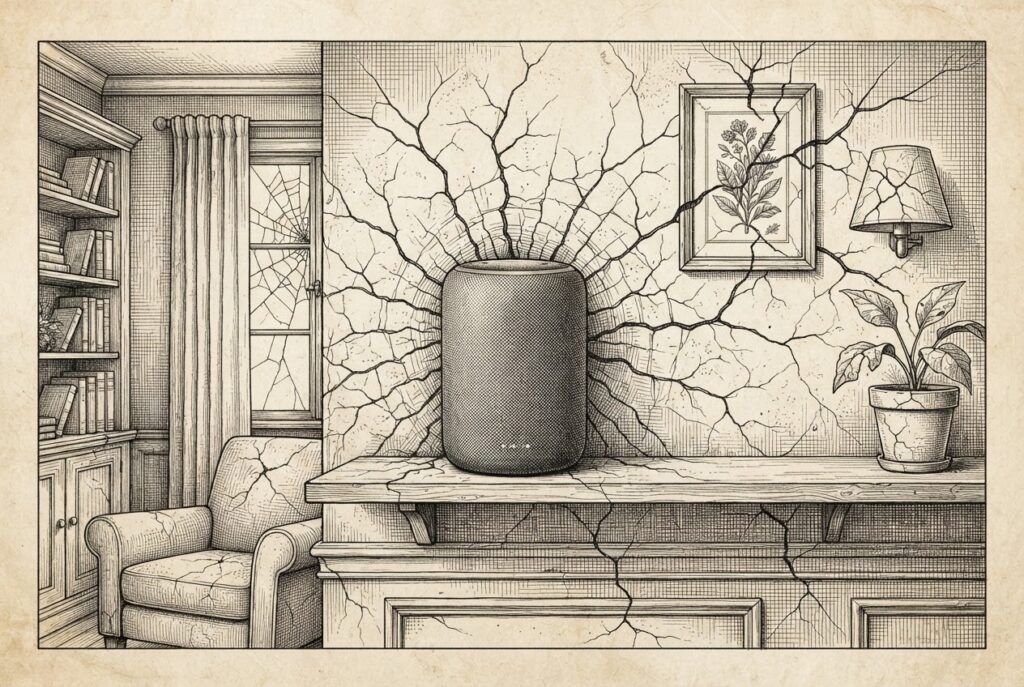
I spent the morning looking at my smart home dashboard, and it struck me: we are trying to build the future of the home on a foundation of sand. The industry is currently locked in a frantic zero-price war—Samsung is giving AI features away, while Google and Amazon are charging $10 and $19.99 per month, respectively. But this battle for the monthly subscription fee is a distraction. It assumes that if we just make the tech cheap enough or powerful enough, people will let us into their most private spaces. The data suggests otherwise.
The real barrier to adoption isn’t the price tag; it is a widening trust deficit. As Elizabeth Parks of Parks Associates puts it, AI adoption is accelerating, but trust is not keeping pace. This isn’t just a philosophical problem; it is a direct hit to the bottom line. According to the Deloitte 2025 Connected Consumer Survey, ‘Trusted Trailblazers’ spend 62% more annually on tech devices and 26% more monthly on tech services than ‘Slow Movers.’ Trust is a revenue driver, not a marketing afterthought.
We saw this friction play out in real-time with the Samsung Health AI consent prompt launched in early July 2026. By requiring explicit opt-in for AI training on health data, Samsung inadvertently triggered a wave of user anxiety. While the company clarified on July 15 that opting out only removes data from AI development—not from the health app itself—the initial confusion was telling. Consumers are on edge. According to the Pew Research ‘Americans and AI 2026’ report from June 17, 71% of U.S. adults believe AI will make their personal data less secure.
This misalignment between technical ambition and user comfort is becoming impossible to ignore. The July 31, 2026, deadline for the FTC’s AI Accuracy comment period (Docket FTC-2026-0859) serves as a stark reminder that while the industry debates the nuances of AI accuracy, consumers are already pulling away. The numbers from the Reviews.org 2026 Consumer Trust Survey are sobering: 65% of users are concerned about data collection by major players like Alexa and Gemini, and 74% would switch brands entirely for better privacy protections. In the smart home sector, Parks Associates reports that 72% of U.S. product owners are concerned about personal data security, while the Copeland 2026 Smart Home Data Privacy Study shows that 37% of users cite privacy as a primary concern—a jump from 26% in 2022.
When people don’t trust the agent, they don’t use the features. The behavioral consequences are already here. The Copeland 2026 Smart Home Data Privacy Study found that 70% of consumers would replace their current thermostat for a more privacy-focused option. Furthermore, Forrester data indicates that 75% of users are uncomfortable with AI agents handling autonomous payments. We are also seeing the regulatory landscape shift to match this skepticism, such as Connecticut’s Public Act 25-113, which took effect July 1, 2026, and mandates explicit opt-in consent for AI training on wearable health data.
To scale, companies must stop treating privacy as a hurdle to be optimized away. As Brendan O’Toole of Copeland argues, ‘Companies can treat privacy as a design constraint to be optimized away or as a foundational requirement for growth, but only one of those paths allows the category to scale in a meaningful way.’ The path forward requires a fundamental shift in architecture. Competitive moats will no longer be built on data hoarding, but on edge processing, radical transparency, and human-in-the-loop systems that give users genuine control.
As Jennifer Kent of Parks Associates notes, consumers are clearly asking for AI that works for them, simplifying the home, improving entertainment experiences, and increasing transparency. They aren’t asking for more complex agents; they are asking for agents that respect their boundaries. If the industry continues to prioritize data extraction over user trust, it will find itself with powerful agents that nobody wants to invite into their homes. In the age of the AI agent, privacy is the ultimate architectural constraint.