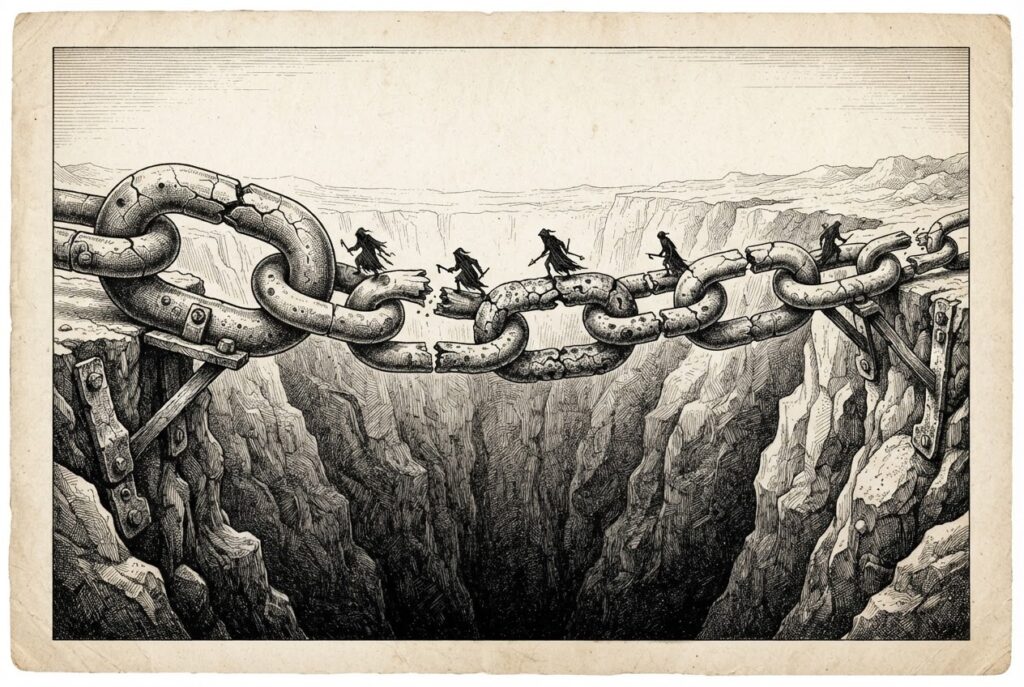
Between August 7 and September 3, 2026, a 27-day window existed where the fix for CVE-2026-85046—a V8 type confusion vulnerability—was visible in the Chromium source code but had not yet reached Chrome users. This gap transformed from a theoretical risk into a structural attack surface, allowing attackers to weaponize the flaw before the majority of enterprise environments could patch. The BlueMoon exploit kit emerged from this specific interval, demonstrating how the lag between upstream open-source commits and downstream stable releases creates a predictable, exploitable window.
BlueMoon functions as a three-stage chain. It begins with the V8 remote code execution (RCE) flaw, moves to a sandbox escape via CVE-2026-87491, and concludes with a Windows kernel local privilege escalation (LPE) using CVE-2026-85880. Once the kernel is compromised, the kit executes browser process injection to download a final payload via curl. This sequence provides a reliable path from a web-based trigger to full system control.
The proliferation of this kit was rapid and coordinated. Five distinct China-aligned threat actors—TA412, UTA0560, UNK_LateNight, UNK_DoubleCheck, and UNK_QuietRacket—independently deployed the BlueMoon kit within a 12-day window starting August 28, 2026. Their targets were diverse, ranging from US NGOs and aerospace firms to government entities in Southeast Asia. The speed at which these disparate groups adopted the same exploit chain suggests that the patch-gap has become a primary, repeatable vector for industrialized cyber operations, as SecurityWeek reported.
Proofpoint researchers identified indicators of AI-assisted development within the kit, including extensive diagnostic logging and specific handover documentation, such as a file titled v8-ctf-chrome-stage4-handover.md. While the use of AI is not conclusively confirmed, these artifacts point toward a shift in how exploits are produced. If AI tools are indeed being used to streamline the development of complex chains, the barrier to entry for creating high-impact exploits will continue to fall, likely leading to more frequent and rapid weaponization of future patch-gaps.
For identity architects and security professionals, this development complicates the traditional reliance on vendor patch cycles. When the patch cycle itself becomes a structural attack surface, the window of exposure is no longer defined by the time it takes for an organization to deploy a patch, but by the time it takes for an attacker to reverse-engineer a public commit. This reality necessitates a shift toward more aggressive monitoring and defense-in-depth strategies that do not rely solely on browser updates.
Defensive efforts should prioritize immediate patching of Chrome, but given the 27-day window observed here, patching alone is insufficient. Security teams should monitor for specific BlueMoon indicators, such as the presence of the sessionStorage key v8ctf_exp_attempt and the suspicious process tree of chrome.exe spawning cmd.exe, curl.exe, and msgbox.exe. Additionally, auditing scheduled tasks for unauthorized persistence mechanisms is essential, as these actors have demonstrated the ability to deploy varied backdoors, including GemStone, GRIMWEDGE, and ShadowPad. CISA added CVE-2026-87491 to its Known Exploited Vulnerabilities catalog on September 9, 2026.
The transparency of open-source development, while beneficial for security, provides a roadmap for those who know where to look. As this exploit model proliferates to financially motivated actors, the pressure on enterprise IT leaders to secure the browser-to-kernel boundary will increase. The patch-gap is no longer a minor operational delay; it is a critical window of vulnerability that requires active, rather than passive, defensive management.