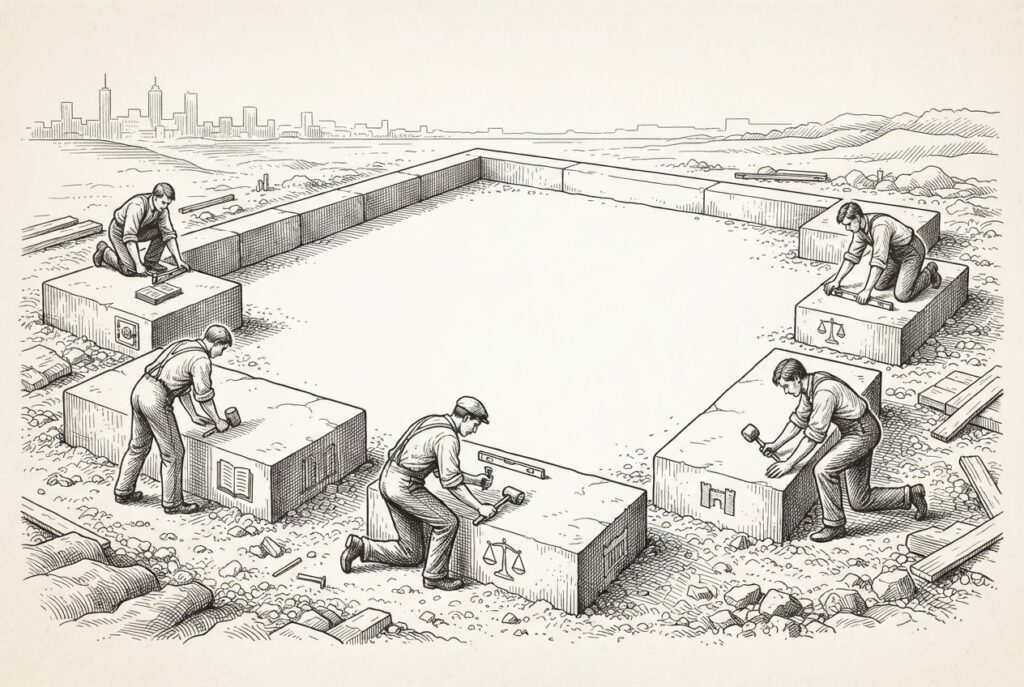
Financial plumbing rarely undergoes a total system upgrade in a single weekend, yet the architecture for institutional stablecoins effectively locked into place between October 6 and October 8, 2026. This was not a singular launch but the convergence of five distinct infrastructure layers that, when viewed in isolation, appear as disparate corporate initiatives. When viewed as a stack, they represent a self-reinforcing mechanism designed to satisfy the rigid requirements of the GENIUS Act.
The foundation of this stack is the reserve layer, where the JPMorgan JLTXX fund and the BlackRock BSTBL parent fund have established a functional duopoly. Under Section 4(a)(1)(A) of the GENIUS Act, issuers are restricted by a 40% concentration limit on any single tokenized reserve asset. This regulatory constraint forces issuers to utilize both JLTXX and BSTBL to maintain compliance, effectively mandating a dual-reserve strategy for any entity seeking to operate within the federal framework. With JLTXX holding $733.7 million in assets under management and BSTBL backed by a $6.1 billion parent fund, the reserve layer is now the most heavily capitalized component of the ecosystem.
Above the reserves, the enterprise payment layer has been integrated directly into the software that manages the majority of global commerce. By embedding SAP Pay into the SAP Cloud ERP, the system now supports USDC and EURC across 89 corridors, reaching approximately 400,000 customers. This integration bridges the gap between traditional enterprise resource planning and blockchain-based settlement, turning standard corporate accounting software into a native stablecoin gateway.
The third layer, credit assessment, provides the necessary transparency for institutional participation. The first-ever stablecoin protocol rating from Moody’s, which assigned a B3 rating to the Sky Protocol, alongside an S&P B- rating, introduces a standardized risk framework. These ratings define the operational boundaries, including a 0.9% capital ratio and specific thresholds for upgrades and downgrades. While these metrics may appear stringent, they provide the quantitative baseline required for institutional risk committees to approve stablecoin exposure.
The merchant surface layer completes the consumer-facing side of the stack. By connecting its $6 trillion payment network to Coinbase stablecoin rails, Citi has turned every e-commerce platform into a potential on-ramp. With 150 million cardholders and a 3.75% platform incentive, the infrastructure is designed to prioritize volume over traditional interchange fees, incentivizing merchants to adopt the rails immediately.
These layers feed directly into the four settlement rails identified in Capital Flows Weekly: SoFi and Mastercard, Visa’s $20 billion annualized volume, Stripe’s expansion across more than 100 countries, and Solana’s delivery-versus-payment capabilities. The rapid transition from zero to four production rails suggests that the infrastructure is ready for high-velocity settlement, even if the broader market remains in a state of anticipation.
The urgency behind this rapid deployment is driven by the January 18, 2027, effective date of the GENIUS Act. This deadline looms over an industry currently operating in a significant regulatory vacuum, as seven federal agencies failed to meet their July 2026 rulemaking obligations. With no statutory fallback provided, the industry is effectively building its own compliance standards in real-time, hoping that the infrastructure will be deemed sufficient when the law takes effect.
Community banks are responding to this shift with a defensive posture. According to a survey by the American Bankers Association and the Conference of State Bank Supervisors, 18% of these institutions are planning to launch tokenized deposits within the next 12 months. However, the same survey reveals that 60% of these banks expect to lose ground to the new stablecoin rails, suggesting that tokenized deposit walls are a reactive measure rather than a competitive offensive.
Despite the technical completion of this stack, a persistent gap remains between the sophisticated infrastructure now in place and actual market adoption. The rails are built, the reserves are compliant, and the ratings are published, yet the transition from legacy settlement to this new stack requires a level of institutional migration that has yet to materialize. The infrastructure is ready for a scale of activity that the current market has not yet demonstrated, leaving the industry in a state of high-functioning readiness while waiting for the regulatory and commercial reality of 2027 to catch up to the code.