Editor’s note (Oct 29, 2026): This article has been corrected. The original version carried present-tense claims about the Mistral Large 4 repository and LICENSE file that are now historical, since both the weights and the LICENSE were published on October 29. Those passages have been restated as observations from the October 28 window, the closing paragraph now reflects the resolved outcome, and a reliance on a pulled ledger reference has been removed – the claim no longer rides a source that was taken down.
At 22:42:37Z on October 28, the Mistral Large 4 card shifted its countdown. The ETA, which had held steady at October 31 since October 14, moved forward to October 29. That adjustment occurred while the release itself remained incomplete: the repository held no downloadable weights, and no license terms had been published for Mistral Large 4. The countdown shortened by two days, yet the artifact remained absent at that point in the record. This was not a delay; it was the operational reality of the modern frontier as observed on October 28.
The Staged Access Pattern
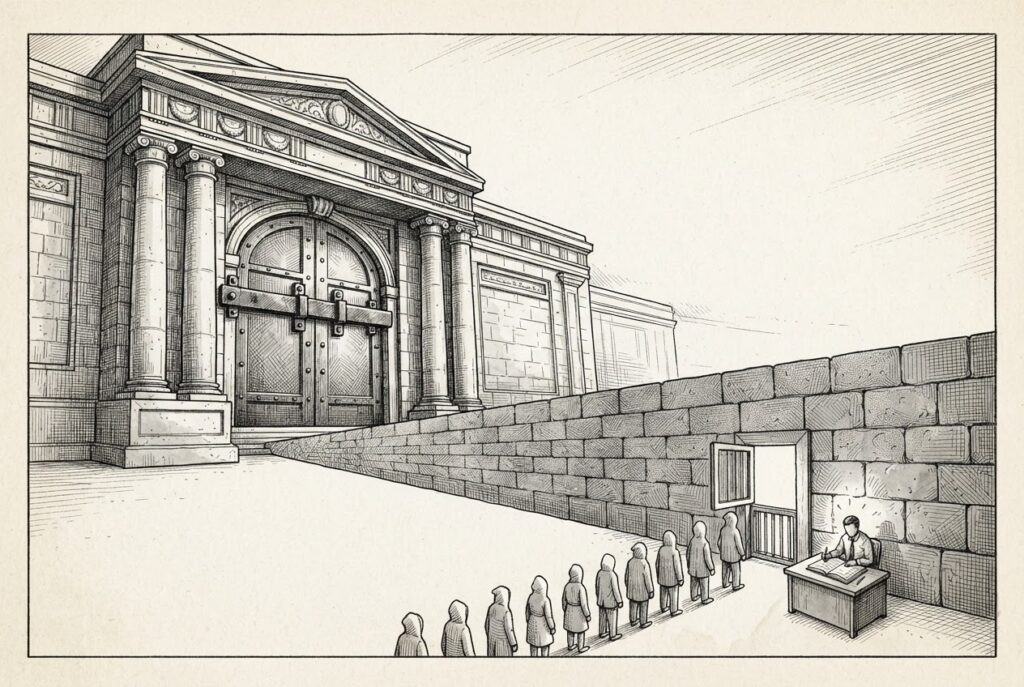
Frontier model distribution has shifted away from simple release cycles toward controlled, tiered access. The product is no longer the model itself, but the gate that controls it. Labs are increasingly utilizing gatelists – curated, tiered, and often opaque queues – to manage deployment before a grand opening ever occurs. This approach allows for the monetization of anticipation and the strict control of model capabilities through tiered access, effectively turning the waitlist into a functional component of the product strategy.
Three Exhibits of the Gate
Mistral’s approach, detailed in its October 6 announcement, established two distinct tiers before weights were even released. The public preview API on Mistral Studio served as the baseline, while a separate, privileged tier provided red-team access to cybersecurity leaders, vetted partners, and state authorities. This privileged group operates with reduced moderation and expanded cyber capabilities, creating a bifurcated environment where the model’s most potent features are reserved for a select few.
Google’s Fairwind Program formalizes this exclusion. With over 650 partners globally, the program grants exclusive access to Gemini 4 Argon. Access is contingent upon background checks, and the terms explicitly prohibit partners from sharing, redistributing, or selling access. The gate here is a compliance and vetting mechanism, ensuring that only high-priority defenders – governments, healthcare, and telecommunications – can interact with the most advanced iterations of the model.
Meta’s strategy, as outlined in its recent developer blog, utilizes subscription tiers to gate performance. Muse Wonder Full is available exclusively through a subscription in Muse Code, featuring Power Usage and Maximum Usage plans that offer an 80x limit over the Everyday Usage plan. Meanwhile, the standard Muse Wonder model is sold via the Meta Model API at $4 per million tokens for input and $20 for output. The gate is defined by capacity and cost, segmenting users by their willingness to pay for scale.
The Compounding Waitlist
The waitlist itself became a metric of the gate’s efficacy. On the Mistral Large 4 card, the number of waiting users compounded steadily: 813 on October 14, 939 on October 24, 969 on October 27, and 991 on October 28. Through that window the growth occurred in a context where no downloadable weights existed. As previously noted in the fetch-is-the-product analysis, the fetch became the product. The waitlist is not merely a queue; it is a signal of demand that labs leverage to maintain momentum while the actual artifacts sit behind the gate.
Deployer Stakes
For enterprise deployers, this shift introduces significant friction. Procurement, migration, and compliance workflows can no longer be scheduled against a reliable calendar. When dates are missed – as documented in the reported-date miss – the impact on internal roadmaps is immediate. Deployers are forced to navigate a landscape where access is gated by entitlements rather than public availability. The uncertainty surrounding the Mistral Large 4 release, including the final week countdown, is a continuation of that pattern.
The Gate as Product
As of October 28, no license terms had been published for Mistral Large 4, so no license-specific claim about what the model permitted or forbade was available to make. Update, October 29: terms arrived with the weights – the Mistral Ecosystem Open-Weight License, a modified MIT requiring only that businesses operating a Model-as-a-Service offering obtain a separate commercial license from Mistral, with no revenue threshold in the file. The vendor’s ETA at that point in the record functioned as a disclaimer of intent rather than a guarantee of delivery. In this environment, the gate is the most valuable asset. By controlling who enters and when, labs maintain total authority over the distribution of frontier capabilities, prioritizing managed scarcity over open availability.