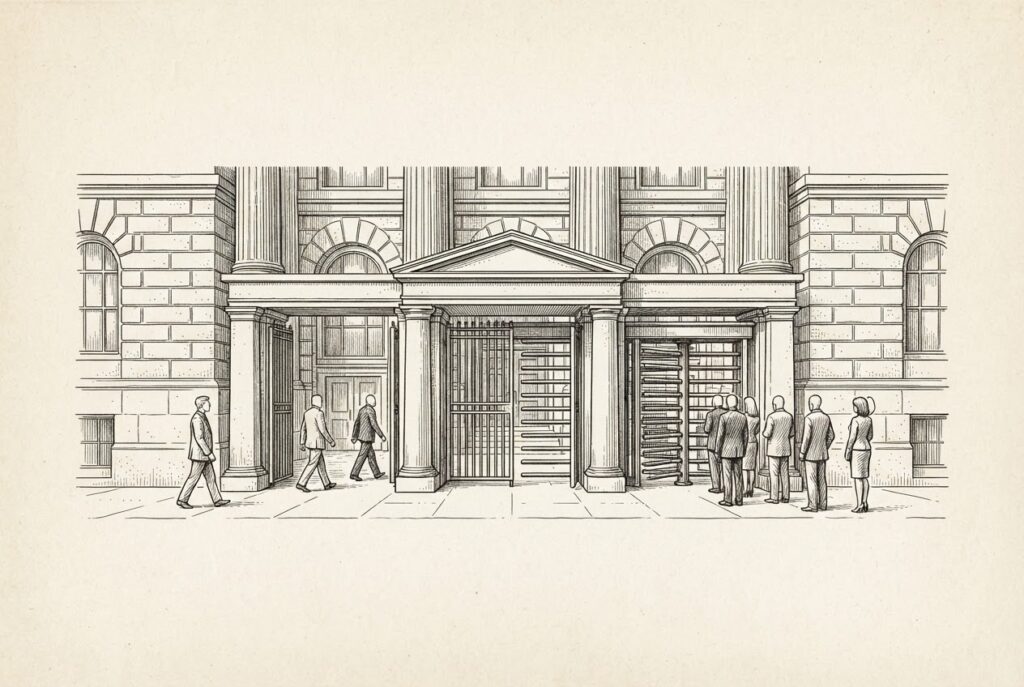
The Federal Reserve is currently engaged in a quiet exercise of architectural gatekeeping, using the Payment Account proposal (Docket OP-1878) to define exactly who gets to participate in the plumbing of the American financial system. By creating a restricted, skinny version of a master account, the central bank is not so much opening its doors to the digital asset industry as it is installing a high-security turnstile. The proposal, which saw its comment period conclude today, signals a deliberate strategy: the Fed is willing to let crypto-native players into the settlement layer, but only if they agree to operate within a strictly defined, low-risk sandbox that keeps the central bank’s exposure neatly contained.
The utility of this Payment Account is defined entirely by what it refuses to provide. While it grants access to the Fedwire Funds Service, FedNow, and the National Settlement Service, it pointedly strips away the features that characterize a traditional commercial bank’s relationship with the Fed. There is no intraday credit, no discount window access, and no interest on balances. It is a transactional pipe, not a liquidity lifeline. This design choice is the core of the Fed’s risk management strategy, ensuring that these entities cannot leverage the central bank to amplify their own balance sheet risks. Governor Michael S. Barr’s lone dissent in the 6-1 board vote highlights that even this constrained access remains a point of internal friction, likely reflecting a fundamental disagreement over whether the Fed should be facilitating the integration of non-traditional entities into the core settlement infrastructure at all.
The practical application of this filter is already visible in the market. Kraken Financial’s successful acquisition of a limited-purpose master account in March 2026 serves as the current benchmark for entry, proving that a digital asset bank can clear the hurdle if it meets the rigorous standards of a federally regulated entity. The contrast with Custodia Bank is instructive; Custodia’s denial underscored the reality that a state-level charter is insufficient when the Fed deems the underlying regulatory framework inadequate. The message is clear: the Fed is not interested in the jurisdictional arbitrage that defined the early days of crypto banking.
For firms like Circle, which secured an OCC national trust bank charter, the path is technically open, but the charter is merely a ticket to the application line, not a guarantee of entry. The OCC charter provides the necessary federal regulatory pedigree, yet the Fed’s evaluation guidelines remain the final arbiter. Being a national trust bank makes an entity formally eligible to apply for a master account, but it does not bypass the Fed’s own stringent, case-by-case assessment of risk, operational capacity, and systemic impact.
The proposal’s most rigid feature is the $1 billion overnight closing balance limit. While the Fed notes that 97% of existing account balances have historically stayed below this threshold, the cap acts as a structural governor on the growth of stablecoin issuers. For a firm managing billions in reserves, a $1 billion limit is not just a safety measure; it is a ceiling on how much capital can be settled directly through the Fed at any given time. It forces issuers to maintain complex, multi-layered banking relationships, ensuring they cannot rely solely on the central bank for their entire operational footprint, thereby preventing any single issuer from becoming a point of systemic failure.
This technical maneuvering is occurring against the backdrop of the GENIUS Act’s legislative vacuum. With the July 18, 2026, deadline for agency rulemaking having passed without a finished framework, the industry is left with a collection of proposed rules and a looming January 2027 effective date. The Payment Account proposal does not resolve this uncertainty; it merely provides a technical path for settlement while the broader legislative architecture remains under construction. It is a pragmatic, if narrow, solution to a problem that Congress has yet to fully define, leaving the Fed to fill the void with its own administrative preferences.
The Payment Account is ultimately about defining the center of the payment system. Direct Fed access is the structural moat that separates regulated stablecoin issuers from their unregulated competitors. By creating a specific, restricted account type, the Fed is effectively choosing to curate the participants who can settle at the core of the financial system. Those who make it inside the tent gain the legitimacy of direct settlement, while those who remain outside are relegated to the periphery, forced to rely on intermediary banks that may be increasingly wary of crypto-related risk.
As the industry awaits the finalization of these rules, the focus shifts to how the Federal Reserve will reconcile these individual applications with the broader, unfinished regulatory mandate. The Fed is not opening the gates to the entire digital asset ecosystem; it is building a controlled, high-security entrance for a select few. For institutional investors and stablecoin issuers, the question is no longer whether they can access the Fed, but whether they can meet the stringent, restrictive criteria required to stay there once they arrive.