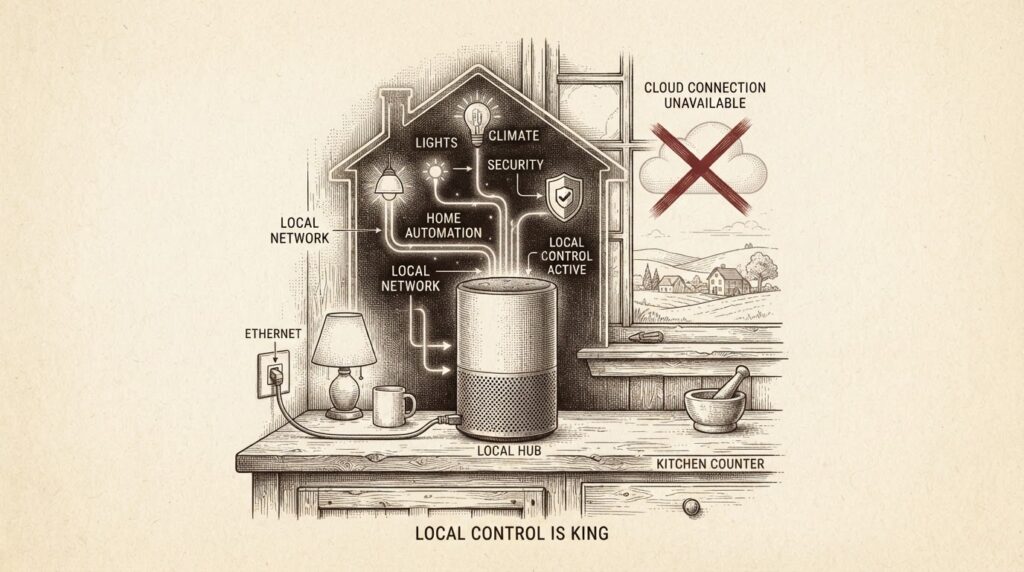
I still remember the weekend I spent trying to get a local voice assistant to work. It was less of a smart home project and more of a descent into a digital purgatory of error logs and terminal commands. You needed a degree in patience just to turn on a light. But with the Home Assistant 2026.8 release, arriving August 5, 2026, that barrier is finally being demolished. The most telling change isn’t some flashy new dashboard widget; it is the quiet, permanent disappearance of the ‘Advanced’ mode toggle. By continuing the label reduction started in 2026.6, Home Assistant is making a bold statement: local-first AI is no longer a niche hobbyist pursuit. It is the new default.
This shift hits at a moment when the smart home industry is suffering from a massive, well-earned trust deficit. Data shows that 64% of consumers simply do not trust major platforms with their AI agents — a finding I explored in depth in The Permission Gap. And honestly, can you blame them? When your thermostat or camera relies on a cloud connection, you are essentially inviting a third party to live in your house. With the U.S. smart home cloud platform market hitting $18.5 billion in 2026, according to Persistence Market Research, the incentive for these companies to harvest your data is immense. People are catching on, and they are tired of the trade-off.
The 2026.8 release tackles this head-on by integrating llama.cpp for local LLMs and LiteLLM for model endpoint connectivity. This enables a fully local AI voice pipeline — combining faster-whisper for speech-to-text, llama.cpp for the brain, and Piper for text-to-speech — all running right on your local network. If you have a decent GPU, you can hit a sub-3-second wake-word-to-response time. Once the models are downloaded, the whole system can be air-gapped. It is a functional, private alternative to the cloud-dependent giants that actually works.
By nuking the ‘Advanced’ label, the developers are making these powerful tools accessible to everyone, not just the terminal-savvy. This is a strategic move that turns local-first architecture into a genuine competitive moat. While incumbents are fighting to keep users locked into their $18.46 billion AI-in-smart-home market, according to Next Move Strategy Consulting, Home Assistant is betting that privacy-conscious users will pay a premium for control. A Copeland 2026 Smart Home Data Privacy Report found that 70% of consumers would replace their thermostat just for better privacy. SecurityInfoWatch reported that over 50% would pay extra for independently certified secure devices or local data storage.
The vulnerability of cloud-dependent models was recently underscored by the FCC ban on iRobot/Roomba hardware due to Chinese ownership concerns. It was a stark, uncomfortable reminder that when your device relies on a remote server, your hardware is only as secure as the company’s geopolitical standing. If the cloud goes down, or if the company is suddenly barred from the market, your ‘smart’ device becomes a very expensive paperweight. Local-first AI, by contrast, keeps the intelligence inside your four walls where it belongs.
This isn’t just about being a contrarian or wearing a tinfoil hat. It is about the reality of living with technology that knows your habits, your schedule, and your voice. When open-source platforms like Home Assistant and openHAB 5.2 — which added its own native LLM voice assistant in July 2026 — start offering these tools, they are providing a real-world answer to the privacy concerns that plague the industry. The trust deficit isn’t going away, and for the major platforms, that is a massive, growing liability.
As we move into the second half of 2026, the smart home market is splitting in two. On one side, you have the cloud-first incumbents, heavily invested in data-hungry models that treat your home like a data mine. On the other, you have a growing movement of users who want the convenience of AI without the surveillance. Home Assistant 2026.8 is the clearest sign yet that the latter group is no longer a fringe movement. They are the new market force, and they are building a home that doesn’t need to call home to function.