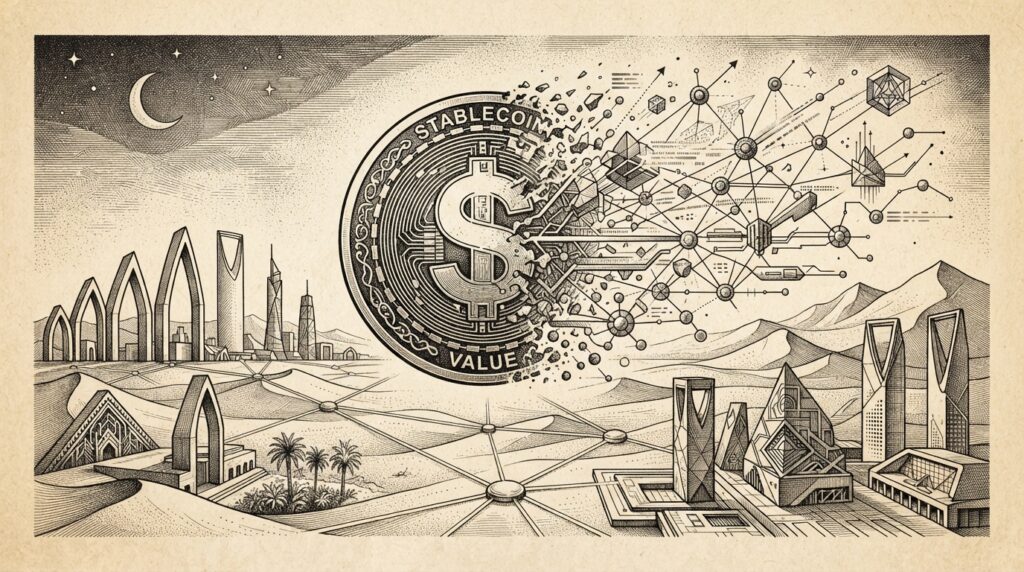
The market remains fixated on the $183.4 billion circulating in USDT, yet Tether is quietly reorienting its core business model from a pure stablecoin issuer toward a diversified asset-tokenization platform. The geographic proof point for this transition is not a Western financial hub, but Saudi Arabia.
On August 6, 2026, Tether announced a strategic collaboration with First Advanced Data for Artificial Intelligence LLC (First Data) and BKN301 to deploy its Hadron platform within the Kingdom. Tether is betting its future on the institutionalization of real-world assets rather than just the velocity of its dollar-pegged token.
The Partnership Architecture
Tether is building distribution infrastructure. First Data acts as the commercial lead, issuer, and primary market operator for tokenized institutional-grade real estate. BKN301, a San Marino-based Banking-as-a-Service fintech, provides the necessary integration, orchestration, and banking connectivity. As Stiven Muccioli, CEO of BKN301 Group, noted, the firm’s role is to ensure that Hadron’s capabilities are seamlessly connected to the banking, payments, and compliance infrastructure required for institutional deployment.
By offloading the regulatory and operational heavy lifting to local partners, Tether positions Hadron as the underlying engine for tokenized commodities, equity, government debt, and funds, while keeping its own balance sheet focused on its core reserve management.
Saudi Market Context
The choice of Saudi Arabia is tactical. The Kingdom’s Vision 2030 framework provides a clear regulatory tailwind for capital market development and foreign investment. The Saudi real estate market, valued at approximately $79 billion in 2026 and projected to reach $114 billion by 2031 according to Mordor Intelligence, offers a massive, tangible asset base for tokenization. A new foreign real estate ownership law, effective January 21, 2026, has already broadened the buyer pool, according to White & Case analysis, and the Saudi Real Estate Registry has already deployed national-scale blockchain infrastructure via SettleMint.
As Paolo Ardoino, CEO of Tether, stated, With Vision 2030, Saudi Arabia stands out as an ideal market for demonstrating the transformative impact of platforms like Hadron by Tether. The initial focus on institutional-grade real estate — with future expansion into energy and infrastructure finance — aligns with the Kingdom’s broader economic diversification goals. Nabil Al-Nuaim, Chairman of First Data, echoed this sentiment, calling Saudi Arabia one of the most compelling markets globally for the convergence of technology, capital markets, and real-world asset tokenization.
Competitive Positioning
Tether’s move into platform revenue is a defensive necessity. The stablecoin reserve income model is under pressure; the OUSD consortium is actively threatening to commoditize that revenue stream. Meanwhile, competitors are aggressively building their own infrastructure plays. Circle is pushing its Arc mainnet, and the recent $1.8 billion Mastercard-BVNK acquisition highlights the race to capture institutional infrastructure for stablecoin payments. With Citi projecting the tokenized securities market could reach $5.5 trillion by 2030, the competition is no longer just about who has the most liquidity, but who owns the rails.
Tether reported a $1.5 billion net operating profit in Q2 2026, supported by a $4.11 billion reserve buffer. It has the capital to fund this expansion, but the challenge remains execution. The question is whether Hadron can replicate the distribution advantage that made USDT the dominant stablecoin in a market where sovereign capital and state-backed entities dictate the terms of engagement. Tether is betting that by providing the technology to tokenize the Kingdom’s assets, it can secure a permanent seat at the table of the next generation of institutional finance — but it remains to be seen if a platform-as-a-service model can navigate the rigid, top-down requirements of sovereign-led capital markets as effectively as it managed the permissionless liquidity of the crypto-native era.