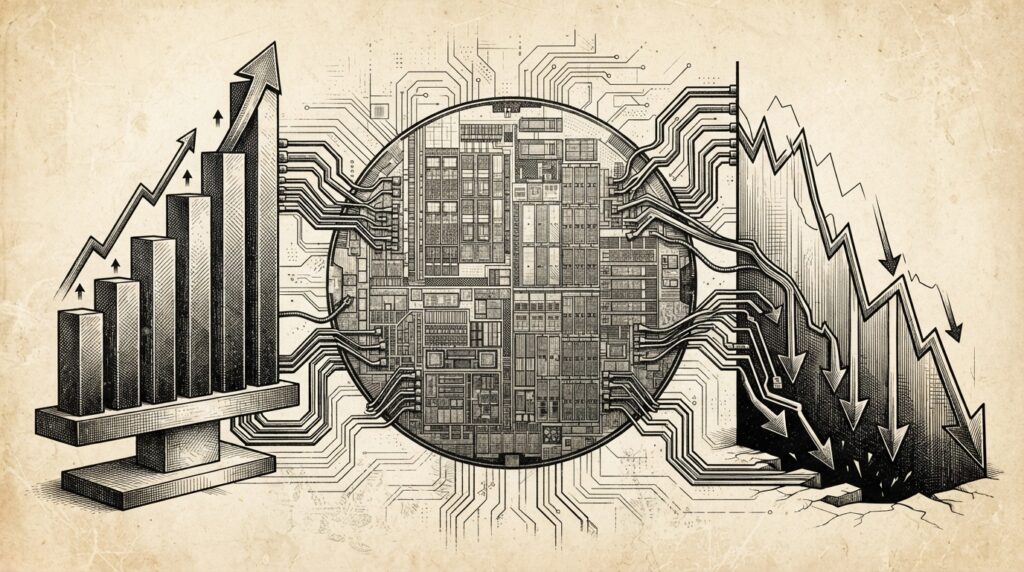
Samsung just posted record-breaking financial results, yet the market responded with a historic selloff. The company reported revenue of 171.5 trillion Korean won ($117.5 billion) and an operating profit of 89.5 trillion won ($61.3 billion), hitting an all-time high operating margin of 52.2 percent. Investors ignored the numbers, sending Samsung’s stock down 13.4 percent on July 28, while SK Hynix dropped 14.7 percent. The combined market cap loss of 396 trillion won dragged the KOSPI index down 10.8 percent, marking its worst single-day performance since the U.S.-Iran conflict in March 2026.
The profit engine is clearly defined. Samsung’s Device Solutions division generated 127.5 trillion won in revenue and 89.2 trillion won in operating profit, both record highs. The Memory Business carried the load, contributing 120.8 trillion won in revenue—a 62 percent jump quarter-over-quarter and a 471 percent surge year-over-year. Running at an annualized rate of roughly $83 billion, the numbers show Samsung extracting massive value from the current AI-driven demand cycle.
High-bandwidth memory is the primary driver. Samsung’s HBM4, designed for the NVIDIA Vera Rubin platform, saw scaled sales this quarter, and the company has already shipped samples of HBM4E, which delivers 16 gigabits per second and 4.0 terabytes per second of bandwidth. With HBM4 sales projected to triple in the third quarter and HBM expected to account for over 60 percent of total memory revenue in the second half of 2026, the compute supply chain squeeze is confirmed in Samsung’s own guidance.
Market analysts point to broader anxieties regarding AI infrastructure financing to explain the July 28 selloff. Fears surrounding circular funding models among AI startups and rising competition from Chinese chipmaking equipment firms have forced investors to question the sustainability of hyperscaler spending. The market is effectively betting that the massive capital outlays required to build out AI data centers cannot continue through 2027 without triggering a correction.
The financial health of major hyperscalers reveals a sharp bifurcation in the demand-side thesis. Meta’s second-quarter earnings showed a 93.7 percent collapse in free cash flow, which fell to $784 million from $12.39 billion as capital expenditures hit $31.08 billion. Microsoft, by contrast, remains a self-funding powerhouse, guiding toward roughly $175 billion in capital expenditures for fiscal year 2027, with first-quarter spending projected to exceed $50 billion alongside 43 percent growth in Azure. The demand-side thesis has not collapsed—it has bifurcated between operators that can sustain the spend and those that cannot.
The supply chain is also feeling the structural squeeze. Because HBM production consumes the same fabrication capacity as conventional DRAM and NAND, the industry-wide pivot toward AI-optimized memory has tightened supply for commodity products. DRAM prices rose 44 percent quarter-over-quarter and NAND prices rose 53 percent, pushing the cost of compute higher across the entire stack—from smartphones to data centers that do not require HBM.
The core question is whether this represents a permanent market structure or a temporary distortion. If HBM4 sales triple as projected and conventional memory prices stay elevated, Samsung will have validated a model where AI demand dictates pricing for the entire memory sector. If the selloff continues despite strong supplier numbers, it signals the market believes the hyperscaler spending cycle is closer to its ceiling than the order books suggest.