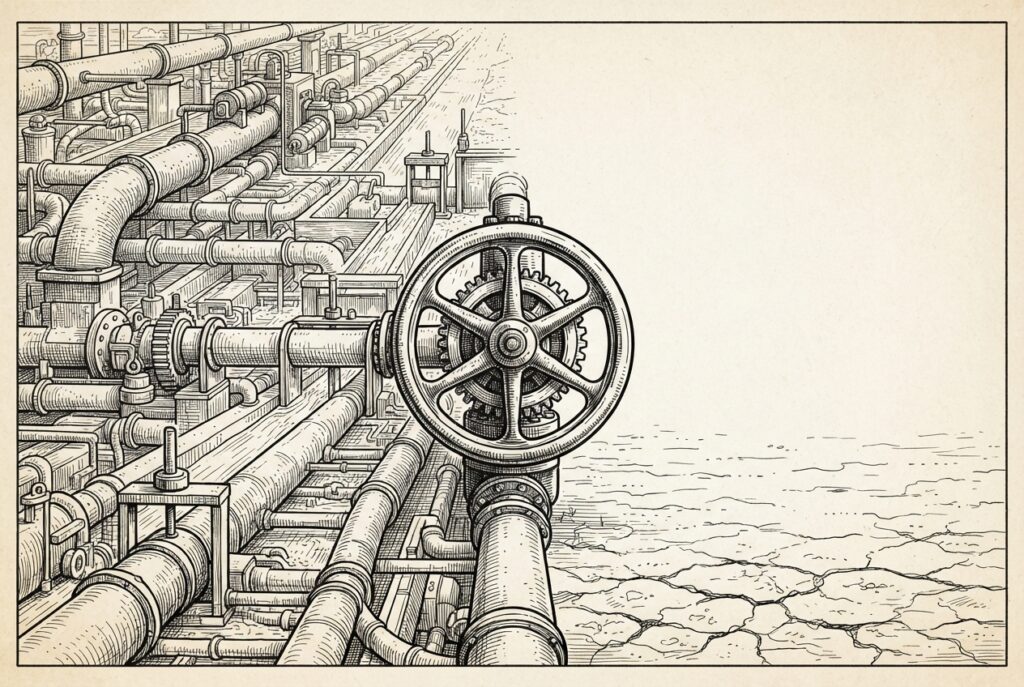
The bottleneck for artificial intelligence has migrated from the silicon wafer to the electrical substation. As the industry races to scale compute capacity, the primary constraint is no longer just chip availability, but the physical and regulatory infrastructure required to power massive server farms. On July 14, 2026, New York became the first state in the nation to codify this friction, with Governor Kathy Hochul signing Executive Order 62 to impose a statewide moratorium on hyperscale data centers requiring 50 megawatts or more of power.
This order functions as a temporary permitting wall, halting state environmental reviews for new projects for up to one year. During this window, the Department of Public Service is tasked with developing a Generic Environmental Impact Statement to evaluate the cumulative effects of these facilities on energy demand, water consumption, and utility costs. The governor’s rationale centers on the tangible externalities of rapid digital expansion. As Hochul stated, “The bottom line is that progress shouldn’t arrive with a higher utility bill, deleted water supply or noise pollution, so we have no choice but to address these challenges created by these massive facilities.”
New York’s policy shift signals a broader trend rather than an isolated regulatory experiment. Data from the National Conference of State Legislatures indicates that 15 states are currently considering similar restrictions, ranging from Delaware and Georgia to Michigan and Vermont. While states like California are attempting to manage the surge through tariff and incentive legislation, the momentum in other jurisdictions leans toward the restrictive approach pioneered by New York. This creates a fragmented regulatory environment that complicates long-term capital allocation for infrastructure developers.
Industry reaction to this shift reveals a stark divide between public silence and private alarm. Major hyperscalers — AWS, Google, Microsoft, Meta, and Oracle — have declined to comment on the moratorium, a form of strategic positioning that avoids direct confrontation with state regulators while they assess the impact on their expansion roadmaps. Conversely, trade associations have been vocal. The Data Center Coalition and the Associated General Contractors of New York have warned that the pause will not merely delay projects but will permanently divert investment to more permissive states like Virginia, Texas, and Georgia.
Federal authorities have maintained a different posture compared to this state-level caution. While the White House has pursued a strategy of streamlining federal permitting and encouraging voluntary ratepayer protection pledges, it has not intervened in the New York moratorium. This creates a palpable tension between federal goals for AI acceleration and the localized grid and environmental concerns that state governments are increasingly prioritizing. The federal legislative attempt to mirror this moratorium, introduced by Senator Sanders and Representative Ocasio-Cortez in March 2026, remains stalled in committee, leaving the regulatory initiative firmly in the hands of state capitals.
The stakes are underscored by the sheer scale of energy consumption. Data centers accounted for 4.4 percent of U.S. electricity usage in 2023, a figure projected to reach 9 percent by 2030. With over 700 data centers currently under construction across 38 states, the geographic concentration of these loads poses significant challenges for grid integration. Unlike distributed energy demand, these massive facilities create localized spikes that can strain existing utility infrastructure, forcing regulators to choose between rapid technological deployment and the stability of local power markets.
New York’s moratorium functions as a critical test case for integrating environmental and utility impact assessments into the rapid AI compute development cycle. With 15 states currently considering similar restrictions, the outcome of the state’s DPS GEIS will likely establish the long-term regulatory framework for the sector. Industry stakeholders, including the Data Center Coalition, have warned that such measures risk permanently diverting investment to more permissive jurisdictions. The broader landscape will be shaped by whether other states adopt New York’s oversight model or if the threat of capital flight forces a compromise between infrastructure expansion and local regulatory demands.