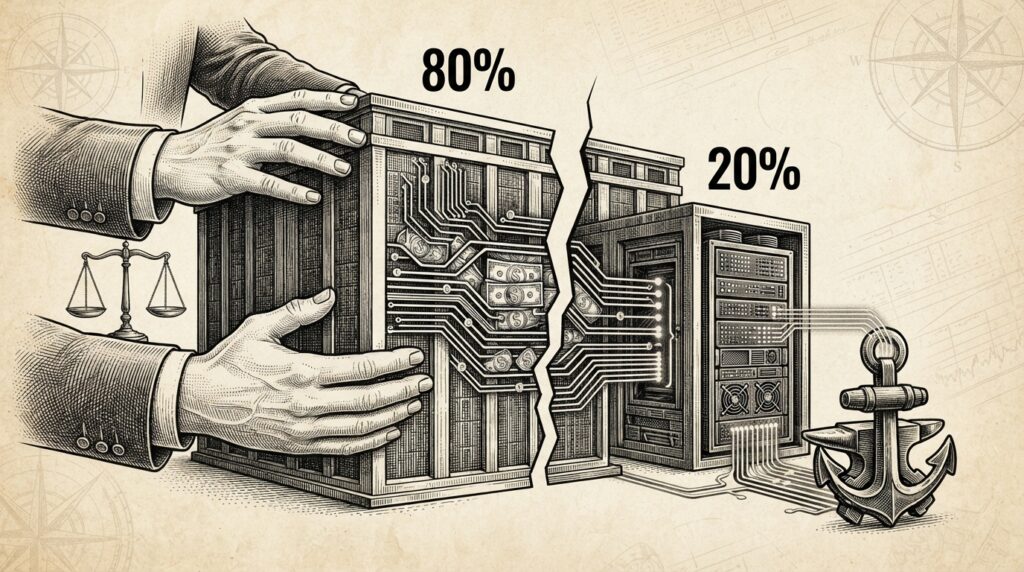
Meta is financing its $14 billion, 1 GW El Paso data center through a sophisticated sale-leaseback variant that converts existing land and construction-in-progress assets into partnership equity. By offloading the immediate capital burden to external partners, the company has established a joint venture where BlackRock-managed funds hold an 80% equity stake, while Meta retains a 20% minority position. This structure allows Meta to maintain sole occupancy of the massive compute facility while effectively shifting the majority of the development cost off its own balance sheet. By leveraging this equity-heavy model, Meta secures the infrastructure necessary for its AI ambitions without the traditional constraints of hyperscale construction procurement.
The architecture of this deal is designed to preserve Meta’s liquidity while securing massive scale. At financial close, Meta contributed approximately $2.3 billion in assets, while BlackRock injected $4.9 billion in cash. To align the ownership at the 80/20 split, Meta received a $1 billion one-time distribution. The remaining $12.5 billion of the $14 billion development cost is covered by debt financing provided by partners including Global Infrastructure Partners (GIP) and HPS Investment Partners. While the specific terms of this debt remain undisclosed, the structure ensures that Meta, as the sole occupant, manages the facility under an initial four-year lease with options for up to 20 years.
This pivot to external financing is a direct consequence of Meta’s deteriorating free cash flow (FCF). In Q2 2026, as detailed in the Meta Q2 2026 IR press release, the company reported FCF of $784 million, a 91% collapse from the $8.55 billion recorded in the same period the previous year. Simultaneously, capital expenditures surged 83% to $31.08 billion, with full-year 2026 guidance reaching $130–145 billion. The company has already paused share buybacks—which totaled $12.75 billion in Q1 2025—to prioritize its $600 billion data center commitment through 2028. As Mark Zuckerberg noted in the joint announcement, “Building the infrastructure for superintelligence is key to making sure the benefits of this technology are distributed to everyone. Our partnership with Larry and the team at BlackRock allows us to move faster and at greater scale.”
The contrast with Microsoft’s approach is stark. While Meta is forced to syndicate its infrastructure risk, Microsoft continues to leverage its massive revenue acceleration to self-fund its AI expansion. In the Microsoft Q4 FY26 IR press release, the company reported $90 billion in revenue with Azure growing 43% year-over-year and maintaining an operating margin of approximately 45%. Microsoft’s ability to generate sufficient cash to support its $175 billion adjusted FY2027 capex guidance highlights a divergence in financial health. While Microsoft funds its growth through cloud dominance, Meta is increasingly reliant on financial engineering to sustain its infrastructure ambitions.
Despite the offloading of equity, Meta remains tethered to the project’s long-term performance through a $13 billion residual value guarantee. This mechanism functions as a floor protecting BlackRock’s investment; under specified conditions during the first 16 years, Meta’s maximum payment is capped at the shortfall between the facility’s fair value and the applicable threshold. This guarantee effectively shifts the long-term asset risk back to Meta, ensuring that while the company avoids the upfront capital outlay, it remains the ultimate guarantor of the project’s economic viability.
This deal is part of a broader trend of creative financing in the AI sector, following models like the sovereign-backed $40 billion AIP/Aligned acquisition and the $250 billion Nvidia/OpenAI Ohio financing guarantee, as reported by the Wall Street Journal. These structures reflect a market where the sheer scale of AI infrastructure—often exceeding the immediate cash-generating capacity of even the largest tech firms—requires credit substitution and risk-sharing. Whether through the DOE-backed models seen in Paducah or private equity-led ventures in Texas, the industry is moving toward a fragmented ownership landscape where the hyperscaler is increasingly a tenant rather than an owner.
As Meta navigates its $600 billion data center commitment, the El Paso project exemplifies the structural tension between aggressive AI deployment and deteriorating financial health, evidenced by a 91% year-over-year decline in Q2 2026 free cash flow against $31.08 billion in quarterly capex. By utilizing a $13 billion residual value guarantee and a 20-year lease, Meta is effectively offloading immediate financing burdens while concentrating long-term asset risk on its own balance sheet. This financial architecture does not resolve the underlying volatility of the AI capex cycle; rather, it institutionalizes a rigid, high-stakes dependency on future infrastructure utility that ignores current cash flow realities.