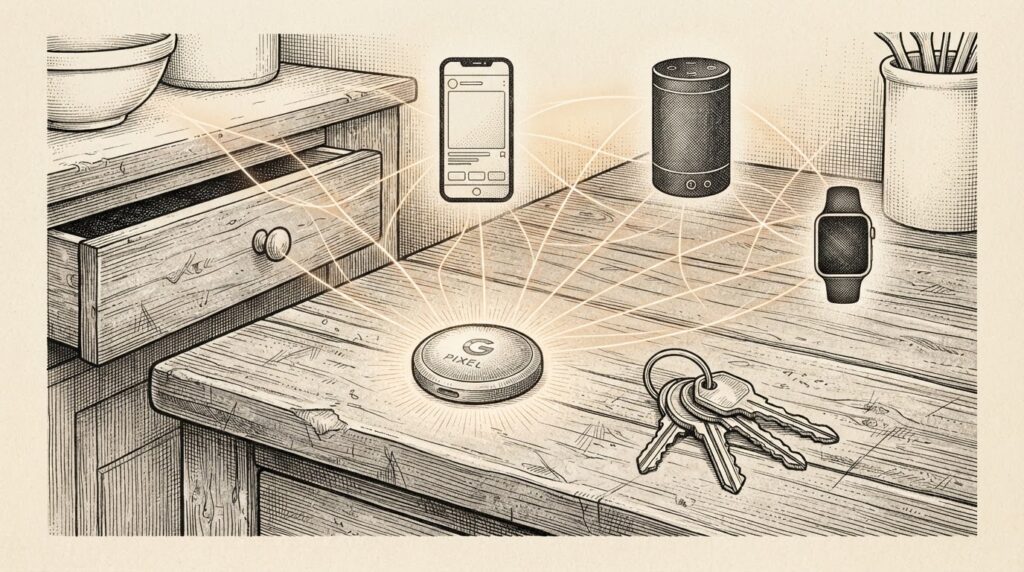
My kitchen drawer is a graveyard for lost keys and forgotten tech. It is the exact place where Google hopes to plant its flag on August 12, 2026, when the Made by Google event streams live at 3:00 PM PT / 6:00 PM ET. While the industry will be buzzing about the Pixel 11 series and its Tensor G6 chip, I am watching the small, circular piece of plastic sitting on the stage: the Pixel Tag.
At roughly $34, the Pixel Tag is Google’s first entry into the Find Hub IoT space. It is more than a tracker; it is a strategic tether to a network leveraging over 1 billion Android devices. By turning every Android phone into a potential node, Google is building an ambient infrastructure that makes the physical world searchable. It is a clever way to ensure I never leave the Google ecosystem, even when I am just looking for my keys.
The hardware connects directly to new Gemini Intelligence features. We are looking at tools like Magic Cue, which pulls data from Gmail and Calendar, and Magic Pointer, which uses gestures to provide contextual information. Then there is Pixel Glow—an RGB LED on the camera bar that lights up during Gemini conversations. It is a tactile way to signal that the AI is listening, serving as the front end for Gemini Spark, a 24/7 personal AI agent running on Google Cloud VMs.
Google is betting heavily on this infrastructure, evidenced by its $5 billion AI Cloud joint venture with Blackstone and the deployment of TPU 8t/8i chips. To recoup that massive investment, they are pushing a tiered subscription model. Plans range from the $4.99 AI Plus plan to the $199.99 AI Ultra tier. By bundling Google Home Premium and YouTube Premium into the Pro and Ultra tiers, Google is using hardware as a loss leader to lock users into a recurring revenue stream.
The integration of Gemini Spark with Workspace and third-party apps via MCP suggests a broader ambient agent layer where the AI follows you across devices. The question for us as consumers is whether this represents a truly integrated ambient computing strategy or just a sophisticated subscription upsell. If I buy a Pixel Tag, am I buying a tool, or am I buying a service that requires me to stay within the Google garden to function effectively?
I am skeptical of the hardware-as-a-service model, but the convenience is compelling. If the Pixel Tag works seamlessly with the Find Hub network, it becomes a utility. If it only works well when I am paying for an AI Pro subscription, it becomes a tax. Google is betting that the friction of switching ecosystems is higher than the cost of their monthly tiers.
Ultimately, the August 12 event is a test of whether Google can convince us that their ambient agent layer is worth the price of admission. They are building the infrastructure to support a 24/7 AI presence in our lives, but they need the hardware to make that presence feel natural. Whether that feels like a helpful assistant or a persistent salesperson will depend entirely on how much value they can deliver beyond the initial purchase.
I keep thinking about that drawer in my kitchen. I want a tool that just works, not another monthly bill to manage. If Google wants me to invite their AI into their home, they need to prove it is there to serve me, not just to keep me subscribed.