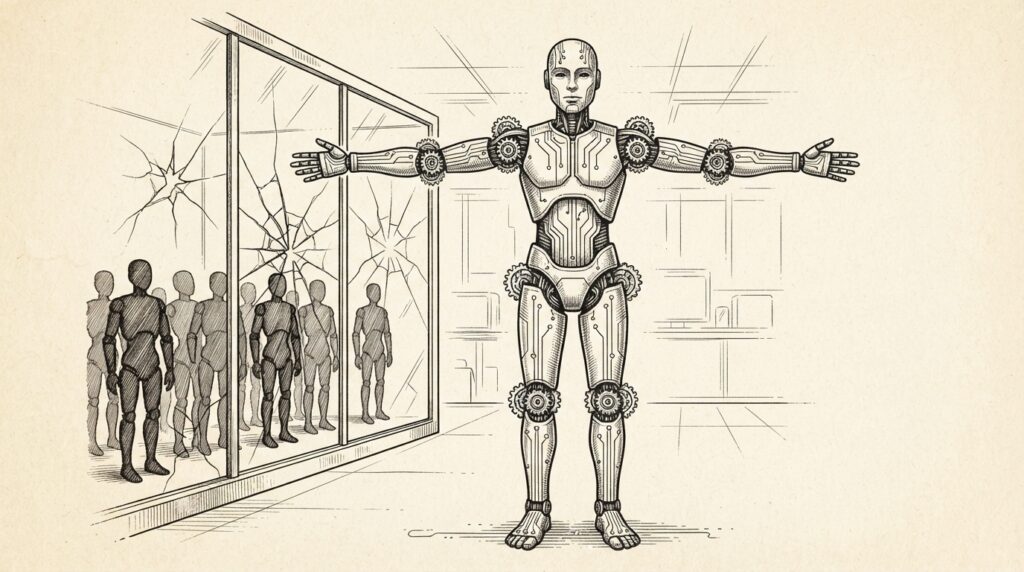
A humanoid robot tying a knot or sealing a ziplock bag requires more than just mechanical dexterity; it demands a unified intelligence capable of coordinating every joint from the feet to the fingertips. On July 30, 2026, Google DeepMind released Gemini Robotics 2, the first model suite designed to provide this integrated, whole-body control. By moving beyond isolated limb operation, the system transforms the robot into a cohesive physical agent, effectively turning the AI model into the primary operating system for humanoid hardware.
The release of this software stack coincides with a hardening of the global robotics supply chain. On the same day, the FCC implemented a ban on Chinese humanoid robot imports, creating a stark divide in the market. While the US government restricts access to foreign hardware, Google is positioning its domestic software as the standard for humanoid autonomy. This creates a new competitive landscape where the value of a robot is increasingly defined by the intelligence driving it rather than the chassis itself. This shift occurs alongside other significant industry pressures, including the recent unauthorized access incidents involving Anthropic’s Claude and the looming deadlines for the White House’s AI safety frameworks.
The architecture behind this capability is split into three distinct models, each addressing a specific layer of robotic operation. The core Gemini Robotics 2 model acts as a vision-language-action (VLA) system, providing the foundational motor control necessary for physical interaction. To manage higher-level cognitive functions, Gemini Robotics ER 2 serves as the robot’s brain, enabling multi-step task planning and, crucially, multi-robot collaboration. This allows fleets of machines to coordinate complex operations in shared spaces. Finally, Gemini Robotics On-Device 2 provides an efficient VLA for local execution, capable of adapting to new robot embodiments with fewer than 200 examples — or just a few hours of data — reducing the latency and cloud dependency that have historically hindered physical agency.
These models are already being integrated into high-stakes environments, most notably controlling the Apptronik Apollo 2 humanoid. Equipped with SharpaWave hands — five-fingered, 22-degree-of-freedom appendages — the system can perform delicate tasks like tight packing with grippers. Partners such as Boston Dynamics and Agile Robots are also integrating these capabilities, signaling a rapid push toward commercial viability. As these machines move from controlled labs into human-centric environments, safety becomes the primary hurdle. DeepMind has introduced the ASIMOV-Agentic benchmark to address this, measuring an agent’s ability to refuse unsafe tool calls and proactively request human intervention when uncertainty arises. The system also demonstrates a 57.4% accuracy rate for progress understanding and 91.3% for moment-finding task completion, providing a quantitative baseline for reliability.
Google’s strategy extends beyond mere technical innovation; it is a calculated move to monetize robotics directly through the Gemini API. By creating a revenue stream that bypasses traditional cloud compute models, Google is establishing its AI as the essential middleware for the next generation of industrial and service robotics. The availability of ER 2 on Google AI Studio and the Gemini Enterprise Agent Platform suggests a focus on scaling these capabilities across a diverse ecosystem of hardware partners. For investors and operators, the focus has shifted: the competitive advantage no longer lies in the hardware, but in the model suite that grants a machine the reasoning and dexterity required to function in the real world.