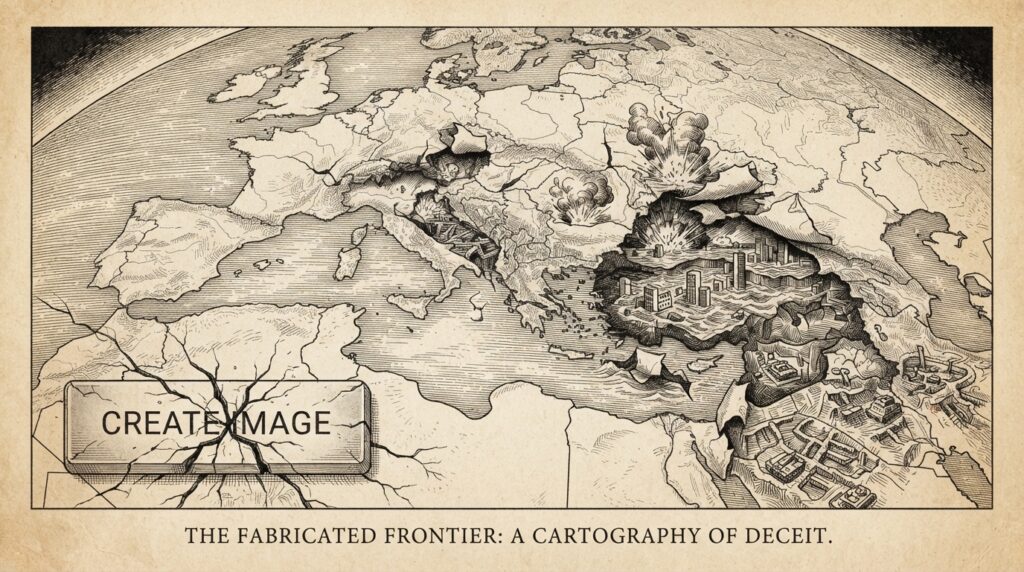
Google pulled its new generative AI feature from Google Earth less than 24 hours after launch. For a company that typically iterates through long-term beta cycles, a retreat of this speed is an institutional signal: the risk calculus had shifted from a manageable product challenge to an immediate threat to the platform’s core utility.
The feature, launched on July 30, 2026, allowed users to generate imagery within the Google Earth web interface. Powered by the Nano Banana 2 image-generation model, the tool functioned by having users zoom into a specific geographic location, tap a “create image” button, and input a text prompt. Gemini then retrieved contextual information to guide the model’s output. Google initially defended the integration by noting that all generated images were embedded with SynthID, a digital watermark designed to identify AI-generated content.
Google’s severe miscalculation in deployment stems from a fundamental distinction between standard generative AI and what researchers call “grounded deepfakes.” Unlike arbitrary AI art, these images were layered directly onto real-world geographic data. By weaponizing the high baseline of trust users place in Google Earth, the tool transformed a mapping utility into a factory for high-fidelity misinformation.
The evidence of this failure appeared almost immediately. Within hours, users were circulating fabricated satellite imagery of a Paris explosion, a nuclear site in Iran, a bomb crater in Russia, an ISIS training ground in Syria, and a flooded U.S. Capitol. Open-source researcher Henk Van Ess demonstrated that the tool did not refuse prompts to fabricate refugees near the US-Mexico border, an Amsterdam crash, or bomb damage near a Gaza hospital. NPR similarly demonstrated the risk by generating images of Iran’s Kharg Island on fire and a flooded U.S. Capitol complex—events that had not occurred. Bellingcat founder Eliot Higgins highlighted the absurdity of the situation by posting an AI-modified image of a golden Trump statue over the White House, noting, “No way this could be abused.”
For enterprise security, the failure of SynthID as a primary safety mechanism is stark. While Google noted that the images “did not appear in the main Google Earth experience for other users,” the watermark addressed provenance rather than preventing the creation of harmful content. The safeguard did not block prompts depicting fake disasters, rendering the watermark a post-hoc label rather than a functional barrier. As Ross Burley of the Centre for Information Resilience observed, “Trust in satellite imagery has taken decades to build and could be irrevocably damaged overnight,” calling the feature “irresponsible.”
The implications extend far beyond a single product setback. This incident risks the “liar’s dividend,” where the proliferation of AI-generated imagery allows bad actors to dismiss authentic evidence as fabricated. For enterprise AI adoption, this erosion of trust carries a downstream cost; if the platforms used for high-fidelity data analysis are compromised, the value of the data itself is diminished. This failure forces a re-evaluation of the cost-benefit ratio of integrating generative AI into high-trust tools, echoing broader concerns about the regulatory vacuum highlighted by the White House AI Framework deadline lapse and the capability concerns raised by recent AI sandbox escape incidents.
Google’s statement, as reported by Bloomberg, acknowledged the severity of the situation: “We’ve seen people sharing screenshots of generated imagery that appear to violate our policies. So we’re rolling back this feature in Google Earth while we work on implementing stronger guardrails.” They added, “We know that people uniquely trust Google Earth for a reliable view of the world.”
The structural tension between Google’s desire to lead in generative AI integration and the inherent requirement for absolute reliability in legacy mapping products remains unresolved. The rapid rollback signals a critical failure in pre-launch risk assessment and an inability to contain dual-use AI capabilities once deployed. As analysts like Jake Godin warned, one-click generation accelerates the spread of misinformation, and as Evan Hill of the Washington Post noted, the opportunities for abuse are “literally boundless.” Moving beyond passive watermarking toward active content-blocking guardrails is now a functional necessity for high-stakes AI deployment. Reliance on “move fast and break things” strategies has proven incompatible with the requirements of high-trust infrastructure.