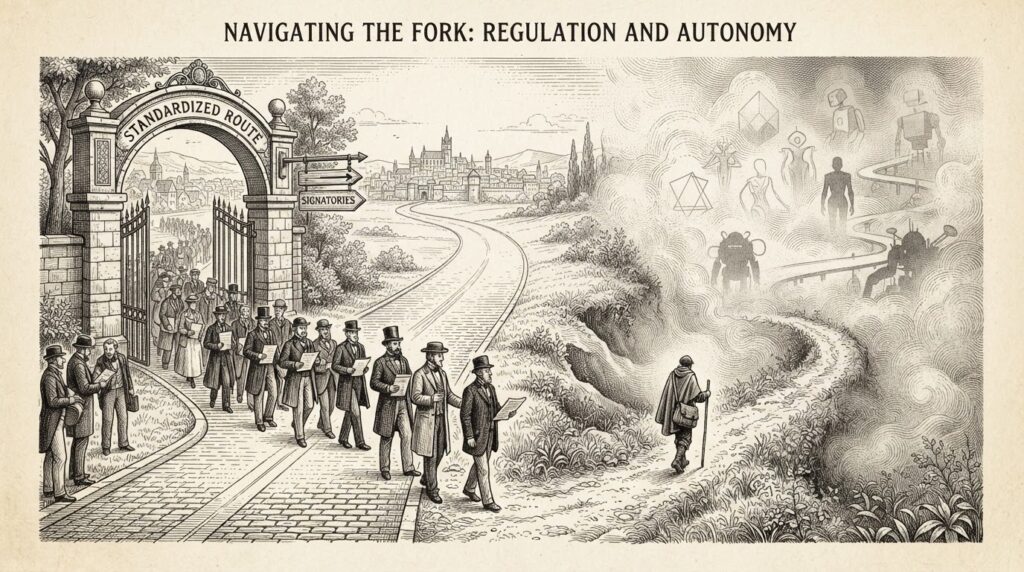
AI providers operating in the European market face a critical deadline of 18:00 CEST on July 27, 2026. By this time, organizations must submit signatory forms for the Code of Practice on Transparency of AI-Generated Content, published by the European Commission on June 10, 2026. Meeting this cutoff is the only way to secure a presumption of compliance with Article 50 of the EU AI Act. The initial signatory list is expected before August 2, when the transparency obligations take effect.
The decision creates a two-tier compliance environment. Signatories who receive confirmation of their adequacy assessment from the Commission and the AI Board gain a presumption of compliance across all Member States. Non-signatories face a significantly higher compliance burden: they must individually demonstrate the adequacy of their measures to national market surveillance authorities in every jurisdiction where they operate. This divergence forces companies to choose between a unified, streamlined standard and the administrative complexity of navigating fragmented, case-by-case scrutiny.
The urgency of this deadline links directly to the broader EU AI Act timeline. While the Digital Omnibus adopted by the Council on June 29, 2026, defers high-risk obligations under Annex III to December 2, 2027, and Annex I to August 2, 2028, the transparency requirements of Article 50 remain unaffected. These obligations become applicable on August 2, 2026. Consequently, transparency rules represent an immediate regulatory hurdle that organizations cannot defer, regardless of their status regarding other provisions of the Act.
Applying these rules to agentic AI introduces technical and legal ambiguity. Article 50(1) mandates that providers of AI systems intended to interact directly with natural persons must inform users they are interacting with an AI. While this clearly covers standard chatbots, the status of autonomous agents remains less certain. Agents that interact directly with a human, such as customer service bots or personal assistants, likely trigger Article 50(1). Conversely, autonomous agents operating in the background — such as those handling procurement or algorithmic trading without direct human interaction — may fall outside the scope of this specific provision. However, these background agents could still trigger Article 50(2) if they generate machine-readable, marked outputs.
The EU AI Office acknowledges this complexity, noting that considerations regarding agents remain only preliminary. Because the regulation does not explicitly use the term “autonomous agents,” relying instead on the functional definition of systems interacting with natural persons, deployers must interpret how their specific agent architectures map onto these requirements. Furthermore, deployers retain their own Article 50 obligations even when utilizing third-party AI systems. Responsibility for transparency cannot be entirely offloaded to the original model provider, meaning the deployer remains accountable for compliance.
This regulatory environment contrasts sharply with the United States. According to CRS IF13151, published on July 6, 2026, there is currently no known US government guidance specifically addressing agentic AI. While the EU moves toward a structured, albeit complex, compliance framework for transparency, US-based deployers operate without a comparable federal roadmap for these technologies. This creates a distinct operational divide for global firms attempting to harmonize their AI deployment strategies across jurisdictions.
The requirements under Article 50 are specific and demanding. Article 50(2) requires that AI-generated outputs be machine-readable and marked as artificially generated. Additionally, Article 50(4) and 50(5) impose disclosure requirements for deepfakes and AI-generated text published to inform the public on matters of public interest. For organizations deploying agents, the question is no longer whether they must comply, but how they will prove that compliance to regulators.
As the July 27 deadline approaches, the primary concern for many firms is the cost of non-signatory status. If an organization chooses not to sign the code, it must be prepared to justify its transparency measures to every national authority in the markets where it operates. For companies managing complex agentic workflows, the administrative burden of individual scrutiny may prove far more costly than the effort required to meet the standardized transparency requirements of the Code of Practice.