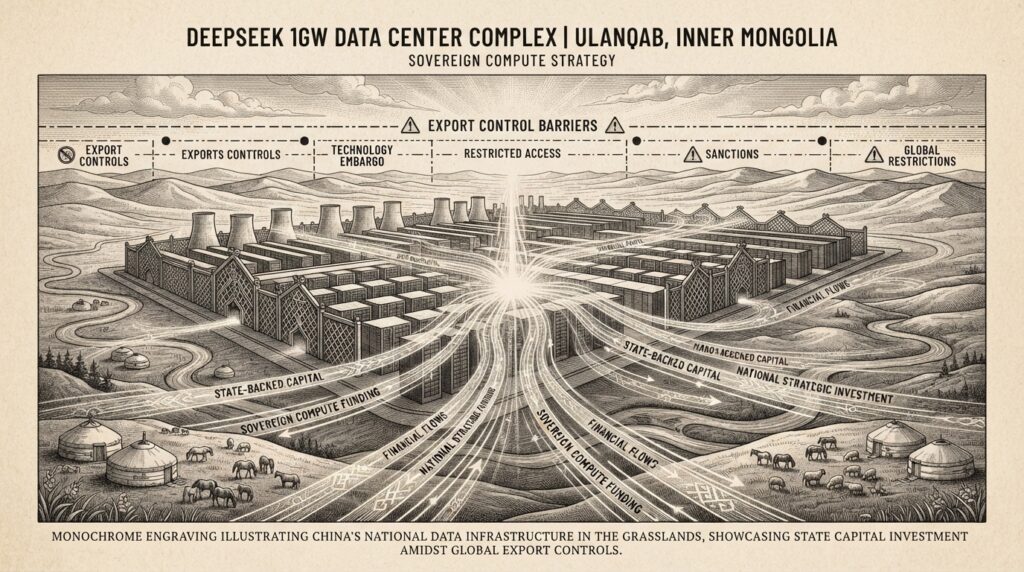
Sovereign compute has moved beyond theoretical policy, manifesting as a tangible race to secure massive, state-integrated infrastructure. DeepSeek’s 1-gigawatt (GW) data center project in Ulanqab, Inner Mongolia, exemplifies this shift, signaling that the next phase of the US-China technology competition will be defined less by individual model performance and more by the sheer scale of state-backed physical capacity.
Ulanqab, a region with a population under 2 million, has become a critical node under China’s ‘East Data, West Compute’ (东数西算) initiative, launched by the NDRC in February 2022. The area already hosts approximately 89 data centers, drawing projects from major entities including Apple, Alibaba, Huawei, and Kuaishou. DeepSeek’s decision to build here aligns with this national mandate to shift compute-heavy workloads from coastal hubs to energy-rich western provinces. The company plans to self-build the facility while leasing additional capacity, with a target for partial operations by late 2027 or early 2028.
Financial projections for such a facility require careful calibration. A $50 billion cost estimate, often cited as a general benchmark by Nvidia CEO Jensen Huang for a 1GW data center equipped with cutting-edge accelerators, provides a useful frame of reference but should not be conflated with DeepSeek’s specific capital expenditure. Nevertheless, the company’s financial backing is substantial; in June 2026, DeepSeek raised approximately $7.4 billion (50 billion yuan) at a valuation between $52 billion and $59 billion, marking the largest private AI financing in Chinese history. Notably, this round involved discussions with a Chinese state-backed semiconductor investment fund, underscoring the alignment between private enterprise and state objectives.
This infrastructure expansion occurs against a backdrop of intense scrutiny regarding export controls. The Trump administration has alleged that DeepSeek obtained Nvidia Blackwell processors—chips effectively banned from sale to China—for its existing Inner Mongolia operations. While a US official confirmed in February 2026 that DeepSeek trained its latest model on these chips, the company has denied the allegations, and Nvidia has stated it has seen no evidence of smuggled hardware. The US House Select Committee on China has further accused the firm of spying and circumventing export controls, though these claims remain contested and unverified by independent technical audits.
The trajectory of DeepSeek mirrors broader patterns in the Chinese AI ecosystem. The involvement of state-backed investors here echoes the $3.5 billion funding seen in Moonshot AI, while the ongoing debate over model distillation techniques and the development of domestic capabilities—as seen with K3 Cyber—highlights the urgency within China to achieve compute independence. These developments also provide context for the policy arguments championed by figures like Dario Amodei, who has advocated for more stringent chip bans to mitigate the risks associated with rapid, state-supported AI scaling.
Looking ahead, DeepSeek is preparing for an IPO on the Shanghai STAR Market, with a filing target of late 2026 and a debut expected in Q2 2027. With annualized revenue nearing $500 million and gross margins of 70-80% on cloud access, the company is positioning itself as a mature, state-aligned enterprise. This transition from a private startup to a publicly traded, state-backed infrastructure giant suggests that the company is being groomed to anchor China’s long-term compute strategy.
The Ulanqab project forces a re-evaluation of the US-China compute race. If a single firm can command 1GW of power and integrate it into a national grid, the traditional metrics of venture-backed innovation become secondary to the ability to secure energy, land, and state-sanctioned hardware. The sheer scale of this infrastructure investment challenges the efficacy of current export restrictions.
As the industry watches the Ulanqab project unfold, the central question remains: can the US maintain a competitive edge through export restrictions alone, or does the sheer scale of China’s state-backed infrastructure investment render those controls increasingly porous?