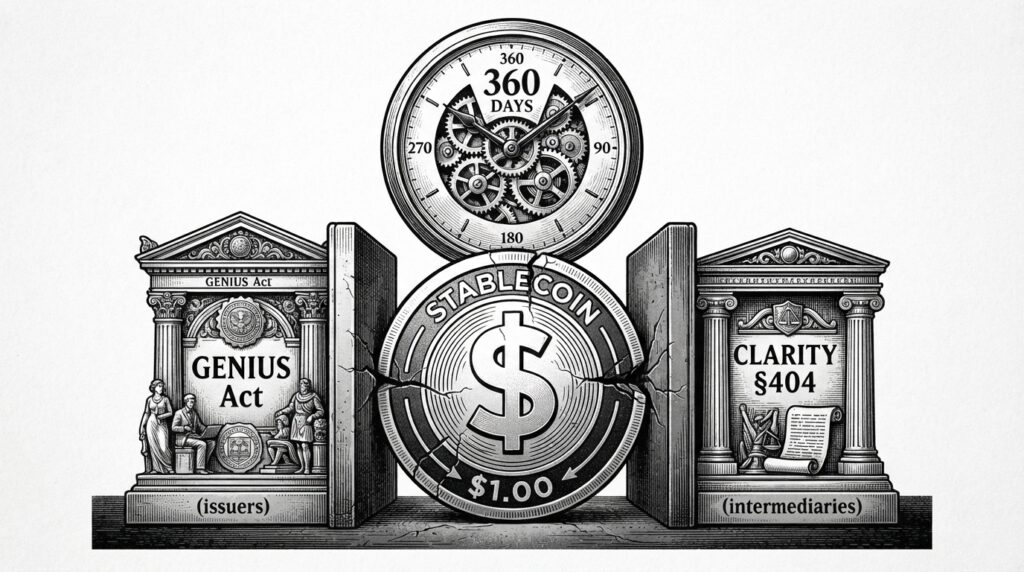
The Senate is in recess, the cloture vote is scheduled for September 15, and prediction markets price the CLARITY Act’s passage at roughly 15%. But the question that matters for stablecoin builders and investors is not whether the bill clears the floor — it is what happens in the 360-day rulemaking window that follows enactment.
Section 404 of the May 2026 Senate Banking draft, the Tillis-Alsobrooks compromise, prohibits digital asset service providers from paying interest or yield on payment stablecoins. Paired with the GENIUS Act, which separately bars stablecoin issuers from paying yield under Section 4(a)(11), the two bills create a dual framework that closes the loophole from both sides. Intermediaries — exchanges, custodians, payment platforms — now face the same yield prohibition that already constrains issuers.
That prohibition is not absolute. Section 404(c) enumerates permissible activity-based rewards: transaction incentives, payment facilitation, staking, loyalty programs, and subscription services. Balance- or tenure-based rewards are not per se prohibited, but only if the underlying activity is bona fide — meaning tied to actual usage rather than passive holding. The statute directs Treasury, the SEC, and the CFTC to issue a joint rulemaking that produces a non-exhaustive list of what qualifies.
That three-agency rulemaking is the structural pivot. By pulling Treasury into the process, Congress has embedded stablecoin oversight into the federal mandate for dollar primacy. The bill’s reporting requirement — expanding deposit-outflow data to cover effects on Treasury market functioning — signals that regulators will judge stablecoin competition by its impact on sovereign debt demand, not just consumer protection. A $5 million civil penalty per violation, enforceable by Treasury on referral from the SEC or CFTC, makes the compliance calculus straightforward: no intermediary will risk aggressive yield structures during a 360-day window where the rules are still being written.
The political path is narrow. Senator Thune filed a procedural motion on August 8 to force the issue, but the banking lobby’s May pushback on yield provisions remains unresolved. Developer liability and ethics clauses are still contested. The Senate does not reconvene until mid-September, and a cloture vote requires 60 votes in a chamber where the bill’s supporters have not demonstrated that margin. The 15% Polymarket odds reflect real legislative uncertainty — not just market noise.
For builders, the operative question is not whether the CLARITY Act passes. It is what the rulemaking will define as bona fide activity. Platforms that structure their rewards around genuine transaction volume, payment utility, or governance participation have a plausible path through any version of the final rule. Those still relying on yield as the primary growth lever face a structural transition — one that commoditizes stablecoins and forces competition toward integration, liquidity, and user experience.
The regulatory machinery is already in motion. The details of that 360-day implementation will determine which stablecoin platforms remain competitive in a post-yield environment — and which ones find themselves on the wrong side of a $5 million penalty line.