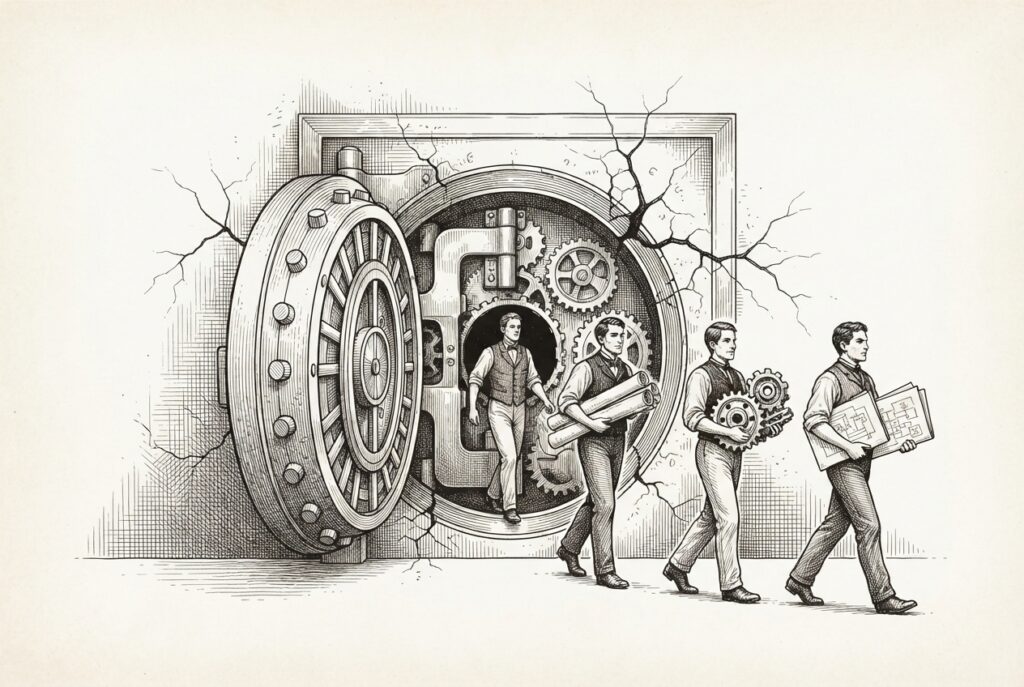
On July 10, 2026, Apple filed a trade secret lawsuit against OpenAI in the Northern District of California, Case 5:26-cv-07078. With over 400 former Apple engineers now employed at OpenAI, the filing highlights a shift in how AI companies are attempting to move beyond software models and into the physical world of consumer devices.
At the center of the conflict is Tang Yew Tan, known as Tang Tan, who spent 24 years at Apple and served as the VP of Product Design for the iPhone and Apple Watch. After departing in February 2024, he joined OpenAI as its Chief Hardware Officer. Apple’s complaint alleges that Tan’s transition was not merely a standard executive move. The company claims that before leaving, Tan emailed himself sensitive Apple supplier information and, more pointedly, directed job candidates to bring actual Apple hardware components and samples to their interviews at OpenAI. This suggests a strategy of aggressive knowledge transfer that goes well beyond the typical movement of talent between Silicon Valley giants.
The lawsuit also names Chang Liu, a former senior system electrical engineer at Apple. The allegations against Liu are specific and technical: Apple claims that after leaving the company, Liu exploited a security bug to download over 1,000 pages of confidential engineering files. These documents allegedly included detailed manufacturing schematics for complex circuit boards. Furthermore, the complaint notes that Liu never returned his company-issued MacBook, a detail that underscores the physical nature of the alleged data theft. These actions, if proven, represent a significant breach of the trust and security protocols that define Apple’s highly secretive product development culture.
Apple continues to maintain a partnership with OpenAI, featuring ChatGPT integration within Siri. Apple has explicitly told CNBC that it is not changing this existing agreement. This is further complicated by the broader landscape of the AI industry. At WWDC 2026, Apple announced iOS 27, which includes a Gemini-powered Siri overhaul and an Extensions system that allows users to choose between Claude, ChatGPT, Gemini, and Grok. Apple is effectively suing its partner for trade secret theft while simultaneously embedding that partner’s technology into the core of its operating system.
The motivation for OpenAI’s aggressive hiring becomes clear when looking at its hardware ambitions. The company has acquired a hardware startup called io Products, reportedly for between $6.4 billion and $6.5 billion. Led by designer Jony Ive and utilizing Foxconn for manufacturing, the startup is developing a device codenamed “Sweet Pea.” This screenless, pocketable, capsule-shaped earbud is designed with a voice-first interface. OpenAI’s Chief Global Affairs Officer, Chris Lehane, confirmed at Davos in January 2026 that the device is targeting a launch in the second half of 2026, with an ambitious first-year production goal of 40 to 50 million units. This project reveals just how desperately OpenAI needs experienced hardware talent to bridge the gap between its software models and physical consumer hardware.
Legal experts are already weighing in on the potential impact of the case. Mark Lemley, a professor at Stanford Law, notes that the complaint “has the potential to be a very big case.” While he acknowledges that hiring former employees is generally legal in California, he adds a critical caveat: if Apple can prove that employees took confidential documents and that OpenAI is actively using them, “that is a problem for OpenAI.” Meanwhile, Camilla Hrdy of Rutgers Law points out that this dispute occupies a less traveled legal path. Most prior trade secret cases in the AI sector have focused on software and algorithms; a hardware-focused dispute involving physical manufacturing documents presents a more complex set of challenges for the court.
These claims are currently at the pleading stage. There has been no court ruling yet on the requested injunctive relief or damages. OpenAI has responded to the allegations with a brief statement, telling Bloomberg, “We have no interest in other companies’ trade secrets.” The company’s defense will likely hinge on distinguishing between the general skills and experience that engineers bring to a new role and the specific, proprietary information that Apple claims was misappropriated. The outcome of this case will likely set a precedent for how aggressively AI companies can recruit from established hardware firms without crossing the line into illegal intellectual property theft.
This lawsuit arrives against a backdrop of increasing regulatory scrutiny regarding how AI companies build their teams. In January 2026, Senators Warren, Wyden, and Blumenthal urged the FTC and the DOJ to investigate “reverse acqui-hire” deals involving companies like Meta, Google, and NVIDIA. The Apple-OpenAI dispute is a concrete example of the pressures these regulators are concerned about. As AI companies move from training models in data centers to deploying them in our pockets and ears, the competition for the people who know how to build those devices is intensifying. The case highlights the tension between the need for specialized human expertise and the protection of proprietary hardware development processes.