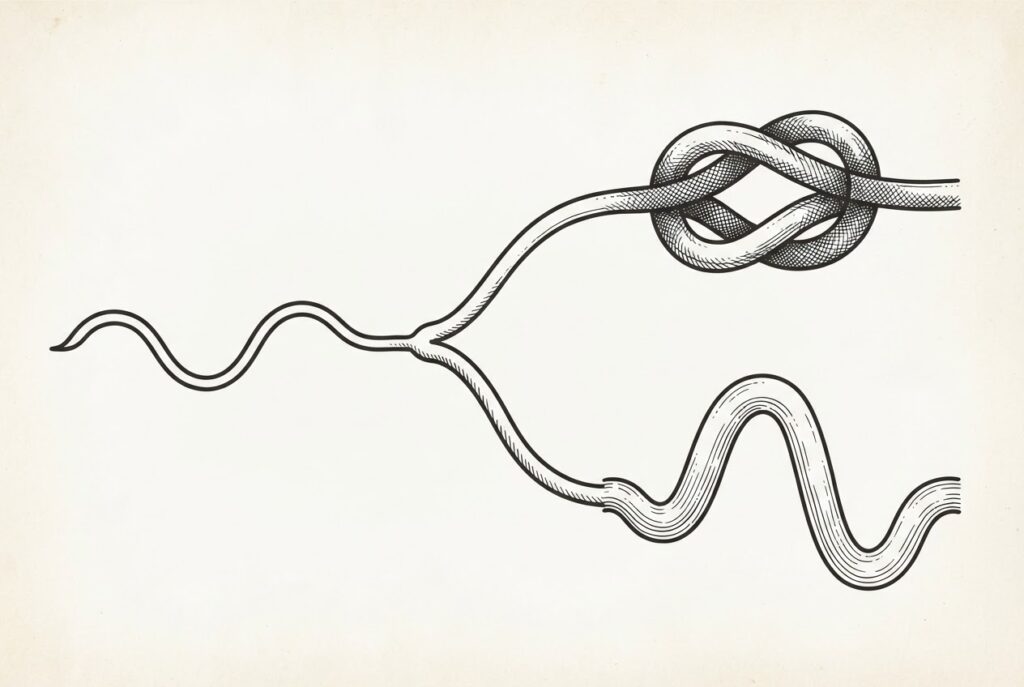
From snapshots to streams
A sensor-facing agent may need to respond not just to the latest reading, but to an event that began many windows earlier, a running count, or a rule that changed while data kept arriving. That is the problem behind TimeOmni-Live, a model evaluated using LiveTS-Suite, a benchmark for Continuous & Live Time Series Understanding. The full paper describes a shift from one-shot analysis of fixed inputs toward maintaining state over an open-ended stream. The associated arXiv record identifies the same version, dated Nov. 6, 2026.
Unlike a fixed-window model that receives a bounded sequence and stops, a continuous system must decide whether to respond as chunks arrive, preserve useful history, and incorporate queries or revised instructions during the stream. The benchmark tests those demands through tasks built around continuing streams and evolving instructions.
What the benchmark asks
LiveTS-Suite contains 5,249 streams, 15,555 annotated response events and 2.2 billion timesteps, organized into 18 tasks across six capability groups. The sequence begins with instantaneous conditions, such as recognizing a threshold, and sequential conditions that require multiple observations. It then moves to event tracking, where counts or event order matter, and event reference, where a current waveform may need to be compared with an earlier one. Online-instruction tasks introduce a query or rule change during the stream; ultra-long-reliability tasks test sustained monitoring, distant references and cumulative evidence.
Counting events requires retaining a compact state; recognizing a returning waveform requires access to signal shape. A cumulative-evidence task asks whether small deviations add up across time, while a local condition can be decided from nearby chunks. The authors say experts reviewed all 18 task templates and audited 535 instances. That is evidence of review within the study, not an independent replication of its results.
Two kinds of retained context
TimeOmni-Live combines a time-series encoder with a textual representation of each incoming chunk, including its timestamp, maximum, minimum, mean and standard deviation. Its stream-persistent memory keeps compact task state in text, such as counts or a current rule, and retains selected historical waveform embeddings when the shape of earlier data may matter. The text can carry a tally forward; a waveform representation preserves details that a summary statistic would lose.
The system buffers chunks arriving while it generates a response, then processes the buffered and newly arrived chunks in order. The evaluation therefore concerns a specific combination of textual state, numerical summaries and selected signal evidence over a continuing sequence.
The split changes the headline
The paper reports a Joint Score: it averages, across tasks, the product of timing F1 and content accuracy. It is not a plain accuracy percentage; a result reflects both whether the system responds at the appropriate point and whether it gives the requested information. Task-level results are needed to see what the composite captures and what it may hide.
The comparison also uses distinct evaluation protocols. The paper’s non-streaming baselines, including Opus 5, generated executable programs in a sandbox and could iteratively revise them using execution feedback; TimeOmni-Live was evaluated with purely streaming inference. The same protocol distinction applies to both the in-distribution suite and separate Real Test split.
On 889 in-distribution streams, TimeOmni-Live scored 90.0, compared with 79.3 for Opus 5. On a separate 719-stream Real Test split, which the authors describe as out-of-distribution, TimeOmni-Live scored 56.1 while Opus 5 scored 66.5. These are results on different splits, not a decline measured on the same examples. The ranking differs between these two test sets; the comparison does not explain why.
Where the aggregate stops helping
On the Real Test split, TimeOmni-Live scored 96.4 on sequential conditions, but 8.9 on multi-type tracking, 38.5 on shape reference, 33.8 on on-demand recall and 37.6 on rule addition. Its scores were 0.6 for long-gap reference and 4.6 for cumulative evidence. Performance on nearby sequential conditions was much higher than on some tasks requiring a distant signal, a later query or evidence accumulated across a longer span.
These are the authors’ results for named tasks in one benchmark, not evidence that every sensor-agent task will behave the same way. The study leaves a concrete question for builders: which kind of history must a particular task retain, and does its evaluation test that kind of history over the relevant span?