Last week, this desk identified four institutional settlement rails that activated or expanded in a single month: SoFiUSD on Mastercard, Visa stablecoin settlement, Stripe’s $1.2 billion card volume, and Solana DvP atomic settlement. There is a fifth, and it is the one that makes the other four possible.
On May 13, 2026, J.P. Morgan Asset Management launched JLTXX – the JPMorgan OnChain Liquidity-Token Money Market Fund – on public Ethereum mainnet. It is a registered government money market fund under SEC Rule 2(a)-7, holding exclusively U.S. Treasury securities and overnight repurchase agreements. One token equals one share, priced at $1.00 NAV, with daily dividend reinvestment. The initial commitment was $100 million from JPMorgan’s own asset management arm, with additional participation from Anchorage Digital. By October 2026, on-chain assets under management had grown to approximately $677 million to $755 million, according to rwa.xyz tracking data.
JLTXX is the second tokenized money market fund from JPMorgan. The first, MONY, launched in December 2025 as a 506(c) private placement accessible only to accredited investors. JLTXX represents the shift to public Ethereum – the same chain where most stablecoin infrastructure already operates. The fund runs on JPMorgan’s Kinexys Digital Assets multi-chain tokenization solution, with subscriptions and redemptions available through the Morgan Money platform in cash or stablecoins. Minimum investment: one million USDC.
BlackRock arrived earlier and larger. BUIDL – the BlackRock USD Institutional Digital Liquidity Fund – launched in March 2024 via Securitize and has reached approximately $2.25 billion in total assets under management across nine chains, including Ethereum, Solana, and Avalanche. But the more significant product arrived on August 3, 2026: BSTBL, the BlackRock Select Treasury Based Liquidity Fund. BSTBL is a tokenized share class for an existing approximately $6.1 billion BlackRock money market fund, and it was designed from inception to qualify as an eligible reserve asset for payment stablecoin issuers under the GENIUS Act.
The reason these products matter – and the reason they constitute a structural layer rather than just another institutional product launch – lies in a single paragraph of the GENIUS Act itself. Section 4(a)(1)(A) lists the eligible reserve assets that permitted payment stablecoin issuers must hold on a one-to-one basis against outstanding tokens. The list includes U.S. currency, demand deposits, Treasury securities with maturities of 93 days or less, overnight repurchase agreements, and securities issued by registered government money market funds. Critically, the statute also permits the “tokenized form” of any of these reserve assets, provided the tokenization complies with applicable law.
This is the mechanism. Registered government money market funds that invest exclusively in qualifying Treasury securities and repos are a permitted reserve category. Tokenized versions of those funds are explicitly allowed. JLTXX and BSTBL are not experiments – they are the precise regulatory instrument that the GENIUS Act contemplates for stablecoin reserves.
The implications are structural. Beginning January 18, 2027, no person may issue a payment stablecoin in the United States without an appropriate federal or approved state license, and every licensed issuer must maintain one-to-one reserves using only eligible assets. The pool of compliant, tokenized, yield-bearing reserve vehicles that can operate on-chain, settle 24/7, and integrate directly into stablecoin issuance protocols is not large. It is, at present, essentially two: JLTXX and BSTBL.
The concentration limit in the GENIUS Act – no more than 40% of reserves with any single financial institution – means that most issuers will need both products, not one. This is not a competitive market forming; it is a regulated duopoly crystallizing around the deadline. JPMorgan and BlackRock are building the reserve infrastructure that every compliant stablecoin issuer in the United States will depend on, and they are building it before most issuers fully understand that they need it.
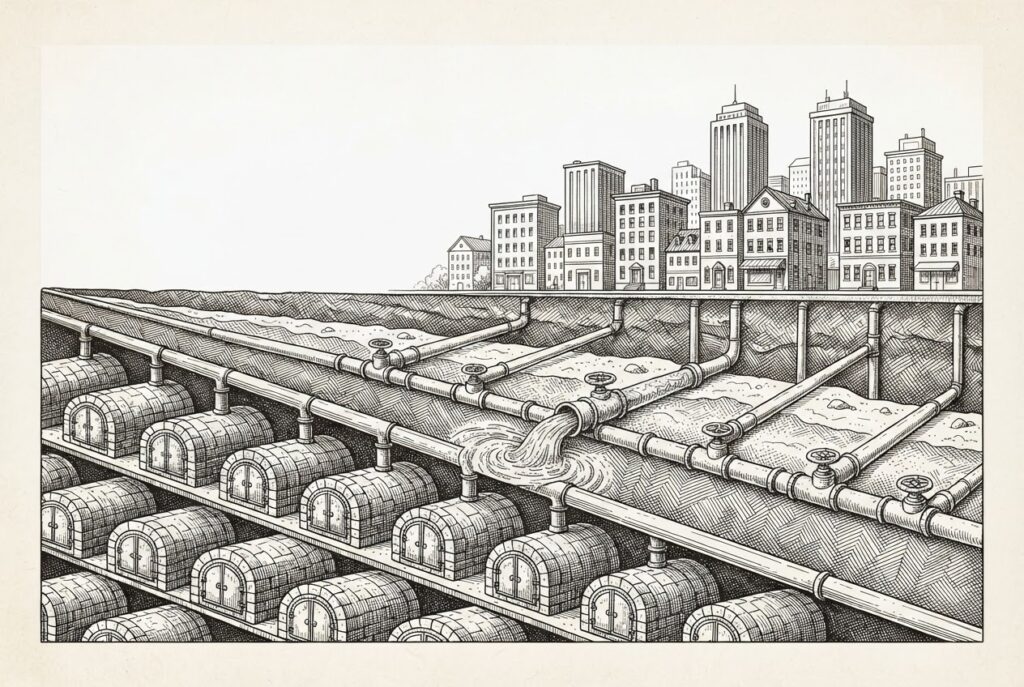
The four rails identified in last week’s Capital Flows analysis – settlement, card volume, tokenized equities, and atomic DvP – are the visible infrastructure. The fifth rail is the reserve layer that feeds them all. Without compliant reserve vehicles, the stablecoin issuers that power those rails cannot legally operate after January 2027. JLTXX and BSTBL are not riding the institutional stablecoin wave. They are the foundation it is built on.