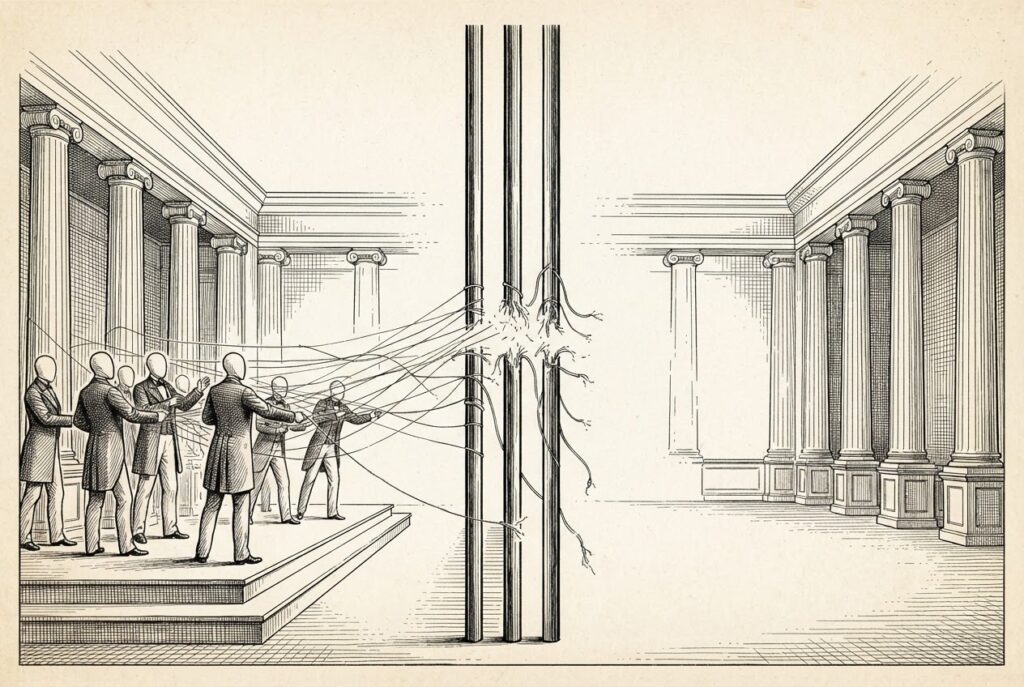
Six days before a consumer class action accused four of the largest AI companies of running an illegal cartel, Anthropic CEO Dario Amodei published an essay laying out what he called a three-step plan for “pacing the frontier” of AI development. The second step was explicit: frontier AI companies within democratic countries should coordinate to establish common safety standards and limits on the rate of unchecked progress. Amodei acknowledged the legal problem in a single footnote. “Some forms of coordination that would be impactful for pacing are legally challenging,” he wrote, “and will require government support.” The footnote specified: “With government mediation or waivers of antitrust restrictions.”
On September 18, the Northern District of California received a complaint that treats that coordination not as a safeguard but as a crime.
What the complaint alleges
Buist et al. v. Anthropic PBC et al. (N.D. Cal. No. 3:26-cv-10693) alleges that Anthropic, OpenAI, SpaceXAI, and Google violated Section 1 of the Sherman Antitrust Act by forming what the plaintiffs call “a classic output-restricting cartel.” The theory: the four companies coordinated to collectively slow the pace of AI development, overcharging subscribers and suppressing product improvements in the process. The complaint references a working group that has been operating since July 2026 and a prior OpenAI inquiry into the antitrust legality of a collective slowdown.
The factual allegations are unproven. The defendants have not yet been heard. But the structural claim is what makes this case worth watching regardless of its outcome: it argues that the same coordination the industry’s safety advocates have been calling for — and that Washington’s regulatory framework quietly depends on — is itself a violation of federal law.
Where the collision lives
Amodei’s essay, published September 12 on his personal blog, received near-immediate endorsements from OpenAI CEO Sam Altman — “I agree with Dario that we need to pace the frontier” — and from Elon Musk. The proposal was not marginal. It called for embedded third-party evaluators inside every frontier lab, common safety standards across companies, and checkpoints linking model capabilities to alignment certifications. The mechanism for achieving all of this was industry coordination.
Three days later, Senator Josh Hawley posted a response on X. It was nine words: “No antitrust exemptions for AI. Not a chance.”
Hawley’s statement closes the legislative escape hatch that Amodei’s plan requires. Without an explicit antitrust waiver, any agreement among competitors to limit output — even for safety reasons — faces scrutiny under the Sherman Act. The FTC, which does not operate under a dedicated AI statute, applies existing Section 5 standards to both unfair or deceptive practices and unfair methods of competition. Safety coordination could trigger both theories.
The structural fork ahead
The lawsuit forces a structural choice that US AI policy has been deferring.
One path runs through the courts. Existing doctrine offers several entry points for safety coordination: the rule of reason permits properly structured joint safety evaluations; the ancillary restraints doctrine allows agreements that are subordinate to a productive joint arrangement; the Noerr-Pennington doctrine protects competitors who jointly petition the government. If the defendants can persuade the court that safety coordination fits within one of these frameworks, the self-regulation model survives — but only after expensive litigation that will chill near-term coordination.
Another runs through Congress. This is what Amodei asked for and what Hawley flatly rejected. The Cruz-Klobuchar-Thune Duty-of-Care Bill, which would give the Commerce and Homeland Security departments authority to police powerful AI models, represents a different legislative approach: direct federal oversight rather than industry self-governance. But it does not address the antitrust question. Until a bill explicitly immunizes safety coordination, companies face the choice between legal risk and regulatory silence.
The third runs through federal agencies acting alone. If industry coordination is legally perilous, the burden of setting and enforcing safety standards shifts to existing regulators operating under existing statutes. The FTC’s Section 5 authority is broad but untested in this domain. Proposals for a FINRA-style self-regulatory organization under the Center for AI Standards and Innovation face their own constitutional hurdles — the private nondelegation doctrine and procedural due process requirements that courts have been tightening since the Horseracing Integrity and Safety Authority litigation.
What the framework assumes
The deeper issue is not which path wins but what the current framework assumes. Every major US AI governance proposal — from voluntary industry standards to embedded evaluators to the G20 Carolina Principles — presumes that companies can and will coordinate on safety. The antitrust lawsuit tests that assumption against law that has been on the books since 1890.
If the court finds that safety coordination is indistinguishable from output restriction, the regulatory architecture does not need to be rewritten. It needs to be rebuilt from a different foundation — one where the government sets the standards and enforces them directly, rather than relying on the industry to do it together.
The defendants will argue that safety coordination increases output in the long run by preventing catastrophic failures. The plaintiffs will argue that slowing development is slowing development, regardless of the motive. The court’s answer will determine whether “pace the frontier” is a policy proposal or a conspiracy theory.