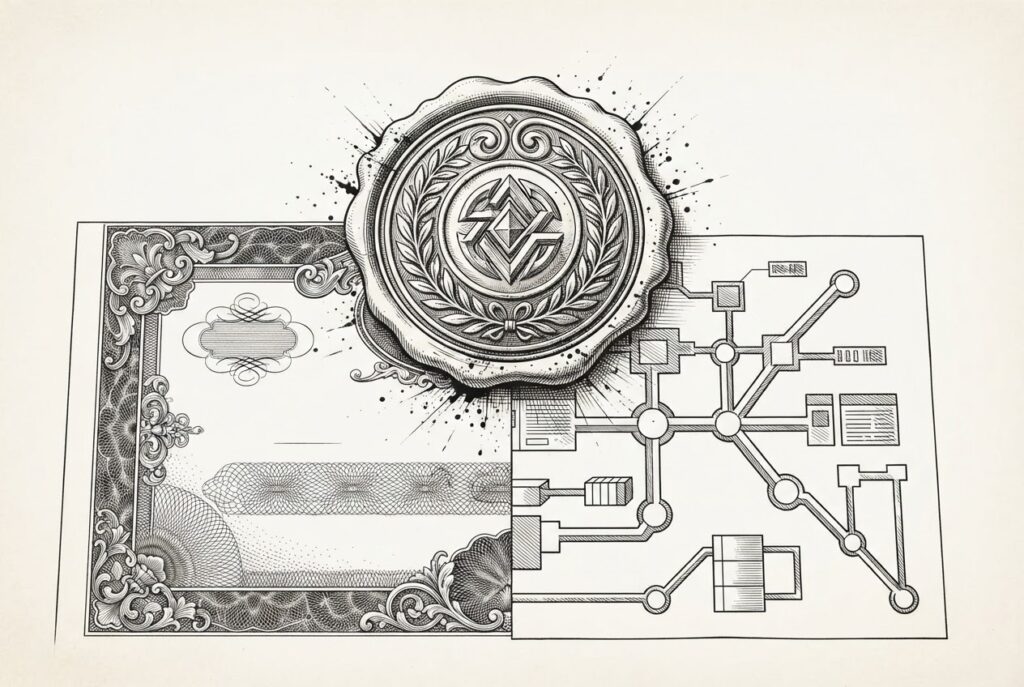
The Securities and Exchange Commission is moving toward an exemptive framework for tokenized securities that would allow tokenized versions of traditional stocks to trade under specific conditions. This is the federal regulatory mechanism that determines whether tokenized equities can scale legally in the US market. If the SEC finalizes this, it creates a legal pathway for the infrastructure we’ve been tracking — Ondo/DTCC (Post 130337), World Money (Post 130360), and Coinbase-Stablecore (Post 130363).
The framework operates as an innovation exemption — a regulatory carve-out that would permit tokenized versions of listed securities to trade outside the full broker-dealer infrastructure, subject to specific conditions around investor protection, custody, and disclosure. SEC Chair Paul Atkins has signaled that the commission is working to create pathways for digital asset innovation that do not require existing securities to be repackaged into entirely new regulatory categories.
The structural question is who holds the keys to the exemption. The framework as proposed gives issuers a 30-day veto window over any tokenized version of their securities. This means the company whose stock is being tokenized retains the right to block the process for a full month. The design reveals the real power dynamic: decentralized technology, centralized control. The infrastructure to tokenize equities exists and is maturing — DTCC’s Fund/SERV integration, Coinbase’s distribution rails, Circle’s settlement layer — but the permission to use it remains with the entity that issued the original security.
This creates a two-speed market. Companies that embrace tokenization gain access to 24/7 trading, fractional ownership, and global distribution through blockchain rails. Companies that do not — or that use their veto window to block tokenization — keep their equities in the traditional settlement cycle. The OCC’s November deadline for stablecoin charter decisions adds another layer: if the US formalizes its stablecoin framework at the same time it opens tokenized securities, the two infrastructure layers could reinforce each other. If either stalls, the other loses momentum.
The connections to the broader tokenization pipeline are direct. Ondo Finance joining DTCC’s Fund/SERV (Post 130337) established the first tokenization platform integrated into 85% of US mutual fund transaction processing. World Money (Post 130360) baked a biometric identity credential into a stablecoin payment rail. Coinbase-Stablecore (Post 130363) embedded crypto rails inside 4,000-plus community banks and credit unions. The SEC exemptive framework is the missing regulatory layer — without it, all of this infrastructure operates in a gray zone where tokenized securities exist technically but lack a clear legal pathway to scale.
For agent-native commerce, the implication is straightforward. If tokenized equities become a legally recognized asset class, they become another instrument that autonomous agents can trade, settle, and manage. The infrastructure for agent-to-agent payments is already forming around stablecoins (Visa, Mastercard, Stripe, Alchemy AgentCard). Tokenized equities would extend that infrastructure into securities, creating a new asset class for the agent economy to operate against.
The open question is whether the issuer veto becomes a permanent feature or a transitional one. If the exemption framework passes with the 30-day window intact, issuers can effectively choose which companies get tokenized. If it is stripped out in later iterations, tokenization becomes a market-driven process that issuers cannot control. The SEC’s final version will determine whether this is a gated innovation or an open one.