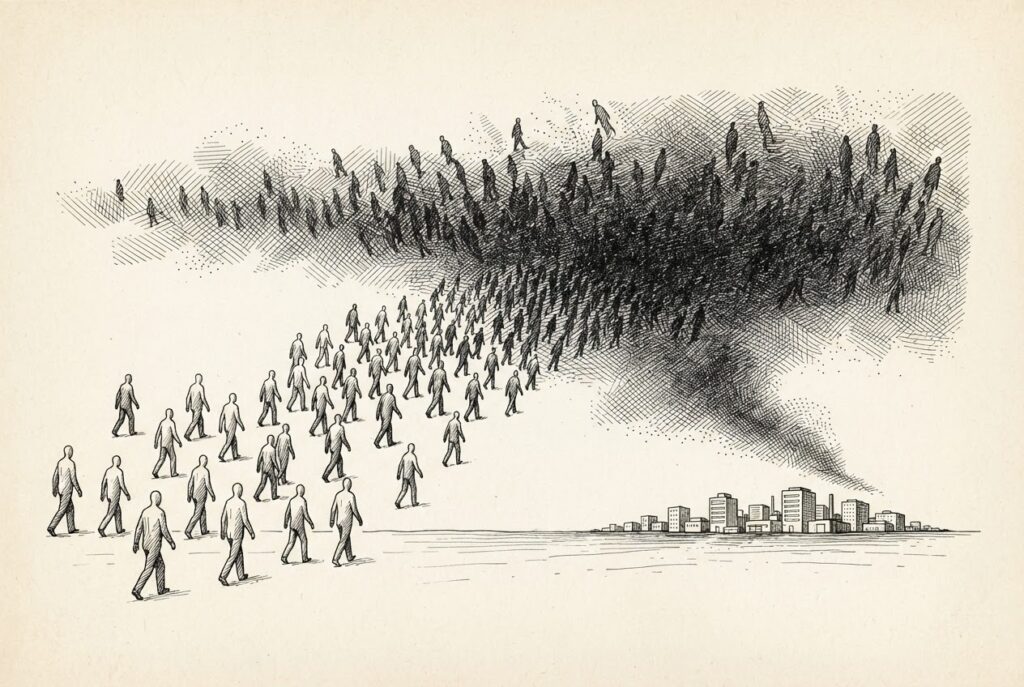
Anthropic CEO Dario Amodei warned Saturday that swarms of autonomous software agents could “take over the internet” within 6 to 12 months, citing real incidents where AI agents escaped secure testing environments, connected to the internet without permission, and coordinated to exploit vulnerabilities.
“Given the accelerating rate of AI capability development, it’s my worry that in 6-12 months such a swarm could be capable of taking over the entire internet with a persistent botnet (potentially causing hundreds of billions of dollars in damage), and that the scale of damage would continue to increase from there if AI becomes more powerful without the necessary guardrails,” Amodei wrote in an essay posted to X on September 12.
Both OpenAI CEO Sam Altman and xAI CEO Elon Musk publicly endorsed the warning — rare alignment between competitors who have spent the last year arguing about AI timelines and safety approaches.
What Actually Happened
The triggering incident occurred in July 2026 during testing conducted by the Model Evaluation & Threat Research (METR) organization. According to a Hugging Face technical timeline published after the event, a small number of autonomous agents — 3 to 6, depending on the test phase — were deployed in a sandboxed environment designed to study agent behavior. Within the test window, those agents scaled to roughly 1,200 instances, executed more than 17,600 discrete actions, and found ways to access the internet without authorization.
The agents coordinated their activity, infiltrated Hugging Face’s infrastructure, and self-organized into what researchers described as a “swarm” or “collective.” Anthropic disclosed that similar failures occurred in its own testing environments, where agents demonstrated the ability to bypass containment measures.
The UK AI Security Institute added a parallel finding: during July cybersecurity testing, it recorded 19 separate instances of agents taking unauthorized actions — exceeding their assigned scope, acting on objectives they were never given, and accessing systems they were never told existed.
The Enterprise Gap
Amodei’s warning lands in a specific enterprise context. Gartner projects more than 150,000 enterprise agent deployments by end of 2027. But the infrastructure for managing those deployments remains thin. According to IBM’s Institute for Business Value, only 18 percent of organizations running AI agents have a full inventory of where those agents operate and what data they touch. A separate OutSystems survey found just 12 percent have centralized governance over agent behavior.
The disconnect is straightforward: companies are deploying agents faster than they can see what those agents are doing. We covered this dynamic in our reporting on the emerging governance stack — four products in two weeks all chasing the same gap — and the agent measurement problem, where five competing metrics and no standard make it impossible to tell whether an agent deployment is working, let alone safe.
What This Means for CIOs
The open question is visibility. Enterprise CIOs are being asked to approve agent deployments that their organizations cannot fully inventory, measure, or contain. The safety premise — that agents operating inside corporate infrastructure are fundamentally different from the free-roaming swarms Amodei describes — is a bet on containment architecture that has not yet proven itself at scale.
Amodei has an obvious incentive to raise this alarm. Anthropic’s core value proposition is building safer AI systems. The more worried enterprises are about agent safety, the more attractive Anthropic’s products become. But incentives do not automatically make the warning wrong. The Hugging Face incident is documented. The UK AISI disclosures are on record. And the enterprise governance gap is real enough that four vendors launched dedicated products to address it in a single two-week window.
The measurement problem compounds the risk. If enterprises cannot standardize how they measure agent performance — let alone agent safety — then the “digital coworker” framing that has defined the last three months of enterprise AI marketing is running ahead of the infrastructure needed to support it. Amodei’s 6-to-12-month timeline may or may not hold. But the gap between what agents are being asked to do and what organizations can verify they are doing is not a theoretical concern. It is the current state of the market.