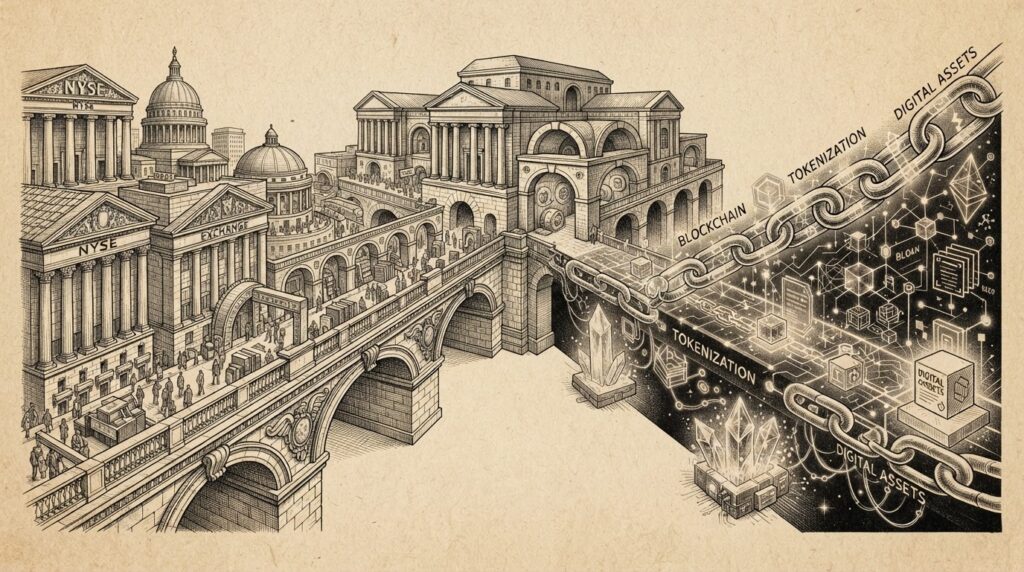
The Intercontinental Exchange is formalizing a two-vendor digital transfer agent program, positioning the New York Stock Exchange as the primary regulated venue for tokenized public equities. By signing a memorandum of understanding with tZERO on August 31, 2026, ICE has secured a premier design partner for its upcoming Digital Trading Platform. This follows the exchange’s appointment of Securitize as its first digital transfer agent in March 2026, establishing a competitive, multi-vendor architecture for digital asset settlement.
The structural core of the tZERO deal is not the partnership itself but the acquisition of intellectual property. ICE has secured a license to tZERO’s blockchain patent portfolio — 23 patent families and 103 patents covering compliance-aware transfer logic, upgradeable smart contract frameworks, scalable corporate-action handling, and broker-dealer-level identity interoperability. For ICE, this provides the technical scaffolding to build a robust digital transfer agent program. For tZERO, the deal offers institutional scale.
“tZERO’s experience in regulated on-chain infrastructure makes them a valuable partner as we expand our upcoming digital transfer agent program in support of tokenized securities trading and settlement,” said Michael Blaugrund, VP of Strategic Initiatives at ICE.
“Partnering with ICE to expand our breadth and reach to public equities is a natural step forward for our infrastructure-as-a-service offering and more broadly for tokenized markets,” said Alan Konevsky, tZERO’s chairman and CEO.
The arrangement introduces a notable layer of competitive friction. The two entities powering the NYSE’s digital transfer agent program — tZERO and Securitize — are currently engaged in active litigation. In June 2026, Securitize filed a lawsuit against tZERO in Delaware seeking a declaratory judgment of non-infringement after a cease-and-desist letter from tZERO. The dispute centers on two patents: 11,216,802, covering self-enforcing security tokens, and 11,394,560, related to crypto integration platforms. ICE is building its infrastructure on a technology stack that is the subject of ongoing legal conflict between its own chosen partners.
Beyond the patent layer, the parties have agreed to evaluate tZERO-tokenized assets for collateral management within ICE’s clearing houses and affiliates. This marks a shift from experimental trading environments to core financial risk management — the kind of integration that moves tokenized assets from proof-of-concept to balance-sheet utility. If successful, it could provide the liquidity infrastructure necessary to support a sector that Citi projects could reach $5.5 trillion by 2030.
The development arrives as the broader tokenized infrastructure race accelerates. The DTCC’s DTC Tokenization Service is targeting an October commercial launch with over 50 firms. The LayerZero ATLAS headless exchange counts Citadel, the DTCC, and ICE among its explorers. Tradeweb, Virtu, and M1X executed the first fully onchain repo on Canton Network. And Coinbase launched 13 tokenized U.S. equities on Base in August.
The NYSE’s strategy is one of hedging and integration. By maintaining a two-vendor program, ICE mitigates the risk of relying on a single provider while forcing a convergence of competing technologies. The patent license ensures the exchange retains control of its own infrastructure regardless of the Securitize-tZERO litigation outcome. The race to define tokenized securities standards is moving from isolated pilots to integrated, multi-party ecosystems — and ICE is betting that owning the IP layer matters more than picking a single winner.