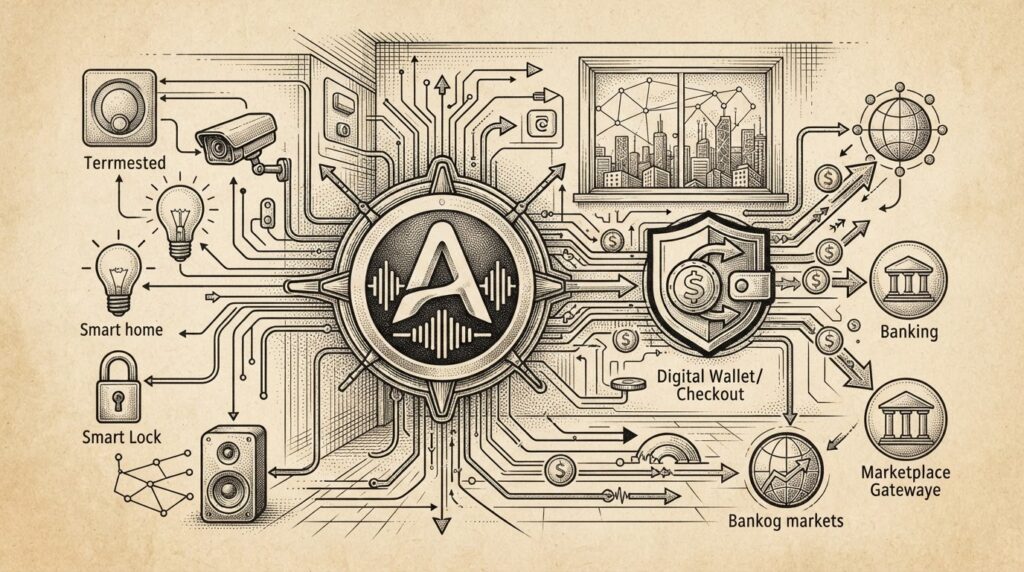
I spent last Tuesday trying to get my smart home to actually act like a home, rather than a collection of disconnected apps fighting for my attention. It usually involves three different logins and a prayer. But with Amazon’s July 2026 adoption of the Model Context Protocol (MCP) for Alexa+, the friction is finally starting to dissolve. By turning devices into programmable agent tools, Amazon isn’t just updating a voice assistant; they are closing the loop on agentic commerce at the protocol level.
This shift builds directly on our previous reporting in Amazon Is Turning Your Living Room Into a Checkout Counter, where we identified the Amazon Wallet as the primary monetization engine. Back then, the vision was a checkout counter in your living room. Now, that counter is becoming a fully integrated part of the infrastructure. By adopting the open standard introduced by Anthropic and now hosted by the Linux Foundation—often dubbed the “USB standard for AI”—Amazon is allowing brands to bring their own MCP servers directly into the Alexa+ ecosystem.
The technical heavy lifting is handled by “Alexa+ for Builders,” which inspects a brand’s MCP server, maps out an integration path, and spits out a simulator-ready package. For the end user, this means the “messy” natural language requests—like “make sure the house is secure and order more filters for the air purifier”—are now routed across brands with actual intent. We are seeing initial support from heavy hitters like Bosch, Whirlpool, iRobot, Yale, and Eufy. These aren’t just simple on-off switches anymore; they are agentic endpoints.
The commerce implications are clear: Amazon is monetizing the protocol. Amazon Wallet is now available to these brands via the MCP toolkit and Category SDKs. This enables in-conversation checkout using saved payment methods, effectively removing the “go to your phone to confirm” step that kills conversion rates. As Morgan Stanley Research projects, agentic AI shoppers could account for up to $385 billion in U.S. e-commerce spending by 2030. Amazon is positioning itself to capture the transaction fee on every one of those automated household replenishments.
Beyond the transaction, the user experience is getting a visual upgrade. Alexa+ now supports the MCP Apps extension, which allows developers to render interactive UIs—think live maps, maintenance dashboards, or even mini-games—directly within the Alexa conversation view. This keeps the user within the Amazon interface while interacting with third-party hardware. The data suggests users are already leaning in; Forbes reported that smart home activity increased nearly 50% in the first month following the Alexa+ upgrade.
Amazon’s strategy here is clear: make the protocol so useful that brands can’t afford to stay out. “By adopting MCP, we are enabling service providers to integrate by bringing their own servers, allowing for a more seamless and intelligent interaction between the user and their smart home devices,” an Amazon spokesperson noted regarding the rollout. It is a pragmatic play to standardize the fragmented smart home market under the Alexa+ umbrella.
However, we need to keep our feet on the ground. These features were only in preview as of July 2026, and the timeline for broad consumer availability remains uncertain. While the technical architecture is impressive, the gap between a developer-ready simulator and a reliable, bug-free experience in a real-world living room is often where these projects stall. We are watching to see if the integration remains as fluid when the network is crowded and the requests get complex.
For now, the loop is closed on paper. The devices are programmable, the wallet is ready, and the brands are lining up. If this holds, the next time you ask your home to handle a chore, it might just handle the bill, too.