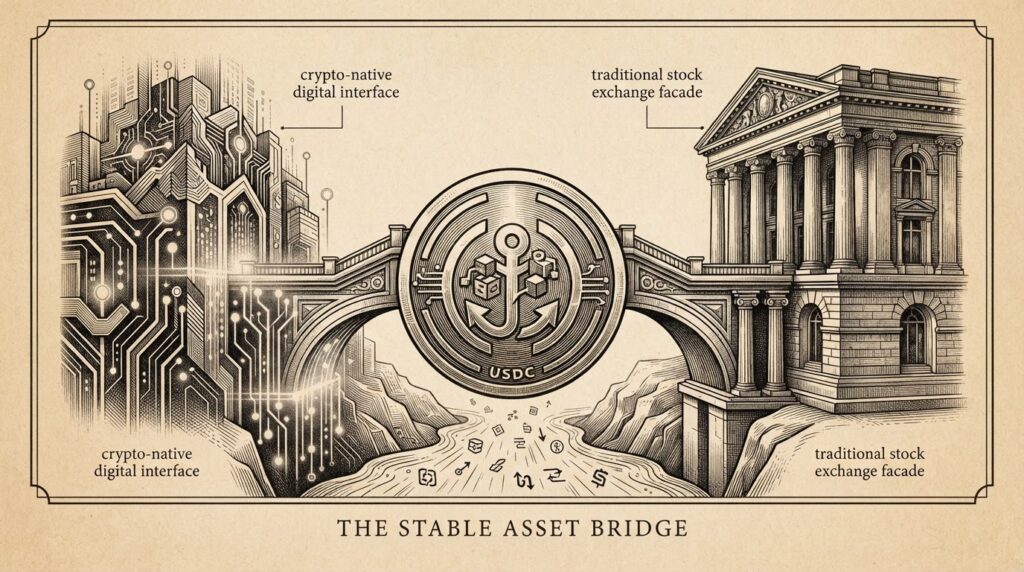
On August 6, 2026, Coinbase launched 24/5 US stock trading for UK users. While the headline features — zero commission and a £1 minimum for fractional shares — are familiar to retail investors, the structural innovation lies in the plumbing. For the first time, a major platform is treating USDC not merely as a payment option, but as a primary funding and settlement rail for traditional equities.
The Regulatory Moat
This capability is underpinned by CB Payments Ltd, which secured authorization from the UK Financial Conduct Authority in July 2026. Operating under a MiFID-equivalent framework, this authorization serves as a significant regulatory moat. It allows Coinbase to route orders through Coinbase Capital Markets Corporation, with execution and custody handled by Apex Clearing, which provides SIPC protection of up to $500,000 per account. As Keith Grose, Regional Managing Director for UK and Europe, noted, the framework provides the regulatory clarity to enhance the firm’s “Everything Exchange,” bringing crypto, stocks, stablecoins, savings and borrowing together under one roof.
The Everything Exchange Thesis
Coinbase is positioning itself to capture the full lifecycle of a user’s capital. The integration of stocks into the platform is a deliberate move to consolidate financial activity. Grose stated, “We’ve made great progress in recent months in building Coinbase into a platform where users can seamlessly access stocks, stablecoins, savings, and more.” This vision is supported by incentives for power users; UK Advanced users now have access to TradingView charting tools and can earn up to 3.5% rewards on trade-ready USDC, while Coinbase One subscribers receive uncapped rewards on USDC trading balances.
Competitive Positioning
The UK market for zero-commission US equities is already populated by established players like eToro and Trading 212. However, these incumbents lack the specific infrastructure that defines the Coinbase offering. Neither competitor provides a USDC funding rail, nor do they offer 24/5 trading. By leveraging the stablecoin as a settlement layer, Coinbase is tapping into a broader trend of onchain finance. Circle reported $14.8 trillion in onchain volume during Q2 2026, with USDC increasingly serving as the settlement layer for global commerce. Similar shifts are visible in the integration of stablecoin payout infrastructure via Visa Direct and the rise of stablecoin-first architectures like Cloudflare Wallets.
The Roadmap to Tokenization
The current launch is a precursor to a more ambitious goal: the introduction of tokenized equities. According to the Coinbase blog and a post by Grose, the firm plans to offer assets backed 1:1 by US stocks, which will include full shareholder rights and dividends. This represents the logical conclusion of the firm’s current trajectory — moving from using stablecoins to buy traditional stocks to holding tokenized versions of those assets directly onchain.
The integration of crypto-native platforms and traditional finance has moved beyond the experimental phase. By embedding USDC as a structural settlement rail for nearly 4,000 US equities, Coinbase has operationalized a model where the distinction between crypto and traditional assets is increasingly mediated by stablecoin liquidity. The infrastructure is live, regulated, and functional, marking a shift where stablecoin-based settlement is no longer a peripheral feature, but the core of the exchange architecture.